He was a 2,700-pound, 14-foot-long beluga whale, discovered off the northern coast of Norway in April of 2019, wearing a harness with a small camera mount and a buckle reading, in English, “Equipment St. Petersburg.” He was friendly, and he was hungry — apparently accustomed to being fed, and not finding food on his own.
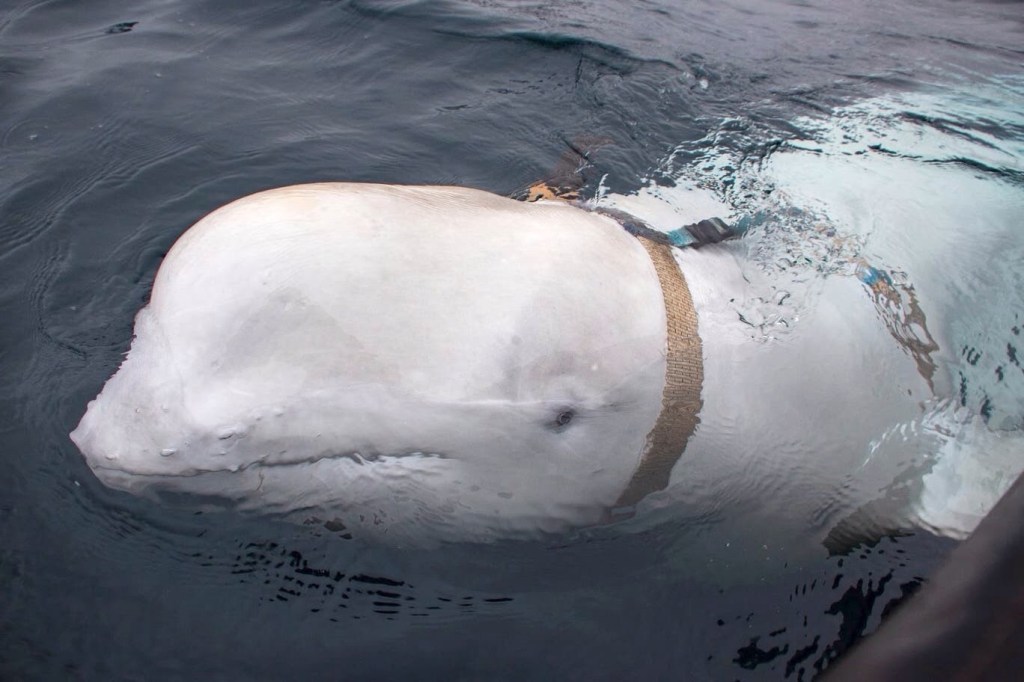
So the good folks of Norway decided to adopt him, and they named him Hvaldimir — “hval” being Norwegian for “whale,” and “dimir” from the first name of Russia’s president, Vladimir Putin. They removed his harness, and he swam to the nearby port of Hammerfest to make his home.
Sadly, after five years of living freely and happily in Norwegian waters, he was found dead near the end of summer this year. A necropsy showed that no foul play was involved; he had gotten a stick lodged in his mouth. And Norway mourned the loss of the beautiful, mysterious creature they called Hvaldimir.
But the question remained: Was he, or was he not, a Russian spy? The Russians are known to have worked with marine mammals, training them — I suppose — much as the U.S. trains its … wait for it …Navy Seals.

(All right . . . go ahead and groan. I’ve never been able to resist a pun.)
Anyway, Hvaldimir had a habit of touching people with his nose when he was hungry, so he had obviously been trained to give signals for some purpose. And the collar clearly indicated that he had been held in captivity. But that was all that was known . . . until recently.
Enter Dr. Olga Shpak, an expert in Hvaldimir’s species, who made it her mission to learn more about him. She now believes that he did indeed belong to the Russian military, and that — being something of what the Russians would call a “hooligan” — he managed to escape from a naval base in the Arctic Circle. But she doesn’t think he was trained as a spy; rather, he was most likely a guard for the base. [Jonah Fisher and Oksana Kundirenko, BBC, November 13, 2024.]
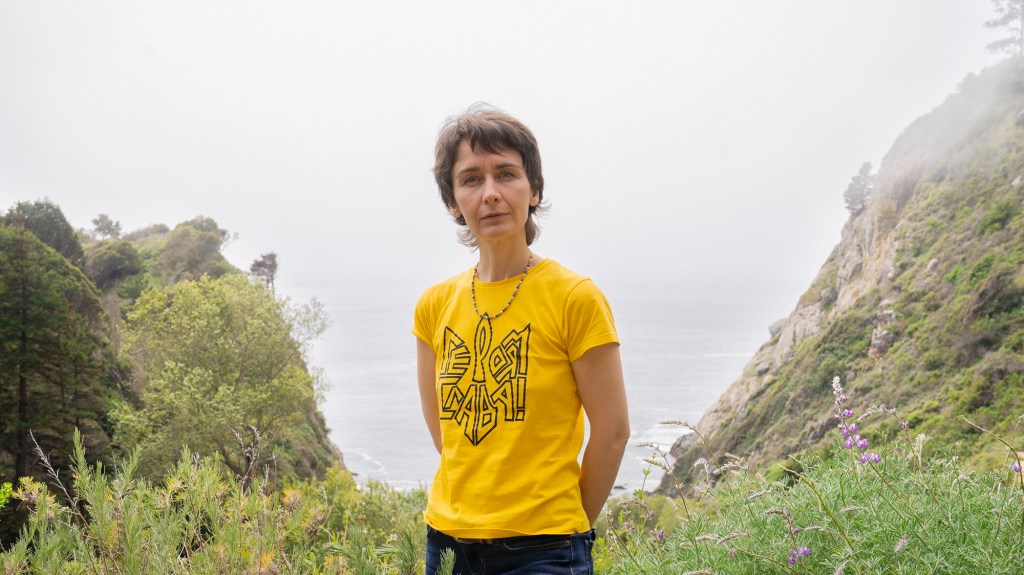
Dr. Shpak, a native of Ukraine, spent more than 20 years researching marine mammals in Russia before returning to her homeland in 2022. Her conclusions are based on conversations with knowledgeable friends and former colleagues in Russia, who have unofficially (and anonymously) confirmed that Hvaldimir — whose original name was Andruha — was one of theirs: a beluga missing from a military program in the Russian Arctic.
Andruha had been captured in the Sea of Okhotsk in 2013 and kept in a dolphinarium in St. Petersburg for a year, when he was “drafted” into the military. Dr. Shpak says:
“I believe that when they started to work in open water, trusting this animal [not to swim away], the animal just gave up on them.
”What I’ve heard from the guys at the commercial dolphinarium who used to have him was that Andruha was smart, so a good choice to be trained. But at the same time, he was kind of like a hooligan — an active beluga — so they were not surprised that he gave up on [following] the boat and went where he wanted to.” [Id.]
With all due respect, Dr. Shpak, I don’t believe he “just gave up on them.” I think he’d been planning his escape for a long, long time.
*. *. *
To the surprise of absolutely no one, Russia has never officially responded to the claim that Hvaldimir (a.k.a. Andruha) was trained by its military. In 2019, when first asked if he might be theirs, Reserve Colonel Viktor Baranets said, with an unexpected display of humor:
“If we were using this animal for spying, do you really think we’d attach a mobile phone number with the message ‘Please call this number’?” [Id.]
Maybe not, Polkovnik Baranets. But I can’t stop wondering about that camera mount.

Just sayin’ . . .
Brendochka
11/13/24
 The Blog About Everything … and Sometimes Nothing