
Washington, first week of March 1994: Things were not going well. With word out that Shvets’ book was about to be released, the press was expected to engage in one of its usual feeding frenzies, and I knew I had to take preemptive action; I couldn’t let my Russian contacts find out about my involvement from a news release. So I went to see Natalya at the Embassy. She was expecting to hear about the conference in Malta; what she heard instead appeared to send her into shock.
Natalya Semenikhina was an exceptional woman: smart, efficient, attractive, with a natural charm and warmth that made her perfect for her position in the Cultural Section of the Embassy. And she had been extremely helpful to me in working toward the creation of my U.S. training program and establishment of a business school in Moscow. I genuinely liked and respected her, and had enjoyed working with her. And now I had to try to salvage our relationship — and all of my hard work and dreams — without betraying the two people to whom I owed a professional responsibility . . . whether they deserved it or not.
She and I sat facing one another over tea in one of the Embassy’s formal meeting rooms, talking first about Malta, the people I had met there, the business opportunities, etc. Then I said I had something else to discuss with her . . . something quite serious. And as I related the story of my meeting the year before with Aksilenko in Moscow, his revelation as to his friend’s tell-all book, their subsequent “relocation” to the United States, and the imminent publication of the book, her face paled and her expression turned to one of total horror. Although I stressed the strictly commercial nature of my relationship with them, I could see clearly that she knew exactly who they were and what was at stake. And, for the first time in all the months I had known her, she was speechless.
Finally composing herself, she said that this was completely outside her purview, and that she would have to discuss it with someone else. At that point, I’m not sure she even knew whom to go to, but she did know she couldn’t deal with it alone. She said she would call me to set up another meeting, and I left the Embassy with a sinking feeling that my work in Russia was about to come to an end. My one hope might be to cut short my working relationship with Aksilenko and Shvets, and perhaps even to forfeit my financial interest in the book. I would have to give that some thought while I waited to hear from her, but I wasn’t optimistic — you can’t unring a bell.
She called the very next day and asked me to come to the Embassy on the day after that. Her voice left no doubt that she was under serious stress. As concerned as I was for my own situation, I also felt regret that it had become necessary for her to be involved — she had had nothing to do with any of it.
The next morning I arrived at the Embassy to be greeted by a very somber Natalya. There was no tea service in the meeting room that day — a bad sign from the normally hospitable Russians. Her speech was hesitant, and had obviously been carefully rehearsed. All of the public rooms in the Embassy were assumed to be bugged, probably even wired with cameras; so I was sure she was being careful to say everything she’d been instructed to say, and nothing more. I, on the other hand, had no idea of what to expect. For me, this was going to be like amateur night at the Improv.
Natalya told me she would normally have arranged for me to meet with a Mr. Lysenko — the name was unfamiliar to me — but that he had returned to Moscow just a few days earlier. So she had talked with someone else in his department, and that person had suggested that I should prepare and submit to them — now check this out — a written statement detailing the history of my relationship with Aksilenko and Shvets, from beginning to end, leaving nothing out: everything I knew about them, everything they had ever told me, everything about the contents of the book, my business arrangement with them, and where they were and what they were doing now. Then, and only then, could my own situation be reevaluated and given careful consideration.
Momentary silence . . . deep breath . . . then . . .

Okay, so I didn’t actually laugh. But oh, how I wanted to! Did they really believe for one moment that I would even consider delivering to the government of any country — let alone an adversarial one — any information that could conceivably be used against American interests? Did they think I was personally low enough to sell out another human being (or two)? Or that I was stupid enough not to realize that anything I might give them would go directly to the Russian Foreign Ministry as well as KGB Headquarters, and could potentially reach all the way to the Kremlin itself? And did they also believe I was weak enough or greedy enough to simply break down and submit to their transparent attempt at coercion?
Actually . . . yes, I suppose that is what they thought. Well, then . . . they clearly had no idea of what kind of person they were dealing with!
Of course, I kept all those thoughts to myself, and somehow managed to remain calm. I briefly considered keeping them hanging for a couple of days by telling Natalya I’d think it over and get back to her. But no . . . there was nothing to think over, and I wanted them to know that. So what I did say was that — for better or worse — Aksilenko and Shvets were my clients in a publishing venture, and that it would be professionally unethical and personally reprehensible (my exact words) for me to betray them in the manner her people were suggesting. Bottom line: a flat-out “Nyet!”
As I spoke, Natalya almost seemed physically to deflate. She had failed, and she looked worried, even frightened. Then she stood up, whispered something that sounded vaguely apologetic . . . and I was politely shown the door.
*. *. *
Walking down 16th Street away from the Embassy, I knew that I, too, had failed in my efforts to guide some of Russia’s middle class into the approaching 21st Century. But they would manage without me and my business school; the Russian people always did, somehow. In a different sense, though, I knew I had succeeded. I had stood my ground, refused to be intimidated, and had managed to preserve my principles of honor and decency. I was, in human terms, the clear winner.
When I reported all of this to Eric later that day, he told me that the man I was supposed to have met — Aleksandr Lysenko — was well known to the FBI: he had been the rezident, or chief of station, at the Russian Embassy for several months. In other words, the top KGB agent in Washington. He had been expelled from the U.S. just days earlier for his role in running the CIA turncoat Aldrich Ames. The fact that I was intended to have met with a person of Lysenko’s rank clearly indicated how seriously the Russians were treating this whole situation. On the one hand, I was obviously relieved that a meeting with him had been averted; but on the other hand, I thought it might have been an interesting experience . . . in a rather perverse way. But that’s one more thing I’ll never know.
Aldrich Ames and Aleksandr Lysenko — two men I didn’t know, and had never even heard of before they made the news just a few days earlier — had somehow, indirectly, invaded my life and changed it forever. Unbelievable!
*. *. *
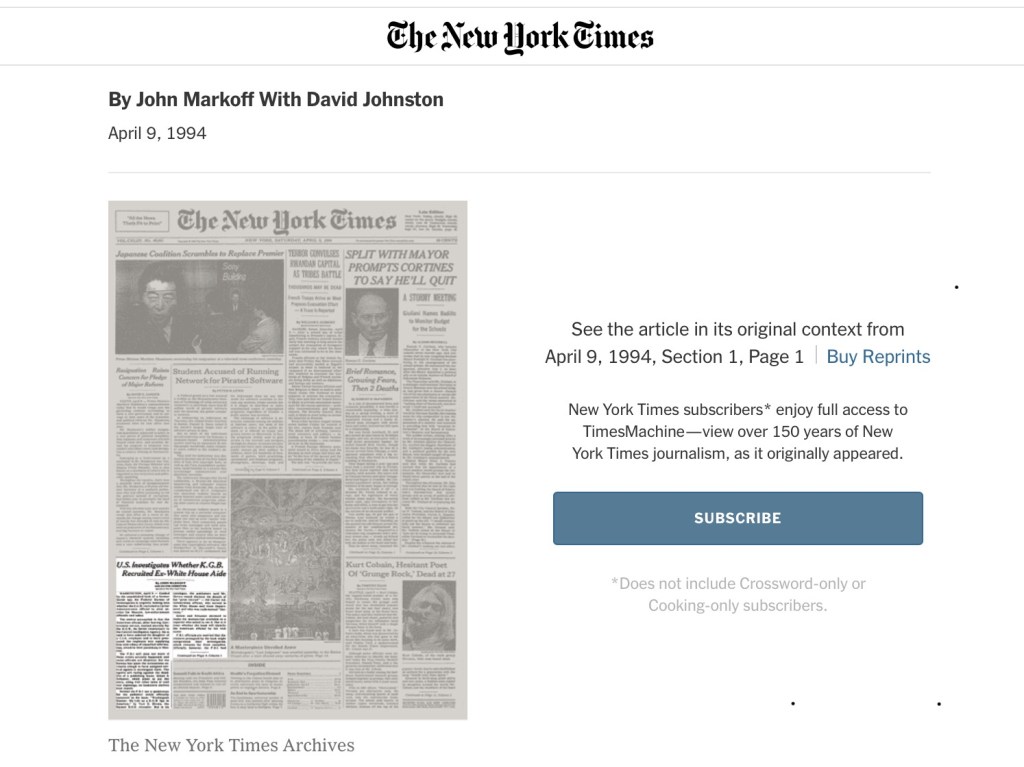
In April of 1994, Shvets’ book, Washington Station, was finally released.
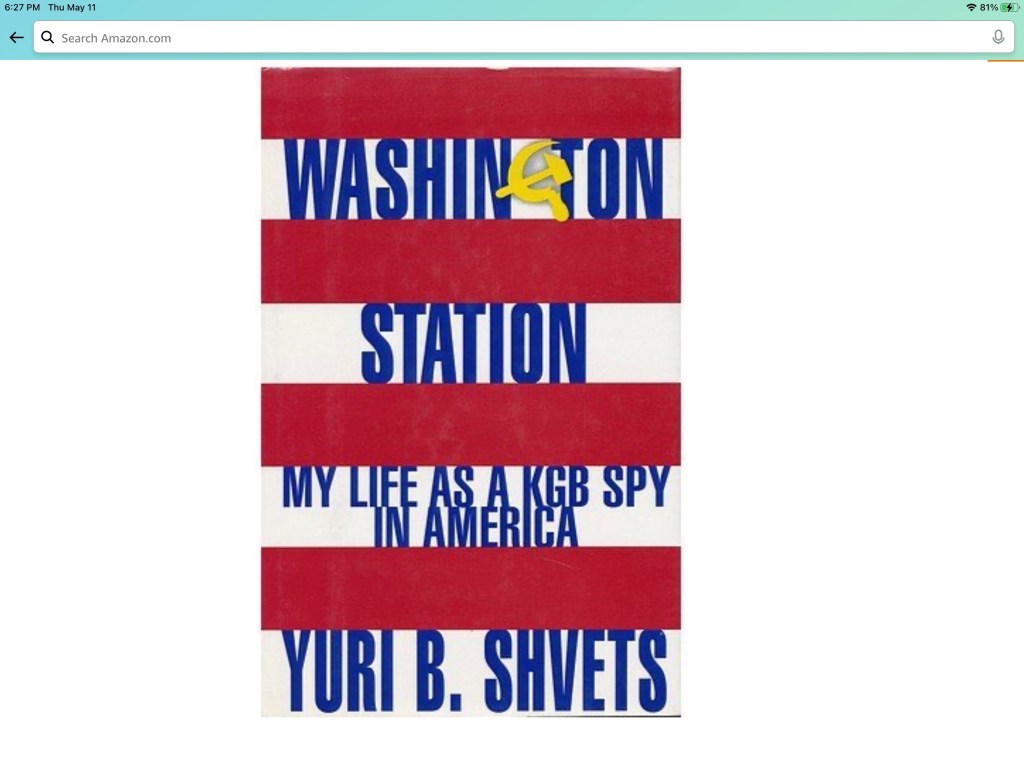
On April 9th, an article by John Markoff and David Johnston appeared in the New York Times about the book, about Yuri Shvets himself, and about my role — not entirely accurately presented — in having brought Shvets and his colleague, Valentin Aksilenko, to the United States the previous year. But the article didn’t stop there. It went on to suggest a possible connection between the arrival of the two men in the U.S. for ten days in April-May of 1993 and the opening of the FBI’s official case against Aldrich Ames on May 12th, just one week after their departure on May 5th.
And as I read that article, a comic-strip lightbulb lit up over my head. It all began to make sense, in a totally convoluted, nonsensical way. All of the attention from the FBI at home and the KGB and Militia in Moscow; the “watchers” and “Good Samaritans” repeatedly showing up during my travels; the ease with which the two former KGB spies had gotten back into the U.S. — it hadn’t been my imagination at all.
No . . . I was just a person who had been in the right place at the wrong time — not really involved, but ultimately the one who had been used to tie the various strings together. Metaphorically speaking, I had become a pawn in someone else’s political chess game, and now, at the end of that game . . . well, now I was simply collateral damage.
You just can’t make this stuff up!
*. *. *
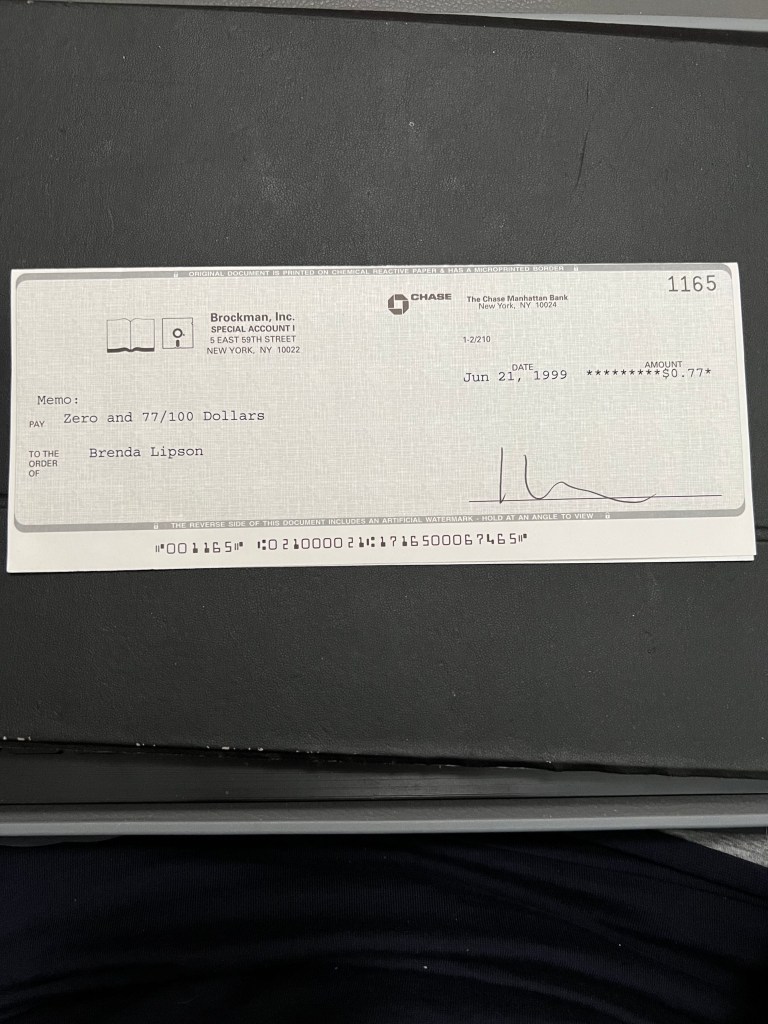
There’s more — lots more — that I really don’t need to go into here. But there is an interesting footnote. Because of the brouhaha surrounding Aldrich Ames’ arrest and eventual conviction and sentencing on charges of espionage, Yuri Shvets’ book could not have hit the stands at a worse time. It was totally overshadowed by the bigger story. The first — and only — printing was smaller than originally planned, and didn’t do well. It was withdrawn from the bookstore shelves before most of the world even knew it was there. Other than my small percentage of their advance payment, my only royalty check arrived in the mail a full five years later, in June of 1999, in the amount of . . . drumroll, please. . . seventy-seven cents ($0.77). As I stood by the wall of mailboxes in the lobby of my apartment building and opened the unexpected envelope from Brockman, Inc., I burst out laughing — so hard, and so loudly, that several passing neighbors thought I’d lost my marbles. I managed to choke out “I’m okay,” and continued laughing all the way to the elevator, up to the third floor, and down the long hallway to my apartment.
I still have that check, and it still tickles me to look at it.
*. *. *
So how does it all end? Am I going to leave you hanging after dragging you around Europe with me for half a year, wondering why I’ve bothered writing all of this stuff? No . . . of course I wouldn’t do that to my loyal readers. So, see you next time for the grand finale.
Brendochka
5/29/23 (re-posted 9/17/24)
 The Blog About Everything … and Sometimes Nothing