Shortly before turning in last night, I took my usual stroll through the late headlines and was jolted awake by the following:
“Russian Jails Recommend Foreigners Apply For Transfers Home After Hostage-Taking Incidents.” [RadioFreeEurope/RadioLiberty, September 10, 2024.]
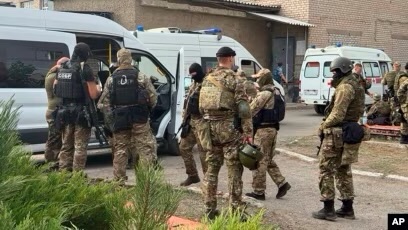
Thinking I might have drifted off to sleep and dreamt it, I took a drink of something non-alcoholic, rubbed my eyes, and read it again. And no, I had not been dreaming; that is indeed what the headline said, accompanied by the above picture.
Citing an article of the same date by IStories — an online publication with which I was not familiar — the RFE/RL article stated:
“Foreign nationals serving terms in Russian prisons have been asked to write requests to serve the remainder of their terms in their homeland following two recent hostage-taking crises at Russian penitentiaries, IStories said on September 10.” [Id.]
IStories cited sources “close to” a correctional colony, as well as rights defender Ivan Astashin and lawyer Yevgeny Smirnov, who had stated the reason for this action was to prevent further hostage-taking situations such as the ones that had recently occurred in prisons in Rostov-on-Don and in the Volgograd penal colony No. 19.
According to IStories’ sources, one Belarusian, three Kyrgyz, one Polish, and two U.S. citizens (unnamed in the article) are currently awaiting transfers to their home countries.
And my reaction to this startling news was . . .

Out of the blue, the Russian government is now supposedly letting foreigners — who for years have been held as hostages of the Kremlin for future trade — go home in order to prevent further internal problems in the Russian prison system. Just like that, no strings attached. And we’re supposed to believe it?
I’m sorry, but I cannot.
I have too many questions. First, who are these “sources” cited by IStories? How reliable are they? What are the conditions of the prisoners’ releases? And exactly who are these supposed Belarusian, Kyrgyz, Polish and U.S. citizens? What did they have to do, other than fill out a request form, in order to be granted reprieve? And exactly what do the forms say?
Further, if they are actually sent home to “serve the remainder of their terms in their homeland,” what guarantee is there that they would be required to do so upon returning home? Since they’re most likely political prisoners, and not actual criminals, odds are they would be welcomed home as heroes.
No . . . the whole thing smells fishy — perhaps some sort of public relations stunt.

I did do a little checking into the background of IStories (“Important Stories,” as translated from the Russian), which evolved from the independent Russian Novaya Gazeta in 2020 as the result of Kremlin pressure on all of the then-independent media. The office of their website is located in Latvia, and they have conducted investigations into such diverse matters as the poor quality of Russian COVID-19 tests, the persecution of Alexei Navalny, oil spill disasters in Russia, the Pandora Papers, and even Vladimir Putin’s daughter Katerina Tikhonova and her husband.
So I am not questioning their authenticity. But, again, I have to wonder about their sources, and the reliability of the information being fed to those sources.
In my experience, when something sounds too good to be true, it usually is.

Just sayin’ . . .
Brendochka
9/11/24
 The Blog About Everything … and Sometimes Nothing