Leaders and delegates from multiple African nations are descending upon Beijing for a three-day summit this week, drawn by China’s promises of “further practical cooperation” and Xi Jinping’s vision for a “community with a shared future.” [CNN’s Meanwhile In China, September 2, 2024.]

Hopefully, they will have a little free time to see something of Beijing besides the inside of a conference hall. And while they are doing the town, their host will be doing his thing: tying his African clients up in big, tight knots — financial ones, that is.
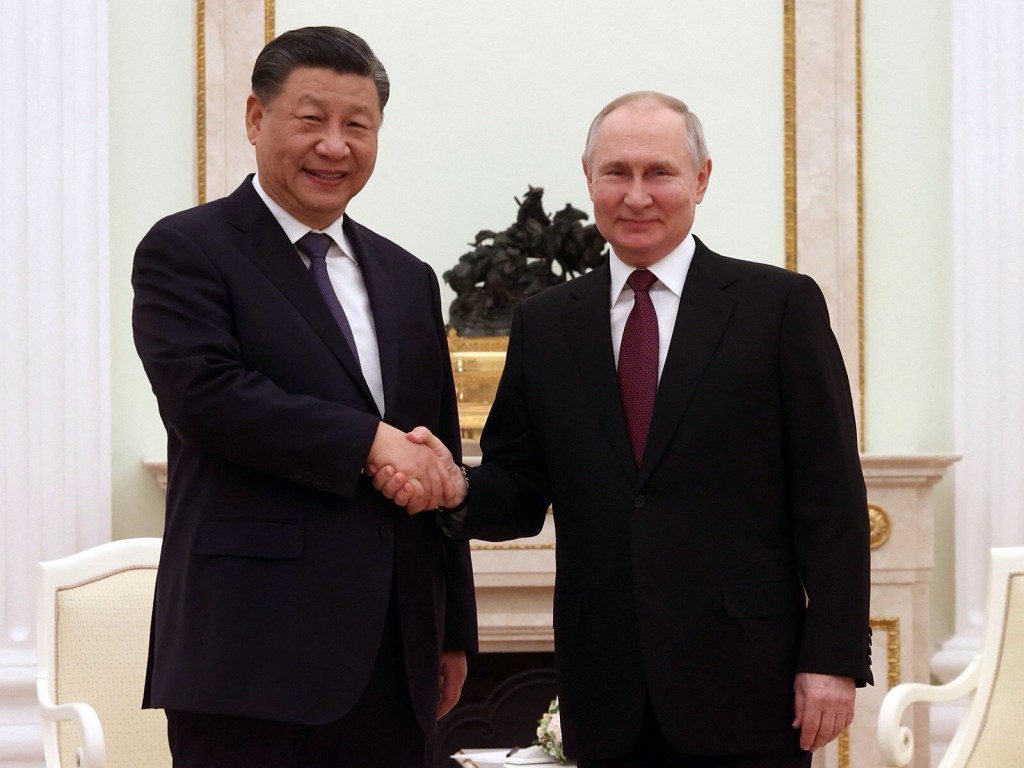
I’ve written in the past about China’s so-called Belt and Road Initiative,** by which — under the guise of infrastructure development — China has, over more than ten years, gradually increased loans to a number of already impoverished countries, many in Africa, until they have become crushingly burdensome for the borrowers. And now those loans are coming due. It is, of course, all part of this dynamic duo’s long-range plan to create a new world order . . . under their control.
** See 11/10/23: Putin and Xi: The Real World’s Romulus and Remus?
But with specific regard to Africa, Yun Sun, director of the China Program at Washington’s Stimson Center think tank, says:
“The Chinese approach to Africa in the past has been driven by hardware infrastructure projects, funded by Chinese loans. We know now that model is not going to be operational anymore, because now the debt sustainability issue has become such a big challenge for the continent. [Now] . . . the world is watching — what is going to happen to China’s relationship with Africa next?” [Simone McCarthy, CNN’s Meanwhile in China, September 2, 2024.]
It is hoped that this week’s summit in Beijing will provide some answers to that question.
In the meantime, however, it appears that Chinese President Xi Jinping has a pleasant surprise for his African visitors: Satellite TV.

“Yessir, step right up and get your 50-inch screen here. If it doesn’t fit into your hut, we’ll lend you the money to enlarge the hut.”
*. *. *
Actually, you’re probably thinking — as I did at first — that Xi’s plan is to provide satellite TV capability to Africa’s largest cities. But not so; they already have TV. Instead, nearly a decade ago, he promised the heads of state attending the Forum on China-Africa Cooperation in Johannesburg “that China would provide over 10,000 remote villages in 23 African countries with digital TV access.” [Id.] And, in Xi’s favor, more than 9,600 of those villages have now received satellite infrastructure. So . . . bring on the soap operas, the game shows, and the other mind-bending entertainment — rural Africa is ready to plug in those TV sets.

Seriously, we’re talking about impoverished people living in some of the world’s most impoverished nations. Never mind that they often go to bed hungry; that their children have no shoes; that education is sparse, if it exists at all; that alternating droughts and floods have killed their crops. They need satellite TV.
Those villagers who were part of China’s project ostensibly received everything for free — satellite dish, battery, installation, and a subscription to the programming. But the subscription was not for a lifetime; it ran out after a few months, and they had to pay to renew it. Some could not afford it, and gave up their access. The party was over.
In one household in the village of Olasiti, about three hours’ drive from the capital of Nairobi, Kenya, the family of Nicholas Nguku was thrilled to be able to watch the Paris Olympics. They clearly live in a more comfortable home, not a hut; and their TV is a reasonable size. The satellite service is inexpensive, by U.S. standards . . . but we’re not talking about U.S. standards.

And by the way, the programming content is provided by a Chinese company. So those soap operas and game shows are from China, dubbed or subtitled in English, and by some accounts are frequently old and dated.
But the villagers needed satellite TV.
Don’t get me wrong — it isn’t that I don’t think they deserve a little fun in their lives. They absolutely do; their lives are difficult. But is TV really the answer? If offered a choice between that and a steady supply of food and clean water, vaccines and medicines . . . which do you think they would choose?
*. *. *
Think about this: If you lived in the Soviet Union in the last century, you were given a free vacation every summer, and for that you were supposed to forget about the lines at the stores for inferior, often non-existent goods. Forget about the squalor of your communal apartment. Forget about being forced to live and work wherever you were told to. Forget about the absence of hope for a better future for your children. You had that free vacation to look forward to, and for that you were expected to be eternally grateful to Papa Joe Stalin.
Sound familiar?
Just sayin’ . . .
Brendochka
9/4/24
 The Blog About Everything … and Sometimes Nothing