It’s probably happened to you. You take your four-year-old into the Christmas Shoppe to buy some new ornaments for this year’s tree; you let him out of your sight for a nanosecond; and . . . smash! . . . you hear the sound, and somehow you just know who caused it. The sales clerk you couldn’t find to help you two minutes ago suddenly materializes; you explain and apologize, and you pay for the broken piece and thank your lucky stars it wasn’t an entire display.

Then you gently scold your little one, explaining that this is why he shouldn’t touch things that don’t belong to him, knowing perfectly well he doesn’t understand and this won’t be the last time something like this happens. And you feel guilty when the tears begin to well up in his eyes, so you buy him an ice cream cone on the way home and all is forgiven and forgotten.
Simple, huh? After all, it’s not the end of the world.
But what if that ornament is a 3,500-year-old Bronze Age artefact, previously in perfect condition, on display in a museum in Israel, and it’s your four-year-old son whose curiosity gets the better of him?
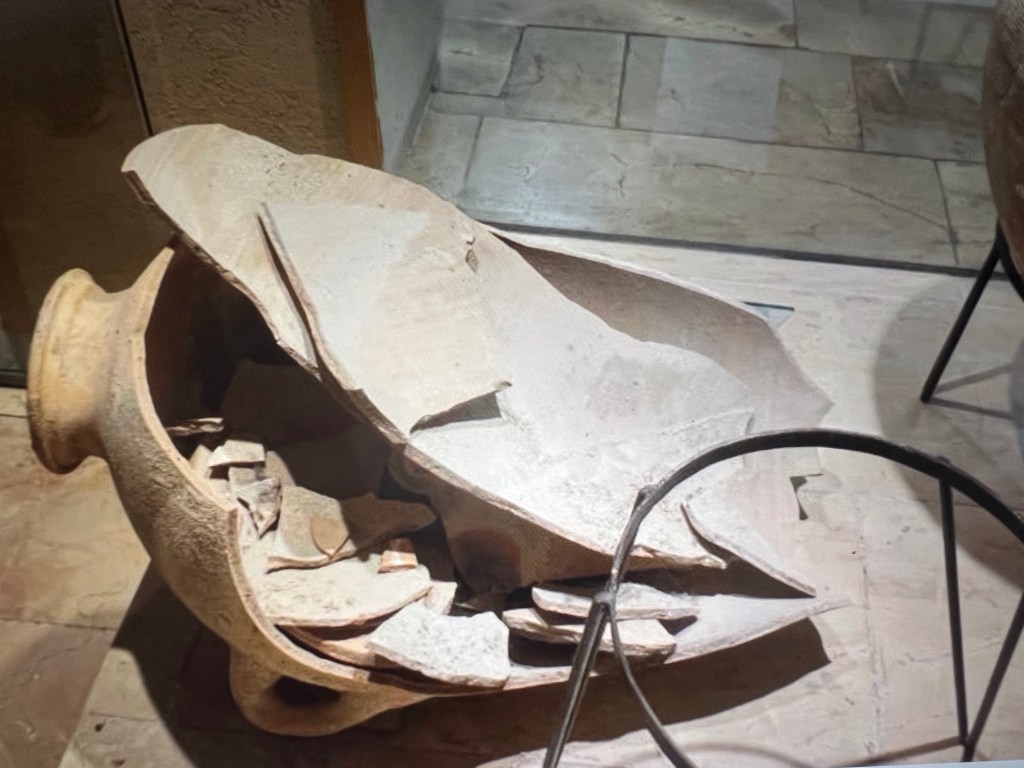
Holy crap!
Well, if you’re very, very, very lucky, you will be in the Hecht Museum in Haifa, which has to be run by absolutely the nicest, kindest, most understanding people in the entire universe . . . because they didn’t turn the little boy, Alex, and his father over to the police, or set the kid on fire, or anything else. In effect, they simply said they’d have the jar restored. [Jack Burgess, BBC News, August 27, 2024.]
Seriously, that is how it was resolved. Little Alex was upset at first, because he had pulled at the jar slightly to try to see if there was anything inside, and he was startled when it fell over. He probably also was expecting to be yelled at, at the very least. (Although I should think Dad was also feeling a little guilty for not having tied Alex’s hands behind his back before entering the museum.)
Instead, the museum folks invited Alex and his family back for an organized tour. A museum representative, Lihi Laszlo, said:
“There are instances where display items are intentionally damaged, and such cases are treated with great severity, including involving the police. In this case, however, this was not the situation. The jar was accidentally damaged by a young child visiting the museum, and the response will be accordingly.” [Id.]
Now, that’s what I call civilized.
*. *. *
But what about the artefact itself? Why were it and its mates on display without any protection, obviously vulnerable to the vicissitudes of life . . . like the presence of four-year-old kids? The museum’s answer: because they believe there is a “special charm” in showing archaeological finds “without obstructions.” And they have every intention of continuing the tradition, despite little Alex’s mishap.
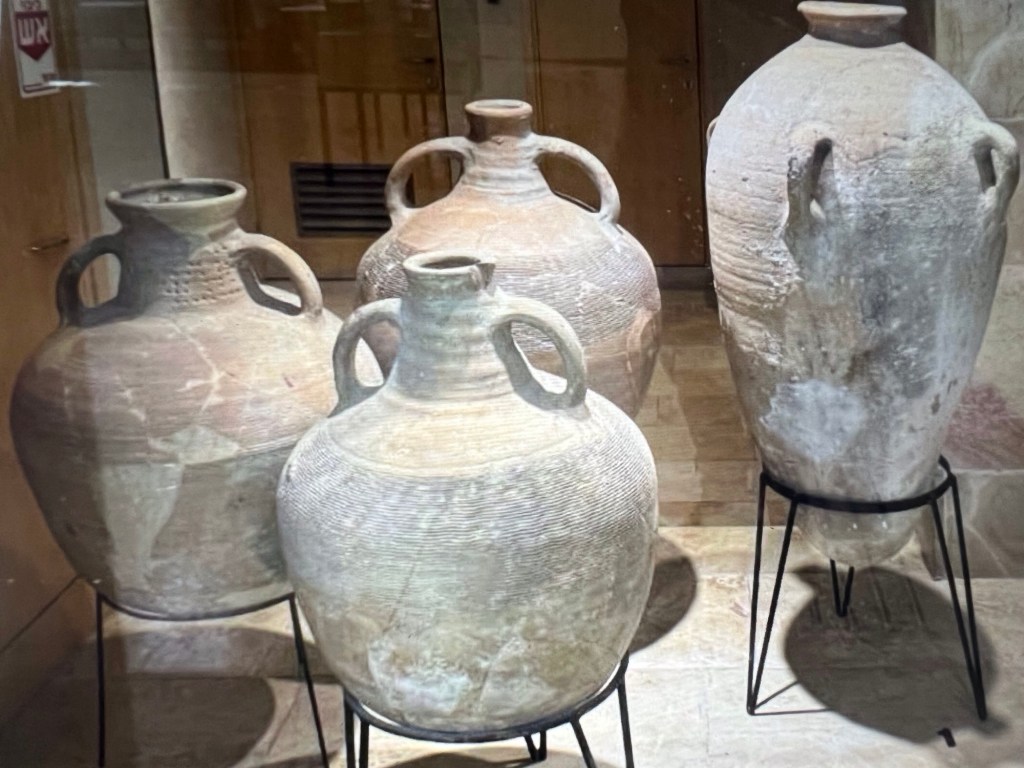
And it’s not as though these things are replaceable. Most likely used to carry supplies such as wine or olive oil, the jar dates back to a time between 2200 and 1500 B.C. It predates the era of the Biblical King David and King Solomon, and is characteristic of the Canaan region on the eastern Mediterranean coast. When discovered, it was considered an “impressive find” because of its intact condition. [Id.]
Just think about it. It survived more than three millennia without damage. And it took a four-year-old kid named Alex two seconds to destroy it.

Never, ever underestimate the power of children.
Just sayin’ . . .
Brendochka
8/28/24
 The Blog About Everything … and Sometimes Nothing