Of course, I think you’ll love it no matter what language you speak. But then, I’m a bit biased: I was born here.
One of the great things about America is its diversity . . . of scenery, of cultures, of climates, of food, and — something I didn’t fully realize until a few days ago — of languages. Oh, of course I know we are considered the world’s “melting pot”; we are, after all a nation that was built by peoples from many lands. My own grandparents emigrated from Ukraine (which was then still part of the Russian Empire) in 1905. But I had no idea how many languages are spoken here.
Bienvenue en Amerique.
Willkommen in Amerika.
Amerika’ya hos geldiniz.
Witamy w Ameryce.
Добро пожаловать в Америку.
That’s just five ways of saying “Welcome to America” (French, German, Turkish, Polish and Russian — and thanks to Google Translate for the first four). But according to WordFinderX, there are as many as 350 to 430 different languages being used throughout the U.S. today. Nearly 80% of people reported in the last national census that they speak only English at home; yet this country has no de facto official language. Not surprisingly, Spanish is the second most-widely spoken language here.
But what about the other 348 to 428 languages? Where will you find someone to converse with in, say, Tagalog, Korean, Arabic, or Hmong? (No, that is not a typo; Hmong is a dialect found in parts of China, Vietnam, Thailand and Laos. I just learned that.)
Luckily, someone has taken the time to figure it out for us. They took household population data to determine the most spoken language — exclusive of English and Spanish — across the country. They then broke it down by regions, states, major cities, and even individual districts and neighborhoods. [Paul Anthony Jones, Mental Floss, August 21, 2024.]
And they made a color-coded map for us:
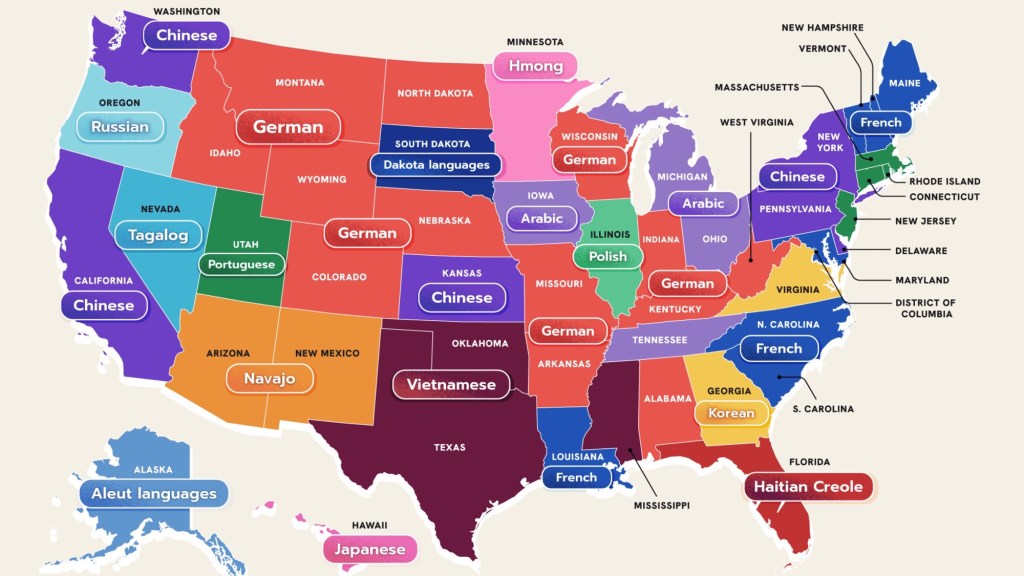
And boy! were there some surprises there! For example, who would have thought to look for a substantial Portuguese population in Utah? Or Philippine (Tagalog) in Nevada? Vietnamese in Texas? Korean in Georgia? Arabic in Iowa?
And there were some interesting tidbits in the regional breakdowns as well. For example, Virginia shows a large Korean-speaking population; but in its capital city, Richmond, the breakout language is Russian.
Keep in mind that in every case, these are third, after English and Spanish. And nationwide, the language that comes in overall third is . . . German. All those terra-cotta-red areas on the map are heavy with Deutsch speakers, largely where German immigration was once high, but in a couple of other places as well, including — oddly enough — Alabama. So if you’re ever in Montgomery or Tuscaloosa, and you find yourself tempted to argue with someone, I’d think twice before calling them a dummkopf — because they might just understand.

Most countries don’t have that problem . . . or is it a privilege? . . . to contend with. For example, when I lived in Prague in 1991, I didn’t speak Czech. But my second language is Russian, and I knew that most of the people there had had to learn some Russian during the recent Soviet occupation. Plus, they’re both Slavic languages and there are some similarities. So I would start out with a cab driver, or a store clerk, or a waiter like this:
Me (in English): “Hello. Do you speak English?”
Them (in Czech): “No. Do you speak German?”
Me (in Russian): “No, sorry. Do you speak Russian?”
Them (in Czech, and offended because they really didn’t like the Russians, though they had forgiven the Germans for World War II): “No!”
Me (again in Russian): “Sorry. I’m American, and I only speak English and a little Russian. I think you understand me, yes?”
Them (nicer now, but still in Czech): “Oh, American! Okay. I understand.”

And thus we would continue — me in my not-so-good Russian and them in Czech. And somehow, with a lot of hand gestures and funny facial expressions, we would understand each other. I did eventually learn some essential phrases in Czech, such as “Bottom of the hill on the left” for the cab drivers taking me home at night, and “Not two oranges — two kilos of oranges” for the lady in the produce shop who never did catch on that I wanted to make my own orange juice.
Languages are tremendous fun, and I wish I had a greater facility for them. I used to work with a brilliant woman (American) who was fluent in Russian, Chinese, and Classical Greek. What she ever did with that last one is beyond me, but I was so jealous of her ability!

I spent most of my life in the Washington, D.C. area, where you can walk down the street and hear any number of languages being spoken in the space of a city block. One day, while waiting for the light to change so I could cross the street, I overheard a young couple arguing in Russian, thinking no one could understand them. I said nothing, until the light changed. As I stepped off the curb, I turned, looked at the man and said — in Russian — “She’s right, you know.” Great fun, indeed.
Welcome to America.
Just sayin’ . . .
Brendochka
8/26/24
 The Blog About Everything … and Sometimes Nothing