Having recently heard the descriptions of the Russian prison systems from the sixteen newly released (i.e., traded) political prisoners, it is difficult to imagine a situation in which four prisoners convicted of actual violent crimes could manage to overwhelm and take hostage twelve people — eight officers and four inmates — killing four of the officers before themselves being shot and killed by special forces snipers.
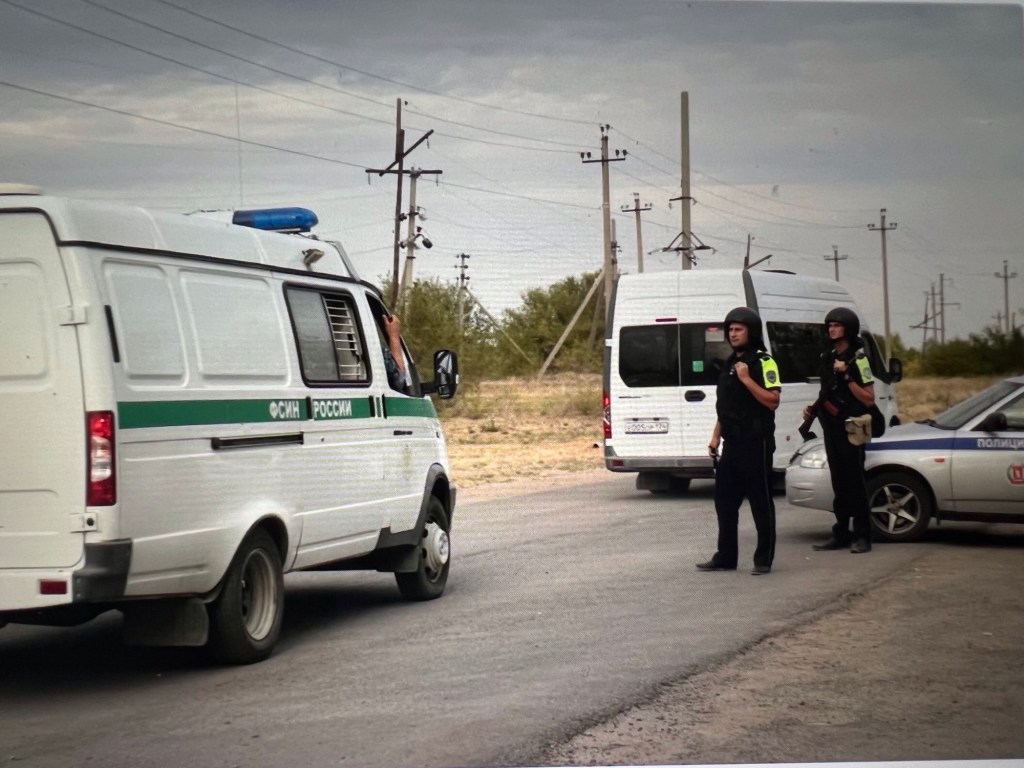
But it happened this week in maximum security prison IK-19 in Surovikino, near Volgograd, Russia.
What we have learned from American journalist Evan Gershkovich and the others of their experiences has been horrifying: innocent civilians, guilty of no more than having criticized the Russian government or the war against Ukraine, being locked for months in punishment cells, deprived of basic necessities, and never seeing another human being other than the prison guards and occasionally their attorneys.
Yet in a supposed “maximum security” prison, we now have four ISIS-affiliated convicts — charged with violent crimes — being in a position to grab and kill prison officers and other inmates during a meeting of the prison system’s disciplinary commission. [Radina Gigova and Sergey Gudkov, CNN, August 23, 2024.]
There is a scarcity of detail thus far; but such meetings are said to be held “where cases of malicious violators are considered, among other things.” It does seem that there must have been a sizable group of people present; but there is no information given as to whether the prisoners were involved in the meeting, whether they were in any way restrained, whether the prison guards were armed . . . or much of anything else to indicate exactly how the scenario evolved, other than the fact that the assailants did have knives. Where they got those knives, we don’t yet know.

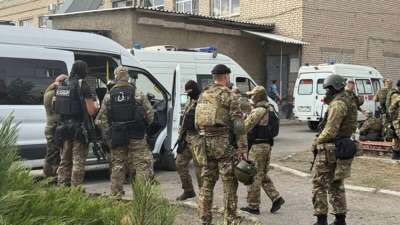
There is a description of one of the hostage-takers “displaying a flag emblematic of the Islamic State” — likely the photo above — and an indication that one of the suspects said the strike was “revenge” for the militants presently being held elsewhere on charges of having committed the attack on a concert venue near Moscow earlier this year in which more than 130 people were killed. [Id.]
This week’s siege ended when “Snipers from the special forces of the Russian National Guard in the Volgograd Region neutralized four prisoners who had taken prisoner [sic] employees hostage with four precise shots; the hostages were freed.” [Id.]
Well, except the three who had been killed earlier (the fourth victim died later).
Further information (though unconfirmed) identified the four perpetrators as being two men from Uzbekistan and two from Tajikistan. Three were serving terms for illegal drug charges, and one for “inflicting serious damage to a person’s health.” [RadioFreeEurope/RadioLiberty, August 23, 2024.]
This was an incident that never should have occurred in the first place. But once it did start, the “special forces” knew exactly how to end it. They’re good at “neutralizing.”
*. *. *
On reading these articles, I couldn’t help making the mental leap from prison IK-19 to other prisons — those penal colonies where American and other Western political prisoners have been (and some still are) held hostage on false charges built out of thin air — and some questions come immediately to my mind. First and foremost: Why are non-violent political prisoners — those men and women like Gershkovich, Paul Whelan, Alsu Kurmasheva, and Vladimir Kara-Murza — so closely confined and guarded, when they are obviously not a physical threat to anyone? Whereas in prisons for violent criminals . . . well, we’ve just seen what can happen there.
There are still eight American hostages locked away in Russian penal colonies on strictly political grounds, falsely convicted of espionage and similarly ludicrous charges. They’re never going to riot, to try to take hostages, to cause any sort of trouble. They deserve humane treatment, but they won’t receive it as long as Vladimir Putin is allowed to use them as pawns for a future trade . . . because he knows that the worse they are treated, the more incentive there is for us to bring them home.

And the grand-prize question — the one I keep asking, over and over again — is this: How long is Vladimir Putin going to be allowed to continue flouting international law, invading sovereign countries, and committing his crimes against humanity? Surely, the Russian people deserve better.
First of all, they deserve the truth.
Just sayin’ . . .
Brendochka
8/24/24
 The Blog About Everything … and Sometimes Nothing