That would be like saying “Happy anniversary of your husband being murdered.” Not cool.
Because it turns out there is more than one Jewish day of mourning and fasting. Yom Kippur is not exclusive after all. And I was not aware of that.

So, being thirsty for all sorts of knowledge, I did a little reading on the significance of this holiday. And, since misery — especially Jewish misery — craves company, I am compelled to share it with as many people as possible. That would be you, lucky reader.
First of all, it’s pronounced something like “Tish above.” But not exactly.
Second, it is commemorated every year on the ninth day of the month of Av, on the Hebrew calendar. On the Gregorian calendar (that’s the one used today in most of the world), that means it will begin this year at sundown on Monday, August 12th, and continue for 24 hours until sundown of the following day — at least, for those of us who have not been washed downriver and out to sea by Hurricane Debbie. So we still have a week to be joyous and eat as much as we want. Because, as I said, Tisha B’av is not a happy holiday.
My research taught me, first, that there are two main tragedies (which probably means there are a bunch of lesser ones) to be remembered on Tisha B’av: the destruction of Solomon’s Temple, and the destruction of the Second Temple in Jerusalem. They built it once, it was destroyed in 585 BCE; built it again, and . . . well, you know what happened. History repeated itself, but not until 70 AD, so it did last for 655 years. That’s pretty good, in terms of amortization.

*. *. *
Well, I was right. It emerged as I read on that there are the so-called Five Calamities that befell the Jewish people on the ninth of Av. Sort of like the Jewish Friday the 13th. The other three were:
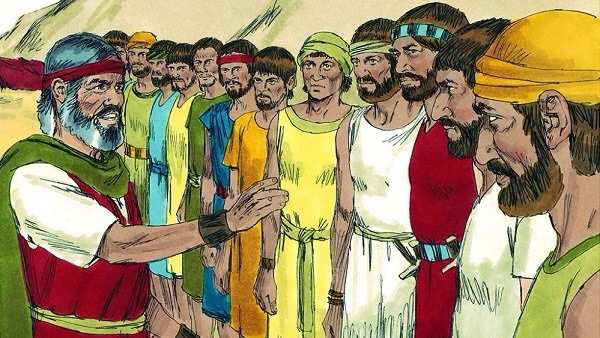
– When twelve spies were sent to the land of Canaan by Moses, of whom ten came back . . . and with negative reports on the land. The Children of Israel despaired in their fear of never being able to enter the Promised Land, which displeased God, Who apparently wasn’t fond of quitters and complainers. So He punished them by declaring that the ninth day of Av would be a day when Jews would be crying for generations.
Generations? Try centuries!
[Note: These were not “spies” of the James Bond sort. It seems they were more like advance men, or scouts, searching for the Promised Land.]
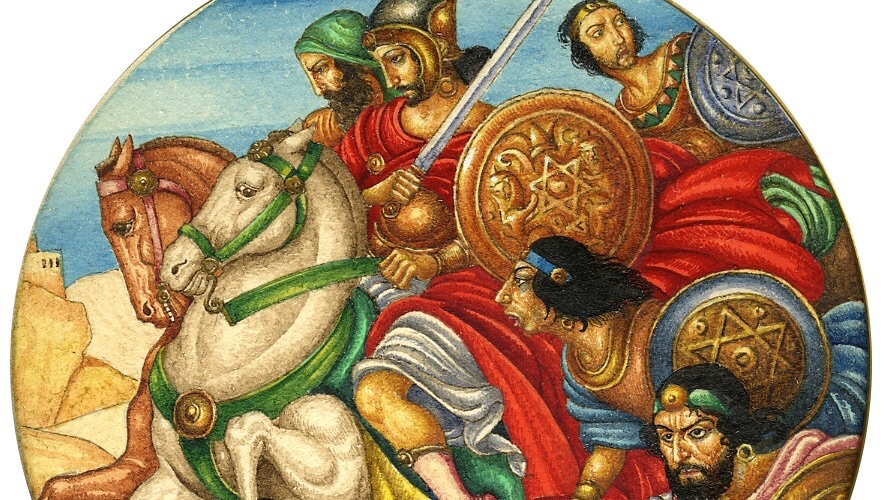
– Then there was the capture of Beitar by the Romans, when thousands of Jews were murdered. This city was located southwest of Jerusalem and was captured after a 2-1/2-year siege by a Roman General named Severus.
[Note: That sort of thing seemed to keep happening a lot throughout the centuries, didn’t it? Right up to the present time, in fact. Genocide, ethnic cleansing ... call it what you will. There always seems to be someone who thinks it’s a good idea.]
– And finally, there was the big one: the total destruction of Jerusalem in 136 AD. Known as the Bar Kokhba revolt, this one lasted four years from 132-136 AD, and resulted not only in the plowing-under of the city itself, but also the displacement of the entire surviving population of the region.
[Note: The good news is that it was eventually rebuilt, and stands proudly in Israel to this day. The bad news is that it’s not a land at peace.]
*. *. *
The “curse” of Tisha B’av seems destined never to end. There have been many events begun on that date in more recent times, as, for example:
– The expulsion of Jews from England, France and Spain between the 13th and 15th centuries;
– The approval of Hitler’s “Final Solution” by the Nazi Party, thus beginning the Holocaust that saw one-third of the world’s Jewish population eliminated; and
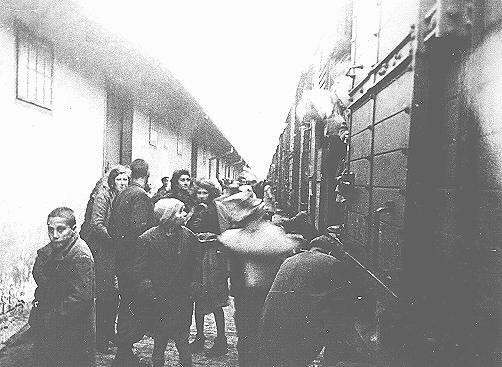
– The deportation of Jewish people from the Warsaw Ghetto to Treblinka Concentration Camp in World War II.
Coincidences? Really?!!
*. *. *
So now you see why Tisha B’av is a day of mourning and fasting. It is not one of the High Holy Days — that honor is reserved for the period from Rosh Hashanah through Yom Kippur. But it definitely takes its place among the most revered by the Jewish people.
[Note: Sukkot and Simchat Torah are also considered High Holy Days; however, being more of a celebratory nature, they’re not really relevant to my narrative.
*. *. *
But Jews can be funny, too. (Just think of Mel Brooks, Joan Rivers, Sacha Baron Cohen . . .) Example: There is an old joke that sums up, in just three short declarative sentences — nine monosyllabic words — the entire history of the Jewish people and their method of dealing with the vicissitudes of life:
They tried to kill us.
They failed.
Let’s eat.
To which I say:
L’chaim! . . . To life!

Brendochka
8/5/24
 The Blog About Everything … and Sometimes Nothing