Let the name-calling begin.
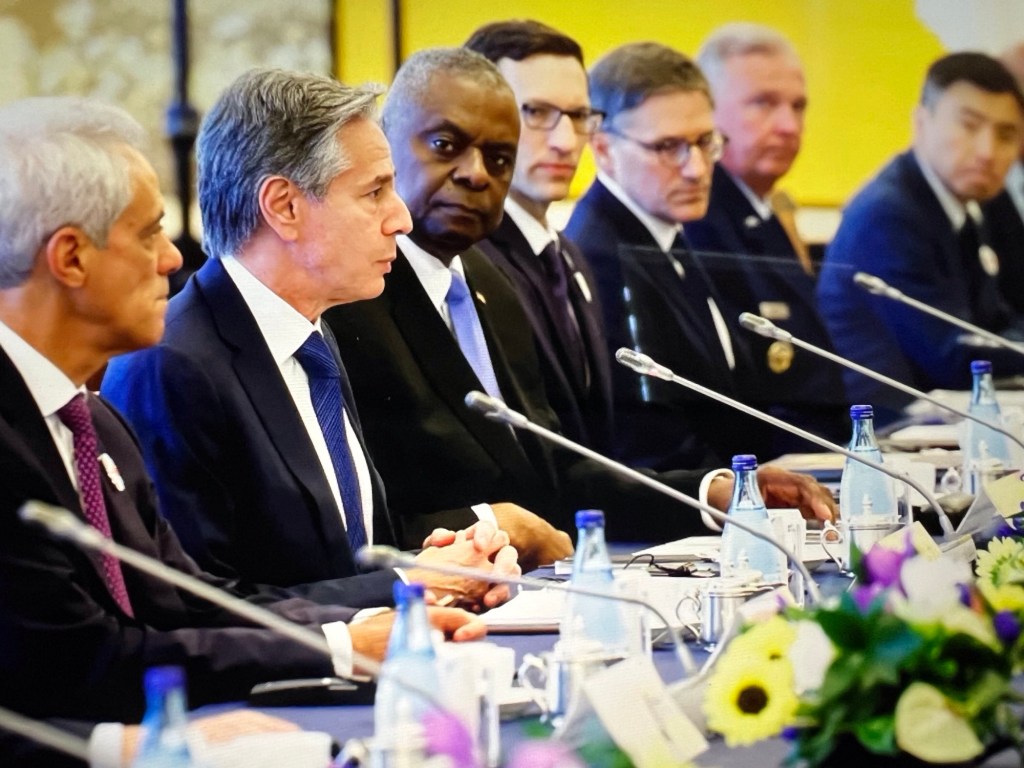
U.S. Secretary of State Antony Blinken (2d from left) and
U.S. Secretary of Defense Lloyd Austin (3d from left)
No, not this group. This was a meeting of the minds — the minds of allies Japan and the United States — in Tokyo yesterday, where discussions of U.S.-Japan relations included a focus on enlarging and modernizing their military coordination in the face of looming threats from China.
The joint statement issued at the conclusion of the meeting — which included U.S. Secretary of State Antony Blinken and Secretary of Defense Lloyd Austin, and Japan’s Foreign Minister Yoko Kamikawa and Defense Minister Minoru Kihara — clarified the convergence of Washington’s and Tokyo’s views on China, characterizing that country as “the ‘greatest strategic challenge’ in the Asia-Pacific region and beyond.” [CNN’s Meanwhile in China, July 29, 2024.]
And then the fun began:
China (from Foreign Ministry spokesperson Lin Jian): “Japan and the United States keep saying that they want to promote regional peace and security and maintain a rules-based international order. In fact, they form cliques, engage in small circles, manipulate group politics, and create camp confrontations.”
U.S.-Japan (in Joint Statement): Repeated mention of Beijing’s “intensifying attempts to unilaterally change the status quo [and its] threatening and provocative activities in the South China Sea, [and its] support for Russia’s defense industrial base.”
China (Lin Jian again): “[The joint statement] disregards facts, reverses right and wrong, and maliciously attacks China’s foreign policy … and exaggerates and stirs up China’s threat.”
China (today): Lin said further that China is “a builder of world peace [and a] defender of international order,” while actions from the U.S. and Japan are the “real challenges facing regional peace, security and stability.”
[Quotes from CNN, id.]

*. *. *
Earlier today I spoke about the joint China-Russia air “exercises” over the Bering Sea on Alaska’s doorstep. That was obviously just the tip of the proverbial iceberg that is the current status of U.S.-China relations. It’s a sad reminder of the late 1970s, when the two countries were able to establish diplomatic and trade relations that lasted to mutual advantage for the past four decades.
Where are Henry Kissinger and — yes, even Richard Nixon — when you really need them? Oh, right . . . they’ve passed on. And their successors? We shall see. But it seems, in all areas of domestic politics and international diplomacy, that the era of the great statesman has also passed.
And we are paying dearly for that.
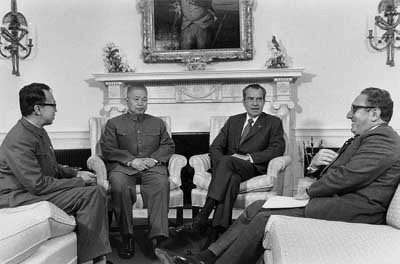
Just sayin’ . . .
Brendochka
7/29/24
 The Blog About Everything … and Sometimes Nothing