So why do I hear a cacophony of voices asking, “Who? The WHAT?? What the hell is an echidna?”
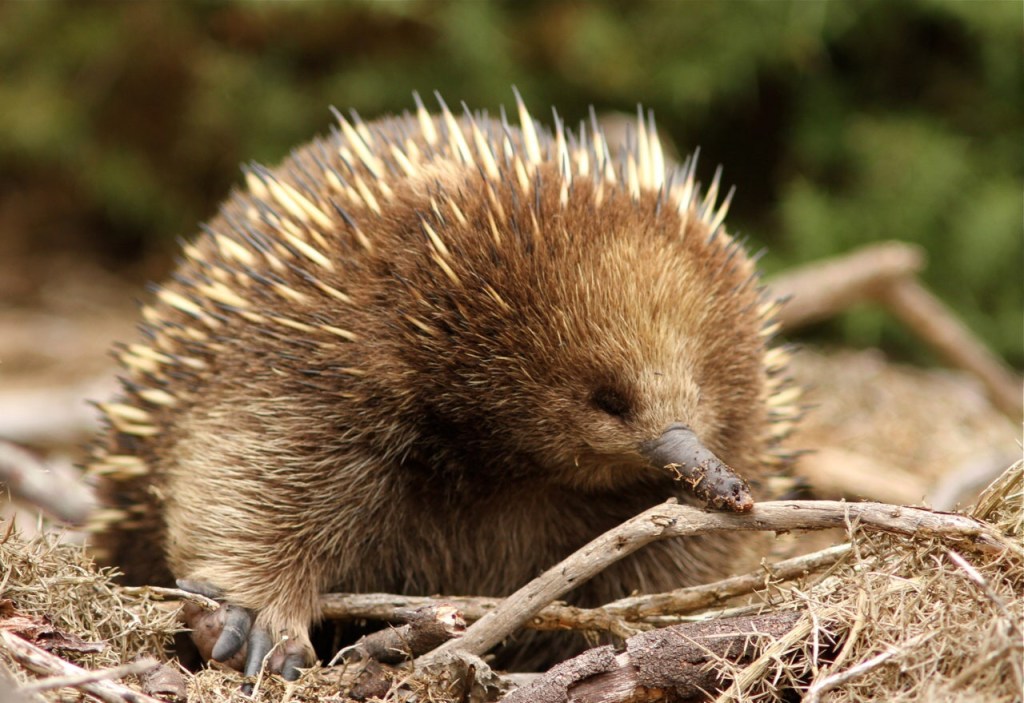
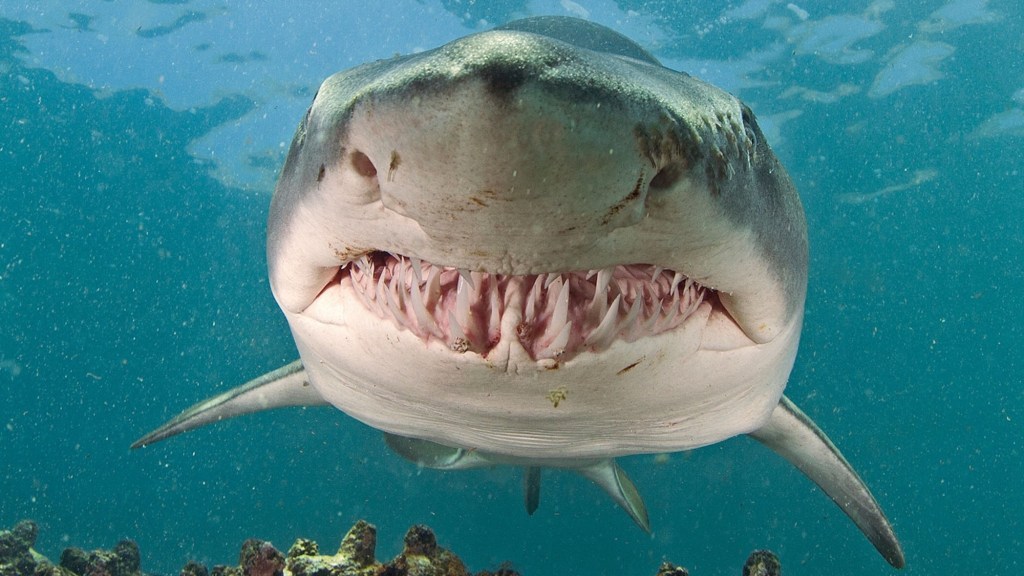
That’s not surprising — I had never heard of it either, until I read a fascinating, though somewhat disgusting, news item about one today. It seems that something happened off the coast of North Queensland, Australia, that had never happened before . . . or, at least, had never been witnessed before. A tiger shark was seen vomiting up a dead one . . . a whole, completely recognizable, though unquestionably dead echidna.
Wanting desperately to barf at the thought of what I had just read, I turned instead to Google to find out what the poor, unfortunate, undigested shark bait had been in life. What I learned was that it is also known as the spiny anteater, of which I actually had heard at some point in my life but knew nothing about. It turns out that it belongs to the family Tachyglossidae (you can file that away for use in your next game of Trivia), lives in Australia and New Guinea, and is most closely related — not to the common anteater, as one might logically expect — but to the platypus, of all things.
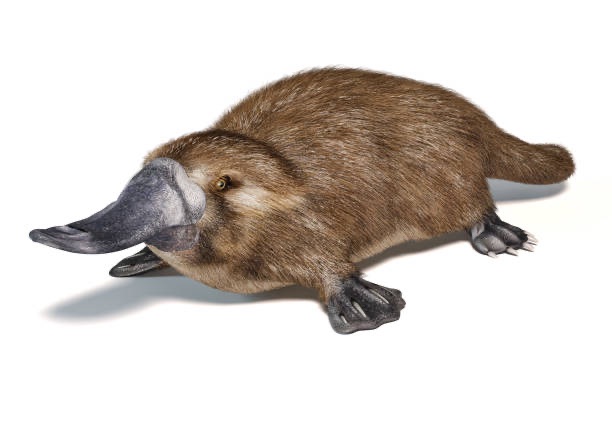
Most interestingly, though, it — and its duck-billed cousin — are the only living mammals that lay eggs.
Wait . . . what? A mammal that lays eggs? How can it still be a mammal? And that’s not all. About a month after mating, she deposits her egg into her pouch, where it remains for about ten days before hatching into a baby echidna, known as a “puggle.” Now, that is just too cute for words. It’s also weird. That adorable, long-nosed, quill-covered monotreme (egg-laying mammal) is also a marsupial. She has a freakin’ pouch!
I want one of those! I’m a mammal. I don’t lay eggs, but how convenient would that pouch be for other things: keys, lipstick, cell phone, a few dollars in mad money . . .
Reading on, I learned from Wikipedia of other interesting, though fairly gross, characteristics of this little cutie (whom, by now, I have named Sid, just because it seems to fit), such as her diet of insects gathered by “tearing open soft logs, anthills and the like, and licking off prey with their long, sticky tongues.” There’s more, for all you nature lovers who don’t mind doing your own research, but way too much to include here.
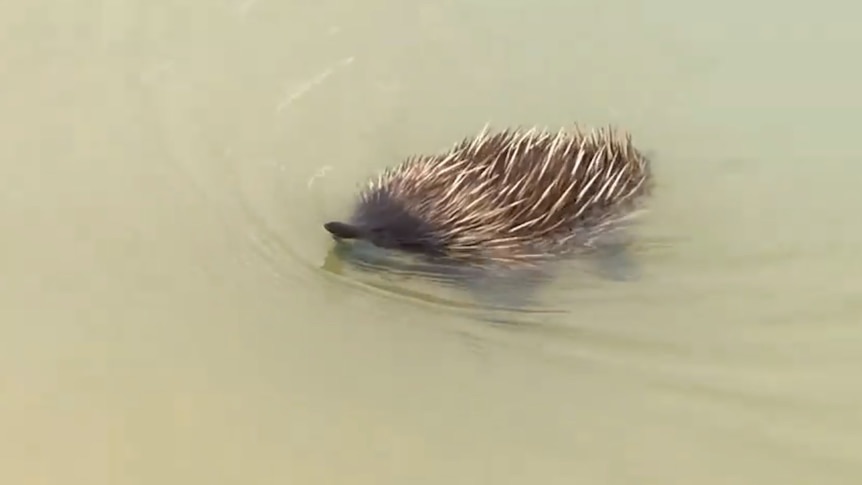
Anyway, by this time I was wondering how Sid had wound up in a shark’s esophagus. That mystery was solved when I also read that she and her relatives are good swimmers. Apparently, she just took a dip in the wrong place at the wrong time. Bad move, Sid.
*. *. *
Nicolas Lubitz, one of the researchers from James Cook University who witnessed the unusual upchucking, said that tiger sharks rarely regurgitate their food, though it can happen when they’re stressed. “In this case, I think the echidna must have just felt a bit funny in its throat.”
Yeah . . . I can understand that. All those funny little quills.
But you’ll be relieved to know that the shark, at least, was not harmed by its experience, “and was released back into the water by the team after being fitted with an acoustic tracker.” [Amarachi Orie, CNN Science, June 6, 2024.]
*. *. *
And if that’s not enough for you, you’ll want to learn that the same team had also caught and tagged a different shark that had surprisingly regurgitated . . . not an echidna . . . but half a dugong.
“Half a what??!!!”
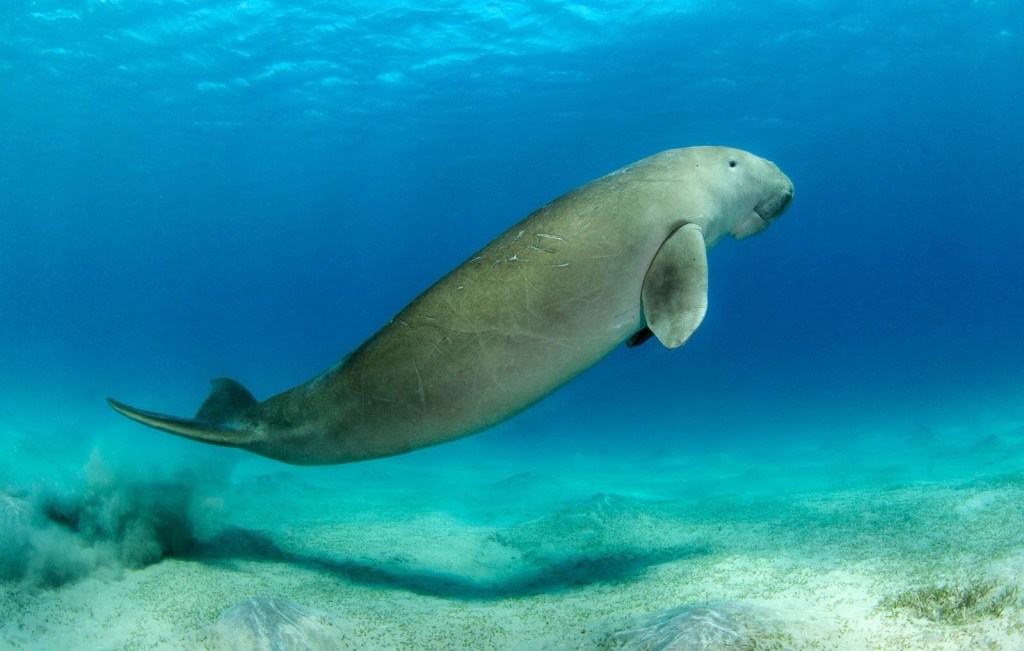
Okay, here we go again. For all of us who are not from Down Under, I looked it up. A dugong is an herbivorous marine animal most commonly found in Australia. This particular shark “threw up a big piece of blubber and then a full vertebral column,” according to Mr. Lubitz, who believes they belonged to a dugong calf. I know it’s Mother Nature at work, but I find that sad; they’re rather cute, don’t you agree? (The dugongs, not so much the sharks.)
Now, if you think that echidnas and dugongs are unusual fare, keep in mind some of the other delicacies tiger sharks have been known to devour: “other sharks, fishes, sea turtles and seabirds, as well as . . . garbage including coal, tin cans, clothing . . . bones, license plates, small television screens, and tires.” [CNN Science, id.]
So an occasional dugong must be a real treat for such an indiscriminate glutton. I think I’ll call that shark Henry VIII.

*. *. *
Thus ends our Natural Science lesson for today. And not a moment too soon. [Cue theme from “Jaws”]. I’m never going near the water again.
Just sayin’ . . .
Brendochka
6/7/24
 The Blog About Everything … and Sometimes Nothing