Again, from CNN’s “The Good Stuff” column this Saturday, compliments of A.J. Willingham, I have been able to glean a few light-hearted items to brighten your Sunday:
First up is a story about a rodent I’ve always considered to be ugly, repulsive, and probably diseased. That would be a rat. But I have to admit, this little guy is kind of cute, and definitely photogenic. Most selfies don’t turn out that well.
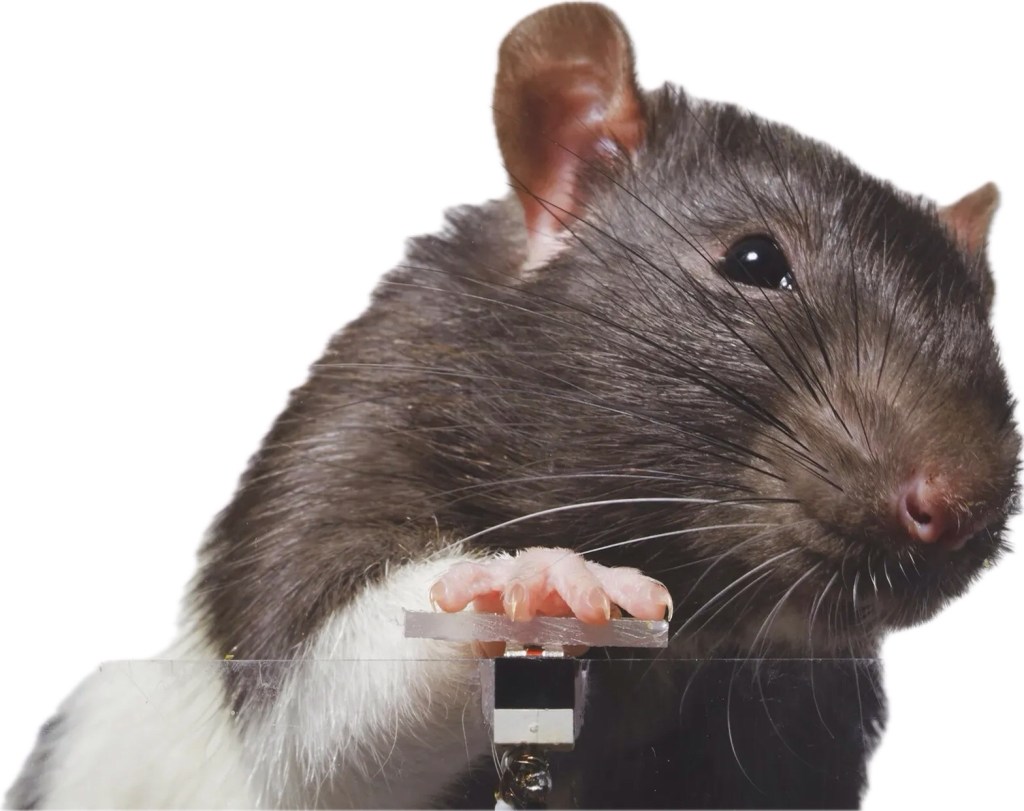
That’s right — this is a selfie. Apparently, a French artist named Agustin Lignier bought two rats as pets a couple of years ago and built them an elaborate cage. No doubt taking his cue from 19th Century physiologist Ivan Pavlov and his now-famous dogs, M. Lignier devised a mechanism that dispensed sugar whenever his rats pressed a button, which also happened to be connected to a camera aimed directly at the button-pusher. He said the project “is a commentary on the notions of pleasure, reward and the addictive behaviors induced by social media,” and that “the images offered a ‘playful’ way to explore topics like reduced attention spans and the impact of social media algorithms.” So what do we have here . . . junkie rats with ADHD? Fascinating!
After a brief time of modeling as guinea pigs for the curious artist, the two little rodents were packed up and sent off to M. Lignier’s mother’s house in the lovely Provence region of France, where they are expected to live out the remainder of their natural lives in comfort. All I can say to that is: Mme. Lignier is a better woman than I. There would be no rats, cute or otherwise, living in my chateau.
*. *. *
Next up is a lovely picture of a place known as the “Edge of the World,” and a suggestion that it’s a great place to visit. I’m something of a klutz, so I’m not at all sure about going anywhere near the “edge” of anything, much less the whole world. The picture is stunning, taken in the Tuwaiq Mountains of Saudi Arabia, with “pastel skies [that] stretch out clear to the horizon.” It’s apparently a popular weekend spot for hikers, and there is talk about adding easier trails for the less experienced adventurers.
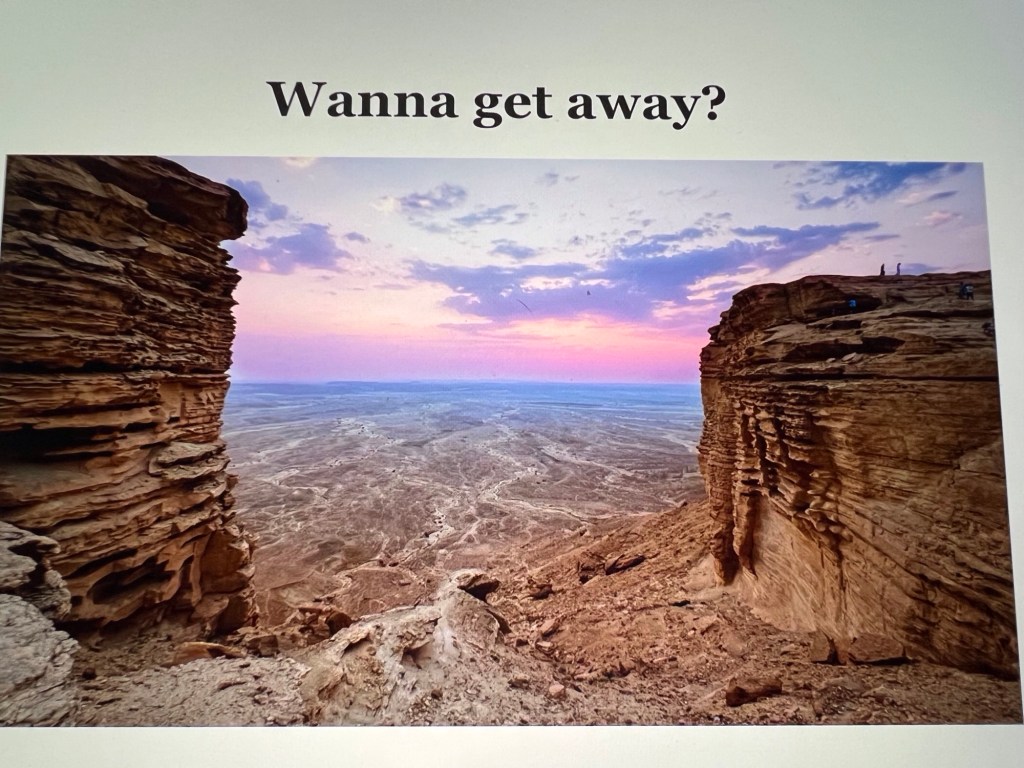
I’m going to have to take a pass on this one. But if anyone does try it, let me know how it went if . . . er, when . . . you get back.
*. *. *
And finally, on a much, much larger scale, we have this series of pictures taken by the James Webb Space Telescope:
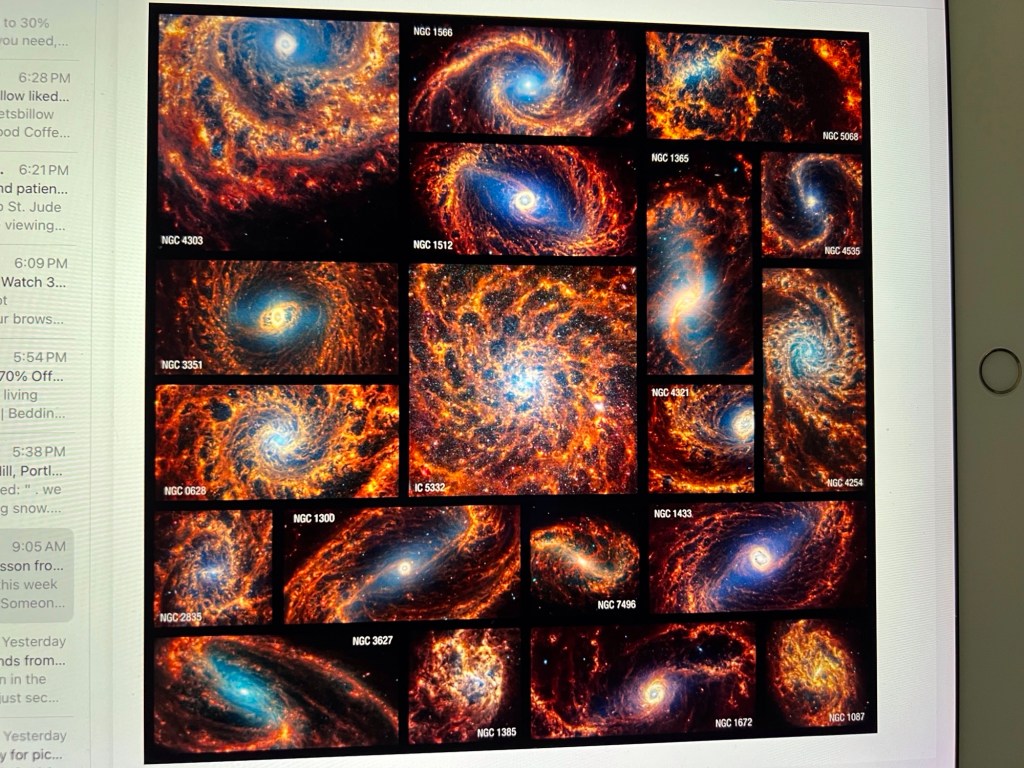
At first glance, they reminded me of a bunch of robins’ nests with very shiny eggs waiting to be hatched. (Remind me never to take a Rohrshach test, please.) What they really are, are “. . . portraits of 19 spiral galaxies and the millions of stars that call them home. The telescope’s ability to observe the universe in different wavelengths of infrared light, such as near-infrared and mid-infrared, showcases the stars, gas and dust within the intricate structure of each galaxy. Our own little solar system resides in one of the spiral arms of the Milky Way.” [CNN, The Good Stuff, Feb. 3, 2024.]
I’m not clear on the wavelengths of infrared light, but I am gobsmacked (my new favorite word) by the enormity of the universe. So, never one to simply shrug something off, I went searching for some statistics.
— The observable universe (and who can even imagine what lies beyond that?) contains as many as an estimated 2 trillion galaxies, and more stars and earth-like planets than all the grains of beach sand on planet Earth.

— Our galaxy is known as the Milky Way. The latest data collected by NASA indicates that there are 3,916 solar systems within our galaxy.
— There are also 5,240 confirmed exoplanets, which are planets that exist outside our solar system.
I’ll let someone else do the exact math, and correct me if I’m off by a few zeros, but with those numbers — and assuming the other 2,000,000,000,000 (that’s 2 trillion) galaxies are about the same size as ours — I’m seeing something like 18-20 quadrillion (that’s 15 zeros) solar systems or star systems in the observable universe.
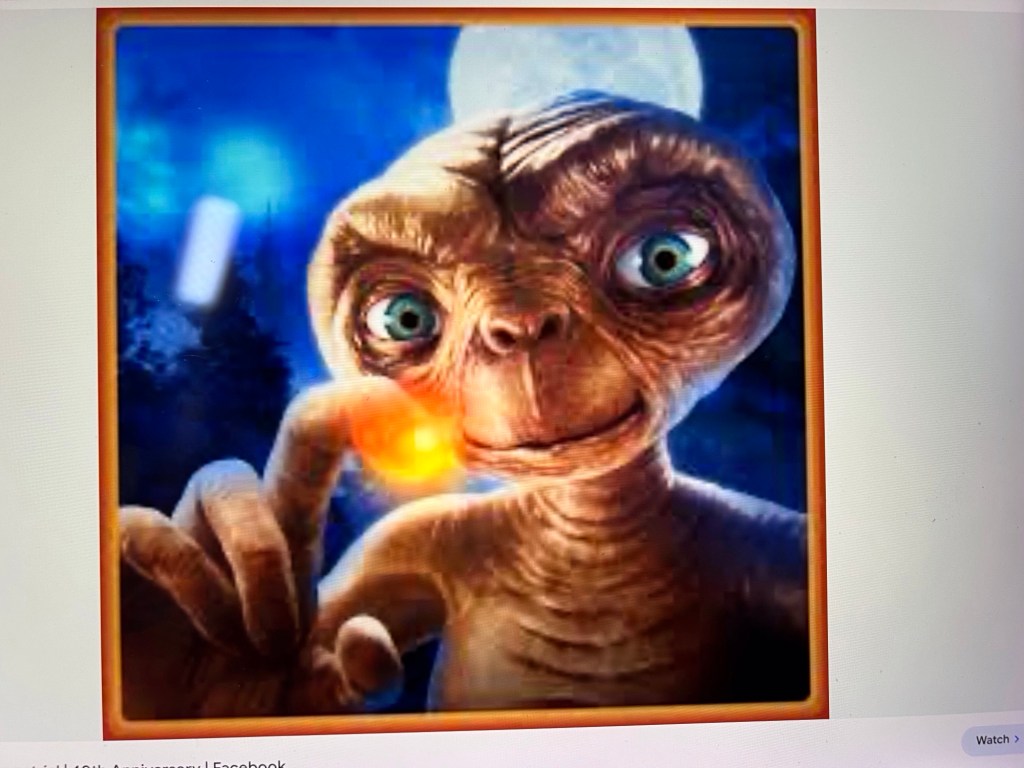
And we still want to believe there’s no one else out there? Really?
Just sayin’ . . .
Brendochka
2/4/24
 The Blog About Everything … and Sometimes Nothing