On only the second day of what was intended to be my countdown to the actual discovery of Alexei Navalny’s location, his whereabouts have been revealed by Russian authorities. And there is good news, and . . . as usual from that source . . . bad news.
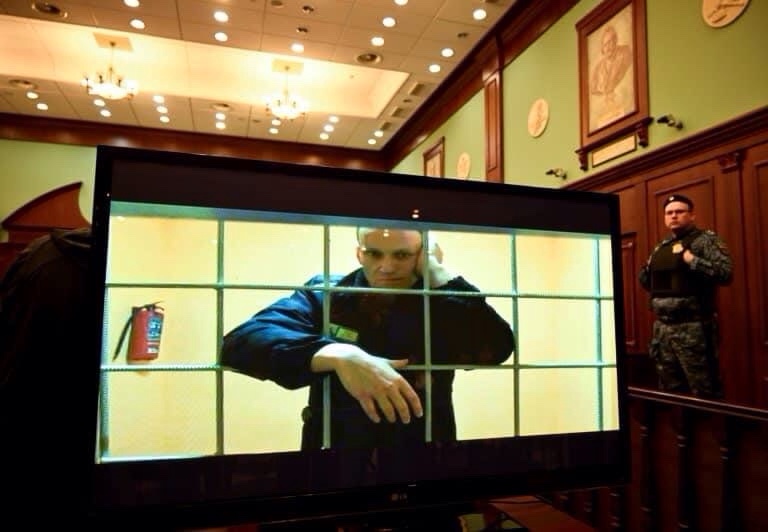
The very good news is that he is alive. Having feared the worst for the past 18 days, his family, friends, and supporters all over the world are now breathing a sigh of relief — but a tentative one.
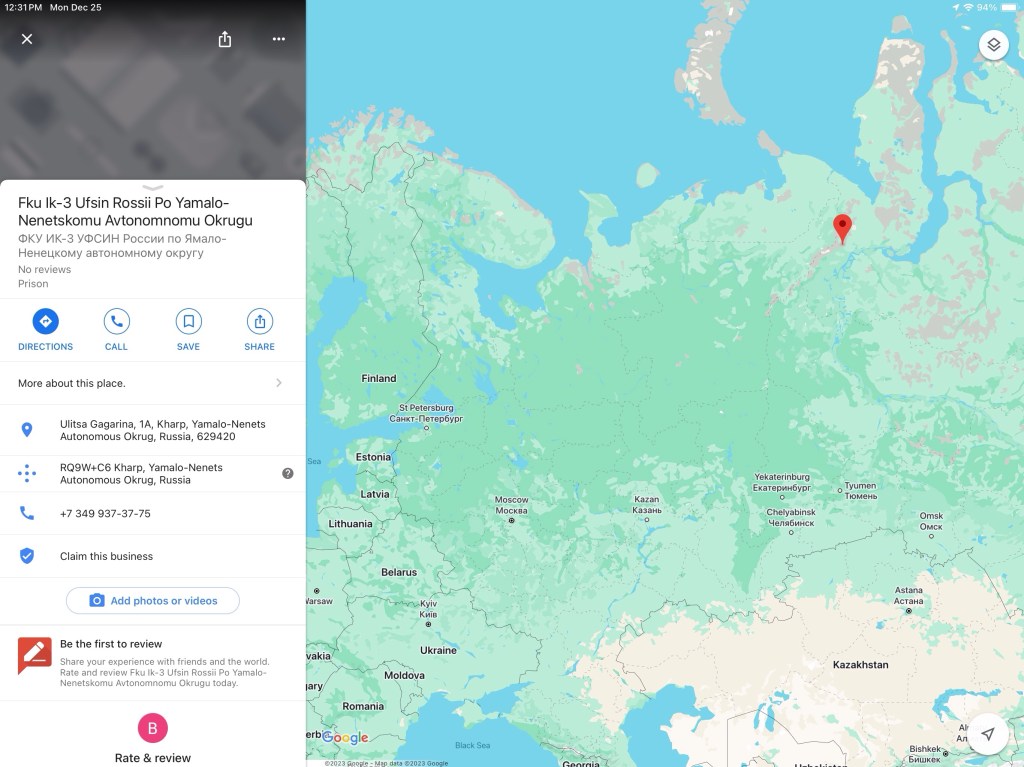
Because the bad news — the very bad news — is that he is now being held in Russian penal colony IK-3, located 40 miles above the Arctic Circle in the settlement of Kharp in the Yamal-Nenets Autonomous District, some 2,000 miles north/northeast of Moscow. Popularly referred to as “Polar Wolf” due to its harsh conditions, both natural and man-made, it appears to be as isolated a spot as the authorities could find for Putin’s principal political opponent. If you really want to shut someone up . . . where better than a Siberian former GULAG camp?
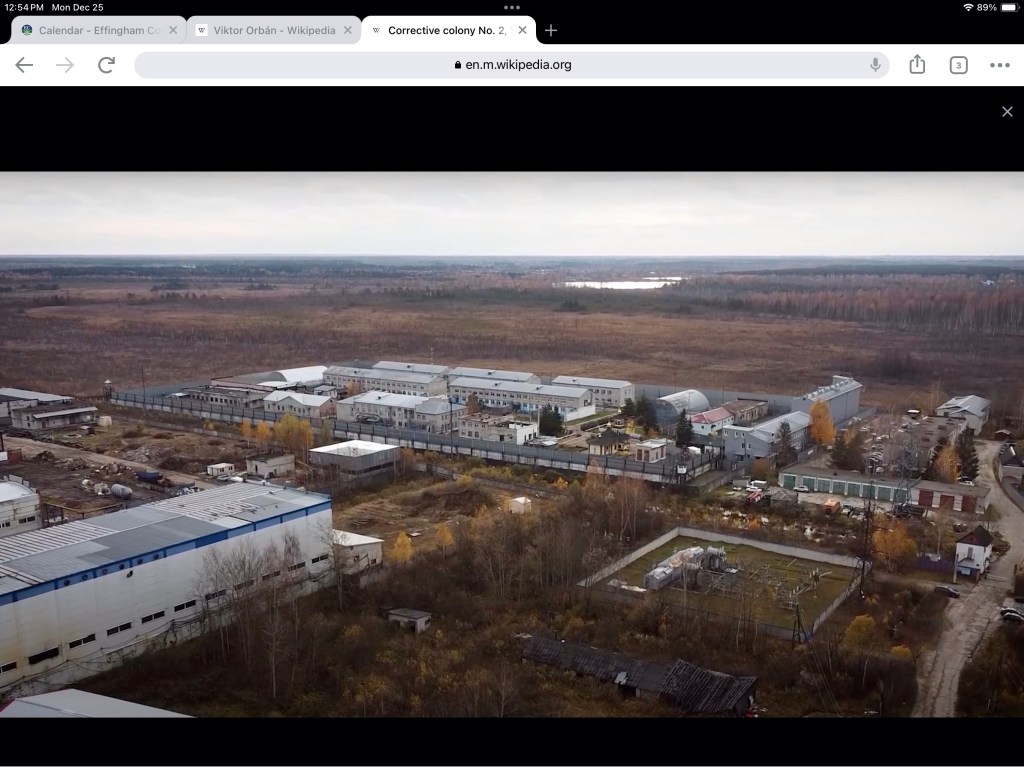
Understandably, I haven’t been able to find any photographs of “Polar Wolf,” but here is an aerial view of IK-2, presumably a similar camp, but located in the Vladimir region, just a couple of hours east of Moscow and thus much more amenable to sustaining life. Now try to picture it — probably older and more dilapidated — buried in snow, surrounded by hundreds of miles of . . . nothing. And that’s how I envision IK-3.
Navalny’s new “home” was once an outpost of the notorious GULAG system of Stalin’s reign, and is considered a “special regime” — the harshest still maintained in Putin’s time. Ivan Zhdanov, director of Navalny’s anti-corruption foundation, has described it as “one of the northernmost and most remote colonies. The conditions there are harsh, with a special regime in the permafrost zone. It is very difficult to get there, and there are no letter delivery systems.” [Katharina Krebs and Christian Edwards, CNN, Dec. 25, 2023.]
Navalny’s team warn that “he had been in poor health before his disappearance after being ‘deprived of food’ and ‘kept in a punishment cell without ventilation.’” [CNN, Dec. 25, 2023.] But apparently those abysmal conditions weren’t sufficient to kill him, so the Kremlin had to search for worse. And in Russia, there’s always something worse.
*. *. *
In 2020, Navalny survived an attempt on his life when he was poisoned with Novichok, a Soviet-era nerve agent not available to the general public. He was treated and his life saved in Germany, where the substance was identified. Upon returning to Moscow in January of 2021, he was immediately arrested and imprisoned. Even before then, in December of 2020 — while denying the Russian government’s involvement in Navalny’s poisoning — Vladimir Putin had said that, “if the Russian security services had wanted to kill Navalny, they ‘would have finished’ the job.” [CNN, Dec. 25, 2023.] Nice.
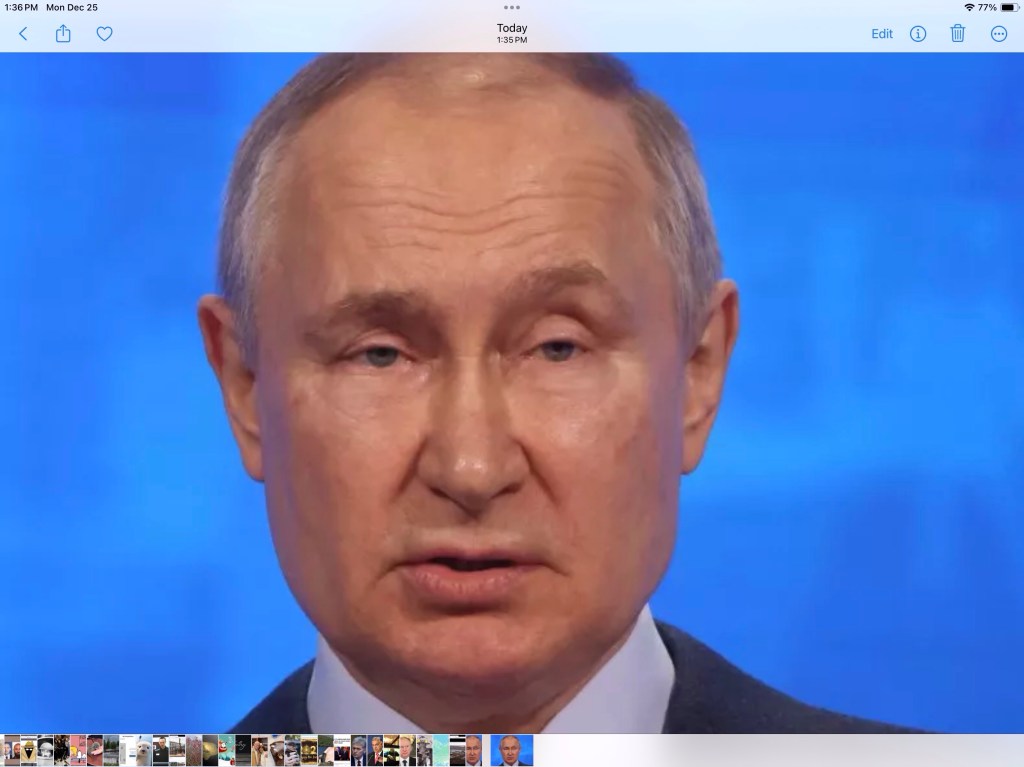
Considering what they’ve continued to do to him since then, it seems that “finishing the job” is precisely what they are now aiming for . . . but without actually putting a bullet in the back of his head. After all, that would rob them of deniability or justification.
Perhaps I should now begin a countdown to Alexei Navalny’s release from prison. But given the Kremlin’s refusal even to consider any vaguely humane action in connection with any of its numerous political prisoners, that countdown could go on for a very, very, very long time. I only hope to see a happy ending to Navalny’s story — and the others — in my own lifetime.
Just sayin’ . . .
Brendochka
12/25/23
 The Blog About Everything … and Sometimes Nothing