
It was done. I had chosen my own way, and that path had led me to places I never dreamt I would be. Now that it was over, there were decisions to be made, a new course to be plotted. And I was totally unprepared.
I had always known, of course, that once Yuri Shvets’ book was published, that part of my life would be behind me. What I hadn’t foreseen was the resultant unraveling of my long relationship with Russia: my business, my travels, and — most painful of all — my Russian friendships.
The KGB had kicked me to the curb; the FBI no longer needed my help; and my friends in Moscow were afraid to talk to me. My business plan was defunct, and my bank account was in desperate need of an infusion of cash. It was as though it had all been a long, weird dream, and I had awakened still groggy and not quite sure of what was real and what wasn’t.
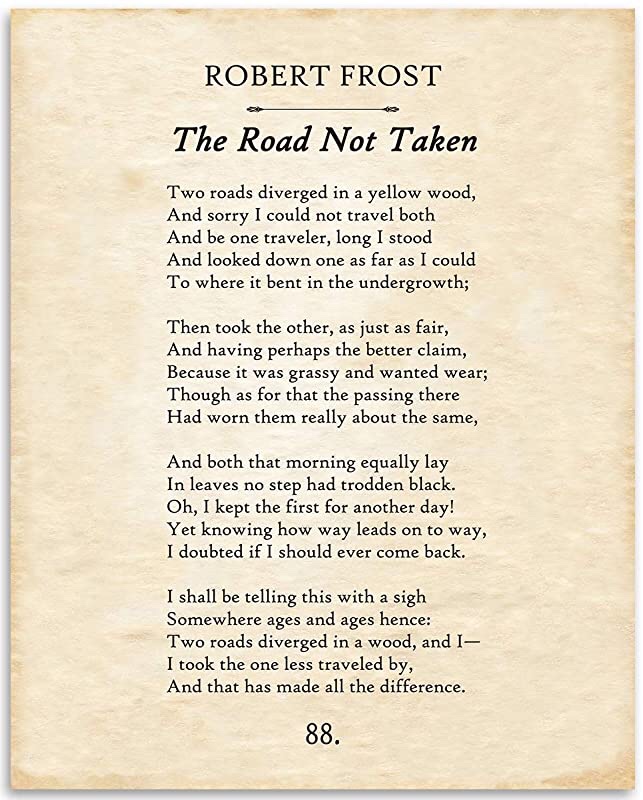
So what do you do when you reach the dead end of a road? As I see it, you have two choices: you can fall apart, or you can look for a new road. I momentarily considered the first option; but then I gave myself a good lecture, pulled myself together, updated my resume, and went searching for a job. It wasn’t that difficult in Washington in those days; we used to say D.C. was recession-proof. In a matter of days I found my place — a good one — and I stayed for 21 years.
The law firm was Foley & Lardner LLP; I was assistant to one of the firm’s top corporate partners, Steve Chameides, whose extensive background included work for Russian and Ukrainian shipping and cruise lines. I was hired in part for my Russian language skills and knowledge of the country, so there was still some attachment. On the downside, there was no opportunity for travel, and I was no longer my own boss; but the work was interesting, the people were great, the location on the Potomac Riverfront in D.C.’s Georgetown neighborhood was ideal, and the pay was good. Was it exciting? For the most part, no. But it had its moments . . .
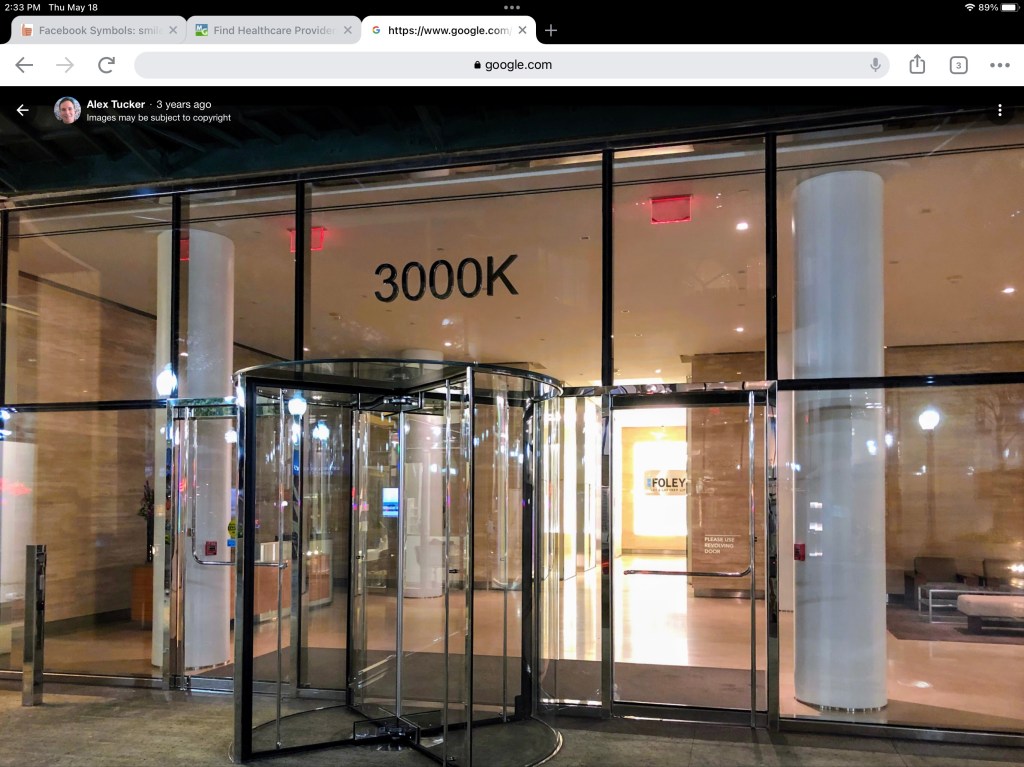
I had only been with the firm for a couple of weeks, and was still finding my solid footing, when Steve was asked by another partner to join a meeting with some potential new clients, one of whom was from Russia. At one point, Steve rang and asked me if I could get someone from our copy center to pick up some documents to be duplicated right away. Rather than waste time delegating, I decided it would be quicker to take care of it myself and went directly to the nearby conference room. Looking only at Steve, I took the documents, left the room, and headed for the copy center. On the way, I happened to glance down at the top page of the sheaf of papers in my hand, and saw a familiar name: the name of Valentin Aksilenko’s brother-in-law from Riga, Latvia, who had been the conduit for the exchange of messages between myself and Aksilenko for a while in 1993.
I stopped walking and began leafing through the papers. And there was the other name I was looking for: Valentin Aksilenko himself. By one of the most bizarre of coincidences, he and his brother-in-law were partnering with a former client of Steve’s, an American man, in some sort of commercial transaction. Aksilenko had to have been in that room! Of all the law firms, in all the cities, in all the world, he walks into mine . . . (Oh, sorry — couldn’t resist channeling Casablanca.)
So now what should I do? First I took the papers to be copied, and instead of leaving them for someone else to bring back to Steve, I decided to wait for the copies and return them to the conference room myself. I just had to know. And when I walked back into that room, there was Aksilenko — seated across the table, facing me as I entered, and looking as though he wanted to slide under the table and disappear. His face was flushed, and he clearly did not know what to expect. Was this too much of a coincidence to actually be one? Was I going to say something? He was in as great a state of disbelief as I was.
But I had had time to compose myself. I handed the documents back to Steve and left the room as I had entered: without a word — but not before looking directly at Aksilenko to let him know I had seen him. I went back to my office, sat down, and waited for the shaking to stop — it seemed I wasn’t quite as composed as I’d thought. And then I called Eric at the FBI. But he was strangely unconcerned, and simply asked me to keep him advised of the outcome of the meeting. I was clearly an outsider now, and this encounter was no more than a little glitch to him. But to me, it was a disturbing indication of how small a world this really is. What’s that old saying?

Later, when the meeting broke up, I did what I had to do: I told Steve the story of my history with Aksilenko, and assured him that I would recuse myself from all work on any projects the firm might undertake for him and his colleagues in order to avoid even an appearance of any conflict of interest. As it turned out, though, that wasn’t necessary; it had already been decided that their proposal was not of interest to the firm and they were not going to be taken on as clients. But Steve was fascinated by my story, and we developed a great working relationship over the next two decades, and a friendship that continues to this day.
*. *. *
That was early in 1995. I have not seen, spoken to, heard from, or in any way communicated with either Valentin Aksilenko or Yuri Shvets in the ensuing 28 years. But they have never been far from my mind, and a little over two years ago — by then in retirement, with plenty of time on my hands — I decided to give voice to my memories. I began writing: not this blog, but a book. I have a nearly completed draft manuscript and a book proposal now, and I’m on a search for a publisher or literary agent. My magnum opus may never see the light of day, but writing it has been truly healing. If nothing else, it will be a legacy for my children.
And from that book was born this blog. It’s been a great way of sharing parts of my story with friends and others around the world who may be interested. And I’ve found writing a blog to be much more relaxing than writing a book: no in-depth research, no pressure, no need for grammatical perfection. No money either, but that’s beside the point.

As for all of that research, I had to do a lot of reading before I could even begin writing. And in the course of that reading, my name popped up in some unexpected places, the most fascinating being a book titled “One Nation Under Blackmail – Vol. 2,” by one Whitney Webb. It is largely about the late (and not so great) Jeffrey Epstein. In Chapter 20, the author writes about Epstein’s connection with the Edge Group, “an exclusive organization of intellectuals . . . created by John Brockman.” Yes, the same literary agent John Brockman who sold Shvets’ book to Simon & Schuster all those years ago.
Ms. Webb goes on to write more about Brockman, including his involvement with Shvets and Aksilenko in 1993-94 . . . which is where my name shows up, mostly in quotes from that old New York Times article. Nothing negative about me, but who would ever have thought I’d be mentioned, even marginally, in a book about a notorious, convicted, and now dead sex trafficker like Jeffrey Epstein? My name is even included in the Index! My grandmother would have been horrified — she used to preach that you’re judged by the company you keep. She was right, of course; but at my age, I figure any publicity is good publicity and can only enhance what’s left of my reputation. So, all in all, I’m fine with it.
*. *. *
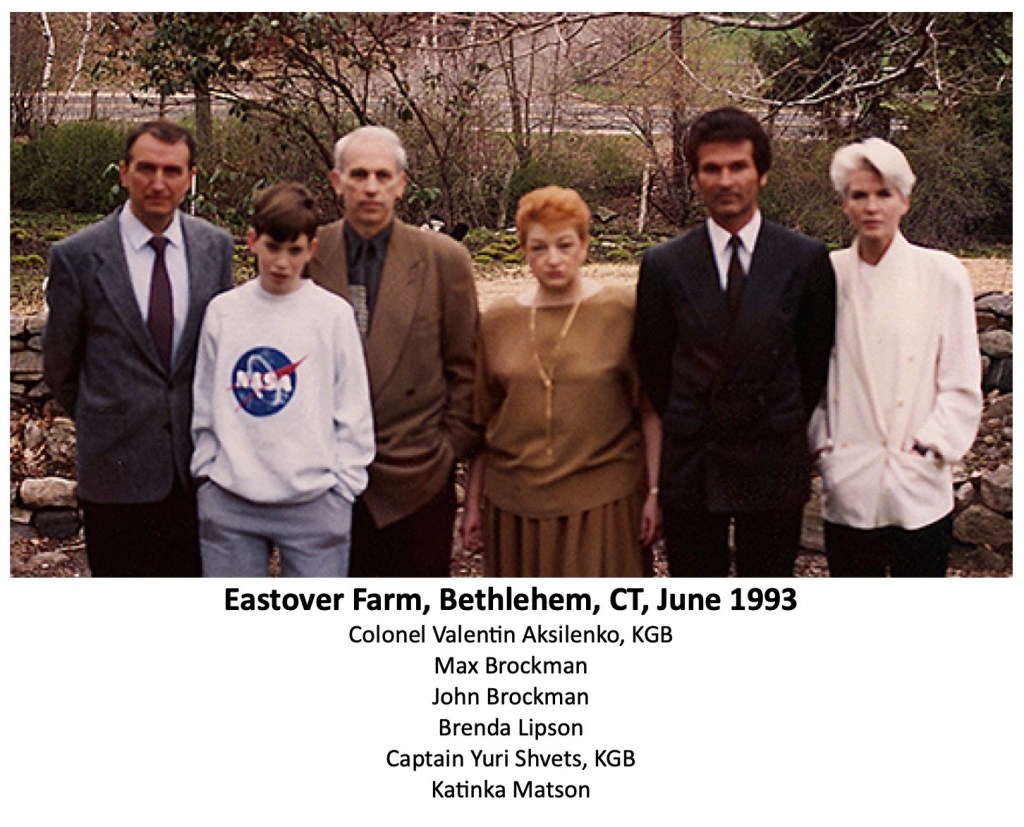
And there we are (pictured above) at the beginning: Valentin Aksilenko, far left; Yuri Shvets, second from right; John Brockman; his wife and business partner Katinka Matson, far right; their son Max; and — in the middle of things as usual — yours truly, with the red hair and an inexplicably odd facial expression. The red hair was an accident of birth; I can’t explain the expression except to say that it was early in the morning, just prior to leaving for the city to meet with publishers, and I hadn’t slept well the night before. And judging from everyone else’s somber expressions, neither had they. Or perhaps the photographer just forgot to say “Smile.”
[NOTE: The photo is from John Brockman’s archives. Two corrections: the date was April, not June, 1993; and Yuri Shvets was a Major in the KGB, not a Captain, at the time of his retirement.]
And here I am today, retired and living in the great state of Georgia, navigating a quieter path, and still missing the excitement of Washington, Moscow, and all the other world capitals I’ve been privileged to visit . . . but grateful to be able to write about them. In my view, a life devoid of tales worth telling would be a life only half-lived.

And what about the other characters in this story? Where are they now? Also in the course of my research, I inevitably ran across articles on Aksilenko and Shvets. It appears they’ve long since become U.S. citizens, enjoying the benefits of living here rather than in Vladimir Putin’s Russia. Aksilenko, true to his nature, has kept a lower profile, reportedly running a business, writing a book of his own, and speaking from time to time before various private and governmental organizations.
Shvets, on the other hand — always the more flamboyant of the two — has maintained a somewhat more public persona. Despite his allegations that he continues to live in fear of retribution from certain forces in Russia and thus must keep his exact whereabouts secret, he has appeared frequently in print and on TV. He also has his own YouTube channel, wherein he expounds on matters of international political importance — in Russian, without English subtitles. I wonder: to whom is he speaking?
In any event, they both seem to have enjoyed the rewards of living in the land of the free. Good for them.
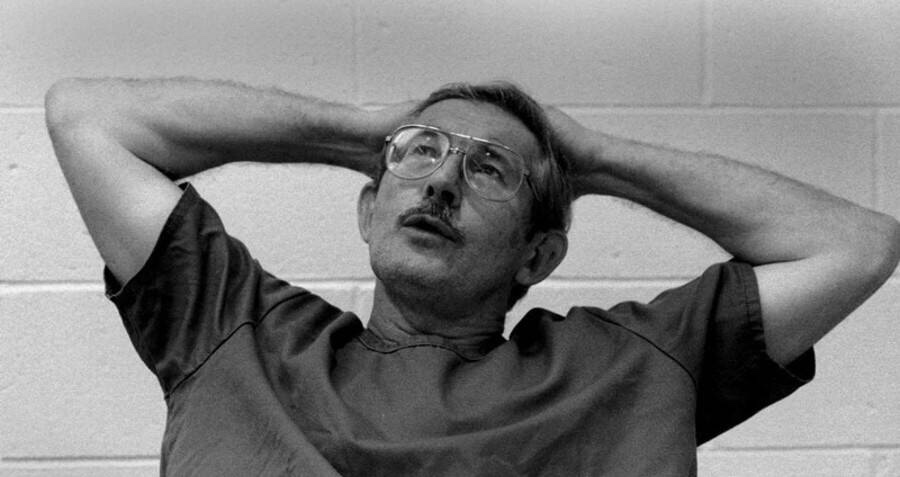
As for the self-proclaimed superspy Aldrich Ames, now 82, he continues to live out his life sentence, without possibility of parole, in Federal prison. Has the identity of the person or persons who blew the whistle on him ever been made public? Not to my knowledge. There were those, nearly three decades ago, who suggested it was none other than Valentin Aksilenko; but others said no, and offered a few different possibilities. I doubt we’ll ever know for sure.
But, if it should happen that Aksilenko — or even Yuri Shvets — was that person, then I would take great pleasure and pride in knowing that, in some very small and indirect way, I helped to make it happen. And if not, then at least it was . . . well, not fun, exactly . . . but undeniably interesting. Not everyone can say they spent two years hanging out with the FBI, the KGB, the CIA, the Russian Mafia, the Moscow Militia, two Russian defectors, and an extraordinary assortment of bit players. But I can.
And if I could turn the clock back to that cold February day in 1993, would I choose the same road again?
Would you?
FINIS
Brendochka
6/1/23 (re-posted 12/22/23)
 The Blog About Everything … and Sometimes Nothing