I wonder why it is that we always seem to remember exactly where we were and what we were doing when tragedy struck, and perhaps not so clearly when the news was good. Maybe it’s because the tragedies are the events that we tend to commemorate with anniversaries: Pearl Harbor Day, the day John F. Kennedy was killed, and 9-11, to name just three. It’s that last one, its anniversary recalled just yesterday for the 22nd time, that started me thinking about this. And so, into the past . . .
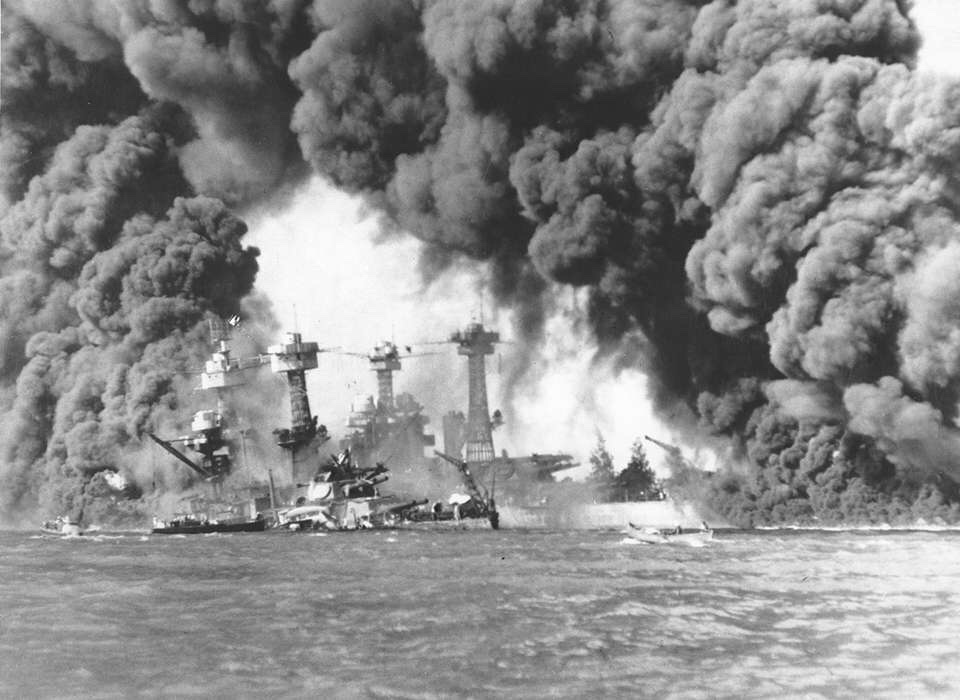
Pearl Harbor Day, December 7, 1941: Yes, I was alive the day the Japanese bombed our base at Pearl Harbor, Hawaii, bringing our country into a war that had already been raging in Europe for two years and that we could now no longer avoid. But I was just two years old, so I have no actual memory of it. It was a Sunday, and I would have to assume that I was at home with my family, or visiting grandparents as we often did on Sundays . . . all of us blissfully unaware of the four years of horror about to descend on our peace-loving nation and the world.
Death of Franklin Delano Roosevelt, April 12, 1945: I was a precocious six-year-old by this time, and I do recall sitting by the radio with my family, listening to the news that our beloved President had passed away at his “Little White House” in Warm Springs, Georgia. I remember it because I don’t believe I had ever before seen my mother cry.
VE Day (Victory in Europe), May 8, 1945: This one was actually the end of a tragic period, and thus a happy day. I was outside in our front yard with my sister when our mother called out the window that the war was over! My sister, who was 5-1/2 years older than I, was excited and began dancing around our apple tree. Never one to miss a good time, I joined in. I’m not sure I fully understood the significance of the moment, but it was fun. Although this was good news, there was sadness in realizing that President Roosevelt had missed — by less than a month — living to see the end of the war through which he had guided our country for four long years.
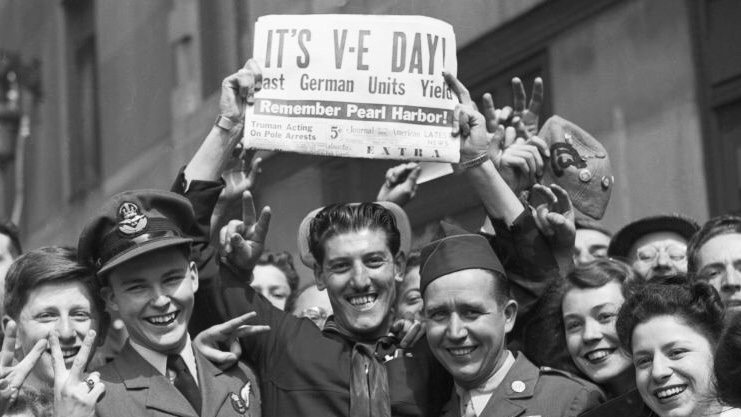
VJ Day (Victory over Japan), August 15, 1945: Although the official document ending the war in Japan wasn’t signed until September 2nd, it is August 15th — the date on which Japanese Emperor Hirohito announced his country’s surrender — that is celebrated as VJ Day. Again, I was at home, as it was summer vacation from school; and I vaguely recall this being a more subdued occasion than VE Day had been, because we were still digesting the horror of the two atom bombs it had taken to finally declare victory for our side. For me, it was the beginning of many years of nightmares featuring mushroom-shaped clouds of death and destruction.
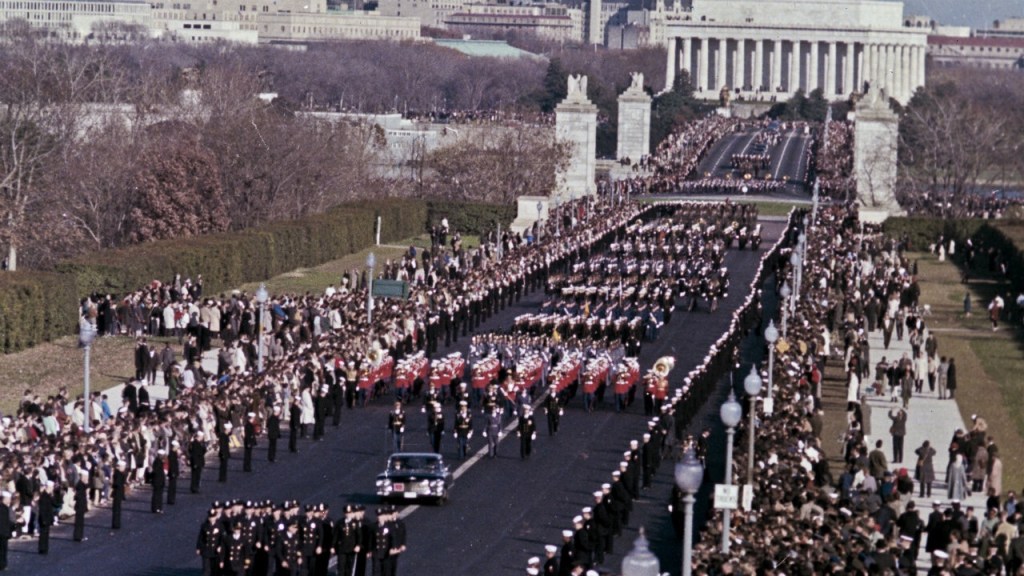
Assassination of John F. Kennedy, November 22, 1963: No one who was alive that day could ever forget it. I was at home, feeding lunch to my four-month-old son and listening to a music program on the radio, when the announcer broke into the programming with a news bulletin. I felt as though my heart had stopped, and for a moment I couldn’t move. Then I grabbed for the phone to call my husband, but I couldn’t get a dial tone for the longest time. Finally, he got through to me. I somehow managed to finish my baby’s lunchtime, but the next few days passed in a total blur, with everyone glued to the TV programming about the unimaginable disaster, followed shortly by the on-camera murder of the accused assassin, Lee Harvey Oswald, by some guy named Jack Ruby. It was, not just one day, but a week never to be forgotten.
Assassination of Martin Luther King, Jr., and D.C. Race Riots, April 4-8, 1968: A little over four years later, another week of horror. I was at work that Thursday when the word spread that MLK had been shot and killed in Memphis. And, in what seemed like an event of spontaneous combustion, whole sections of Washington erupted in flames and rioting that did not stop for four days. That Friday evening, I sat with friends in their high-rise apartment in suburban Arlington, Virginia, watching the distant flames reaching toward the sky, and trying to get drunk enough not to feel anything. It didn’t work.
Assassination of Robert F. Kennedy, June 5, 1968: The younger brother of JFK, against the advice of friends and family, was running for the presidency that had taken his brother’s life. At a rally in Los Angeles, he too was shot and killed. At the time, I was working for a small law firm that included Bobby Kennedy’s California campaign manager, Fred Dutton, who was in L.A. with Kennedy at the time. I heard the news at home in the morning, but dutifully went to work anyway. I was the only one there, and soon received a call from one of the partners telling me to close the office and go home. The Kennedy family — the closest thing the United States had to royalty — had once again been struck by unimaginable tragedy. But not for the last time.
Resignation of President Richard M. Nixon, August 8, 1974: This was a first, and we prayed it would be the last. It was the culmination of two years of what had become known simply as “Watergate.” And half a century later, we still haven’t stopped talking about it, or comparing it to current events. It invaded our lives and monopolized our thoughts and our conversations from the time of the break-in at Democratic National Committee (DNC) headquarters in the Watergate complex on June 17, 1972. And then, finally, it came to a climax when a president gave in to the threat of impeachment, resigned, and waved goodbye from the doorway of a helicopter. And, like most of America, I was watching his departure on television. One more day never to be forgotten.
The Fall of Saigon, April 30, 1975: The end of a 20-year fight in South Vietnam against the communist regime of the North (as backed by China and the Soviet Union), it became known in the history of our country as the only war America had ever lost, and it remains a dark stain on our record. My sister had been in Saigon in 1966-67, as a civilian member of a team with a government R&D contract, and I spent a good bit of time trying to console her when she heard the tragic news. For her it was personal, and she was devastated; but I was just glad she had returned home safely, well before the chaotic end.
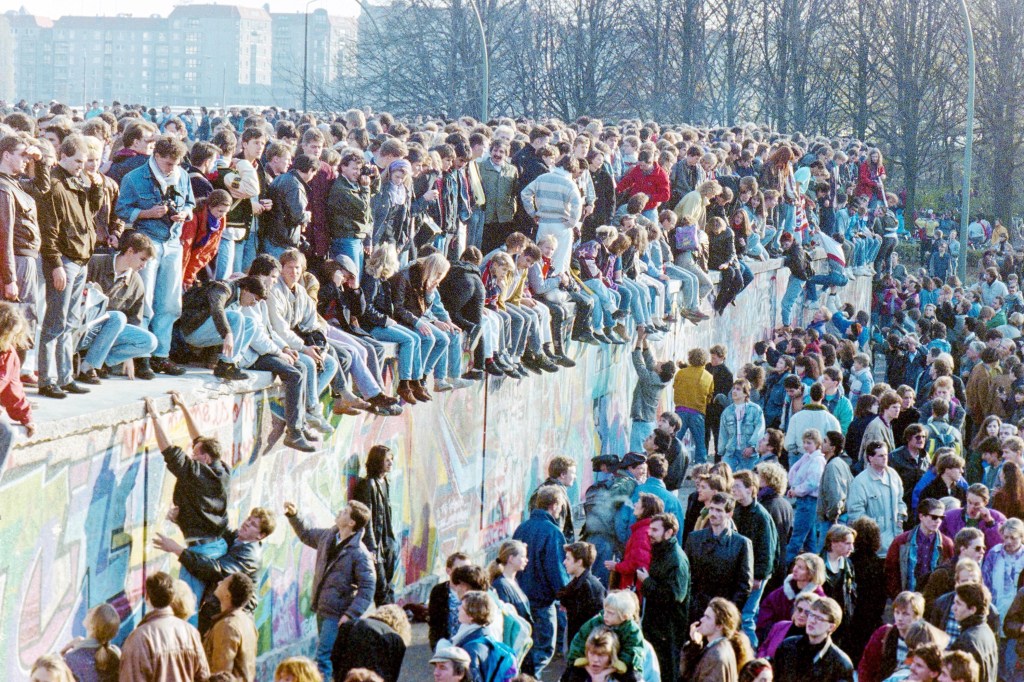
Berlin Wall Breached, November 9, 1989: Another piece of good news to be remembered, and seemingly too good to be true: the beginning of the end of the communist regime in Eastern Europe, when an East German Communist Party spokesman erroneously announced that the citizens of both East and West Germany were free to cross into each other’s territories. And the wall came a-tumblin’ down. As usual, I was at work, sharing the startling news with friends and predicting — incorrectly — that it wouldn’t last; “walls can be rebuilt, you know,” I told people. Ever the skeptic . . . and I still am, 34 years later.
End of the Cold War, December 25, 1991: It had been coming for two years, but on December 25, 1991, Mikhail Gorbachev officially resigned as head of the Russian government, and Boris Yeltsin plopped himself into Gorby’s chair. It was Christmas day, and like most people, I got to share this event with my family. My mother had just passed away in September, so Christmas felt strange that year and we needed some good news. The Cold War was finally over . . . officially. But sometimes appearances and reality are very different things.
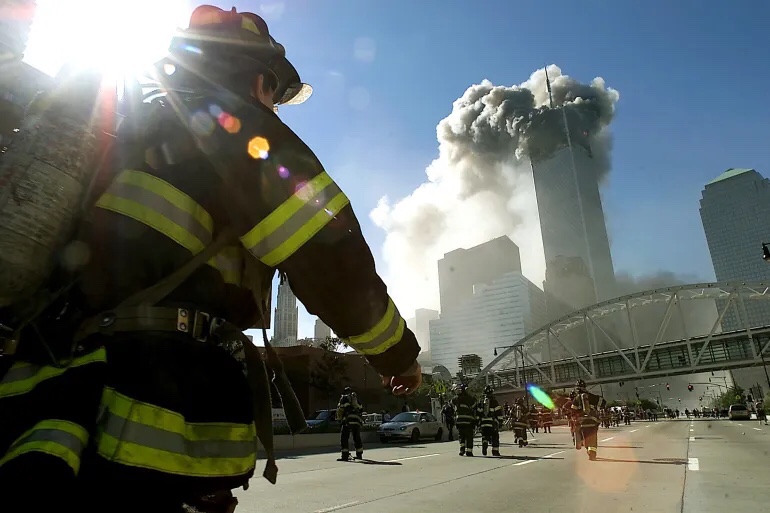
9-11 Terrorist Attacks, September 11, 2001: Unless you’re very, very young, you don’t even have to think about this one; you know where you were. I was in my car, on my way to work, listening to the radio as usual. When the announcement came of the first tower being hit, I thought only of what a horrifying disaster it was, and wondered how it could have happened on such a bright, clear, sunny day. When the second one was hit, the whole world knew it was no accident. I continued on to work, where I heard about the third plane striking the Pentagon, and ran to the window to see the smoke rising from across the Potomac River. And the first word to cross my mind was “war.” I went home shortly afterward, and stayed there for two days, shaken to the core.
All of those earlier events of which I have written here were just practice for this one.
*. *. *
Of course, I have many happy memories too. And the ones that leap immediately to mind are the ones that followed each of these monumental events: memories of the way the people of this incredible country — without any urging or need for encouragement — came together as one, to fight, to survive, and to heal. We got through the worst of times with a renewed spirit of patriotism, of love for our country, and respect for one another.
But why should it take a war, or an assassination, or a terrorist attack to remind us of who we are and what we stand for? There must be a way to keep that spirit alive . . . today, tomorrow, and always.
Just sayin’ . . .
Brendochka
9/12/23
 The Blog About Everything … and Sometimes Nothing