About 45 years ago, when I had grown tired of hearing my kids begging me for a pet, I let them drag me into a pet store thinking I could get away with buying a couple of goldfish in a bowl. But we never made it past the puppies, because there he was: the most beautiful, soulful, brown-and-white fur ball of a Sheltie (Shetland Sheepdog) I had ever laid eyes on. And it was love at first sight. We took him into the little play area, where he wagged his fluffy tail and chased a ball from me to my son to my daughter and back to me, cranking up his cuteness factor to 110% and yipping ecstatically at the thought that we might become his forever family. Only Ebenezer Scrooge could have said no to that face, and he seemed to know it. He came home with us that day; we named him Toby; and no dog was ever loved more.
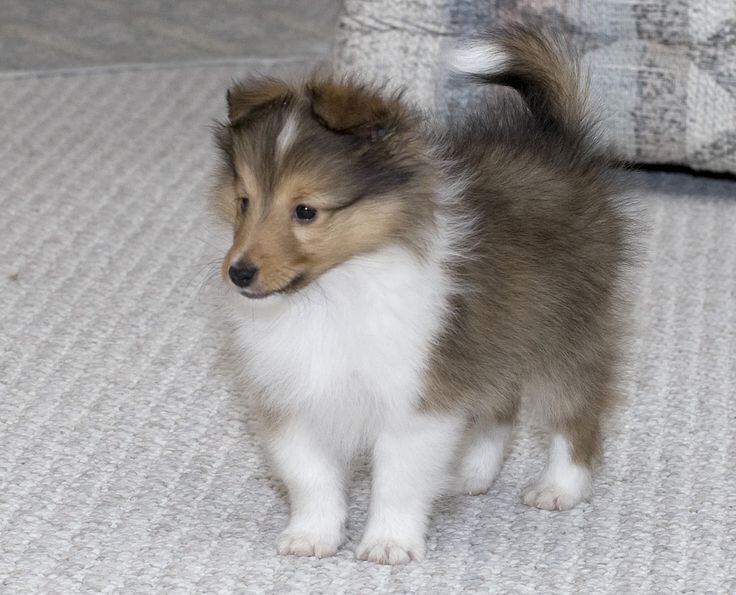
Just four short years later, Toby tragically passed away of pancreatitis — possibly a genetic condition of which the folks at the pet store were unaware, or had failed to inform us. At that point, the reason didn’t matter; we were all heart-broken, and I vowed I would never adopt another animal. I just couldn’t go through that again. And I didn’t.
But my kids made no such pledge, and when my two young animal-whisperers grew up and established their own homes, they immediately adopted dogs and cats and have never been without one (or more) since, despite the pain of the inevitable loss. And three years ago, I moved into a household that already included one dog and one cat. And once more, I was hooked.
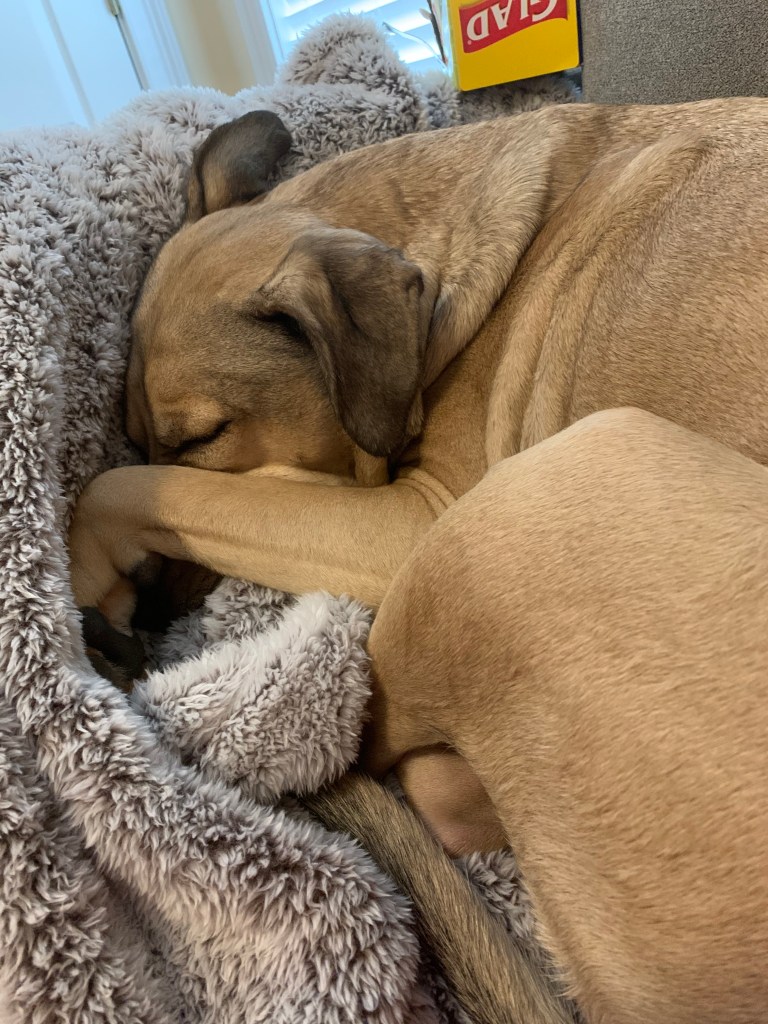
Dixie was a shelter pup — her DNA shows that she is part Staffordshire, part American pit bull, and part Golden Retriever. She has the best qualities of each breed: the protective instincts of the first, the tenacity of the second, and the loving loyalty of the third. She is incredibly smart and mostly obedient, but relentless in her appeals for food or play or scratches. At almost four years of age, she is alternately a big ball of energy — not as inexhaustible as a Border Collie, certainly, but trying hard for second place — and a champion napper, curling up in the most improbable positions.
Our cat, on the other hand, is from a whole different planet. She has no name: she is simply referred to as “Cat” or “Kitty,” because she wouldn’t respond to a name in any event so why bother. She is older — around twelve, we think — and feels that her age and her multi-colored beauty entitle her to be the laziest, most spoiled creature on earth. She has only three demands, but they are absolute and non-negotiable: feed me regularly, pat me occasionally, and keep the damn dog out of my way or I’ll claw her eyes out.
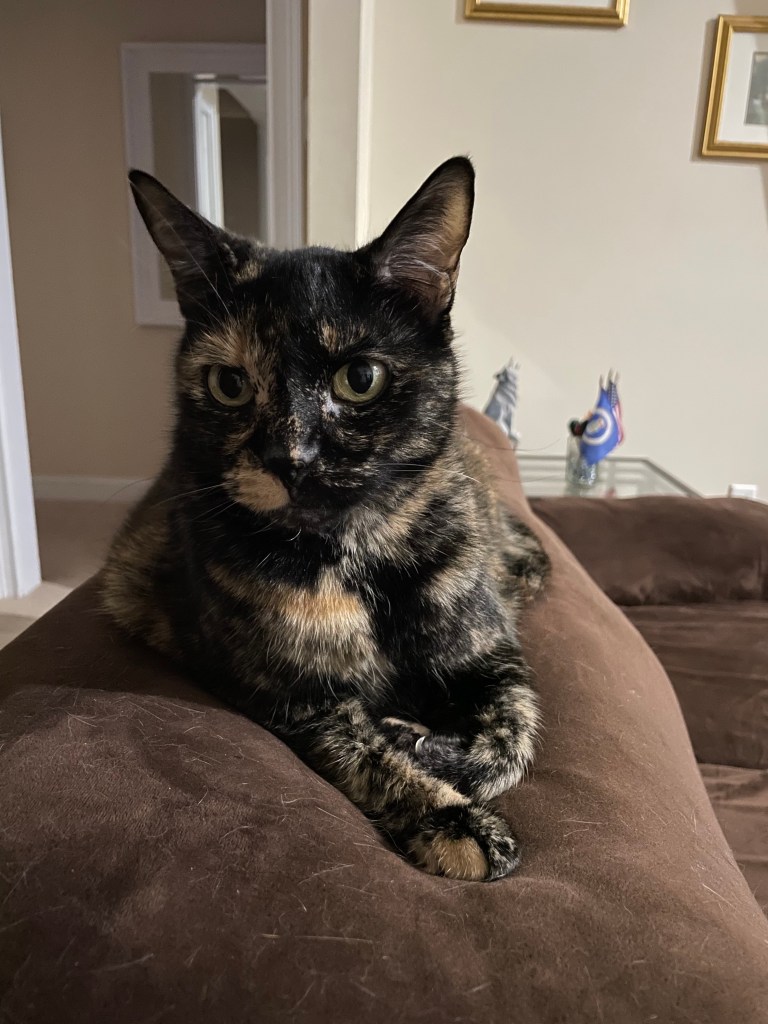
Dixie loves her family unconditionally; Cat allows us to live with her. They could not be more different. Cat is too regal to play with humans, and a rubber mouse or feathers on a stick will only hold her attention for a moment or two. She doesn’t mind a little trip to la-la land, though, from a bit of catnip now and then.
Dixie, on the other hand, is hilariously playful and has a favorite toy: a red, hard rubber, figure-8-shaped thing that is great for throwing, fetching, tugging, or just gnawing. It has no name; it’s just a thing called “Toy,” and she will continue to chase after it or try to pull it away from you for as long as you have the strength and endurance to keep at it. And she always remembers where she left it.
Cat mainly wanders from room to room, seeking out the ideal resting spot. It may be a blotch of sunshine on the floor near a west-facing window, or the top of Daddy’s recliner, or the penthouse level of her kitty condo. And there she will recline, surveying her domain, and frequently preening herself until satisfied that she is the most beautiful creature in the room.
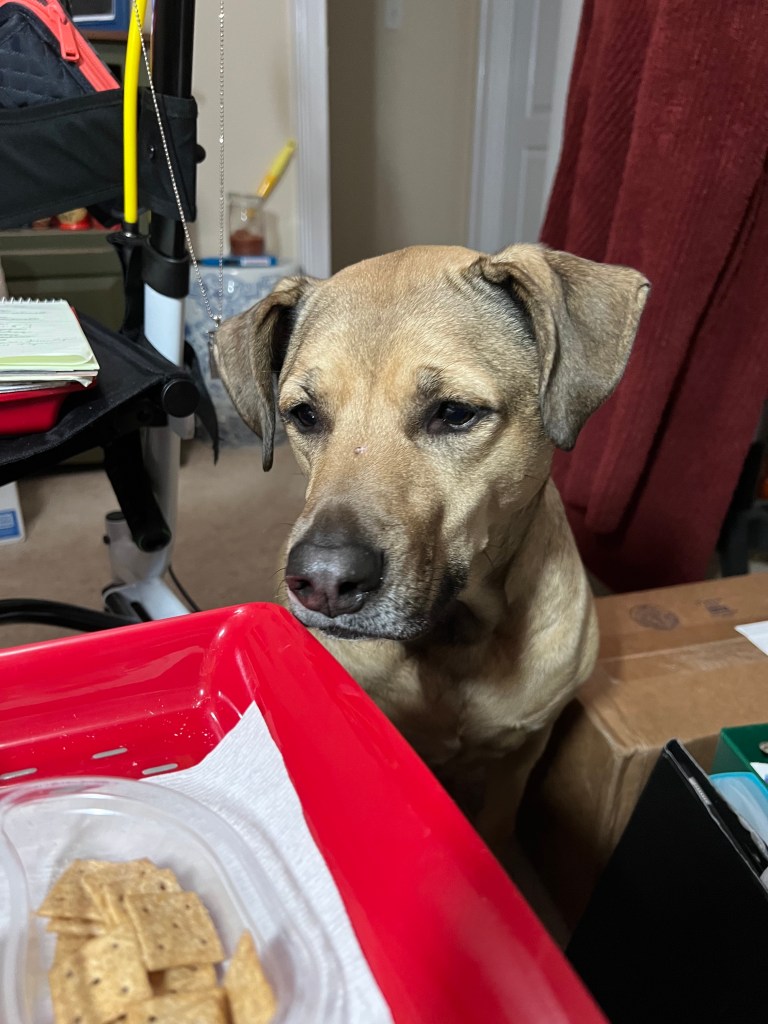
Dixie, on awakening from one of her frequent . . . is it okay to say “cat naps”? . . . will immediately set out in search of human companionship. Preferably a human with food. If she hears the rustle of cellophane, or the snap of a food container lid, she comes bounding into the room, ears up and eyes searching for something edible. If I tell her “no food,” she looks downcast, walks slowly toward the door, and — giving it one last try — turns to look at me hopefully, as though food will somehow, magically, materialize. She would eat anything, and constantly, if she were allowed to.
Cat, of course, nibbles daintily from her little dish in small amounts several times a day, and delicately sips water — sometimes from her own water bowl and sometimes from Dixie’s big bowl — as needed. She scorns most people food, other than fish or butter. Annoyingly perfect little creature!
And when I’m sitting in my den, tapping away at my keyboard as I am at this moment, Dixie will come strolling in, sit by my feet, and stare at me until I look up. If I say “no food” and she still doesn’t walk away, I know what she wants. I then ask her, “Dixie, want a scratch?” and she stands up, waits for me to put aside the iPad and the lap desk, and assumes the position: sitting at attention, her back toward me, head cocked adorably to one side. And then it’s time for therapy . . . for both of us. There is, after all, nothing so satisfying as the feel of a dog enjoying the feel of a human.
Just sayin’ . . .
Brendocha
7/28/23
 The Blog About Everything … and Sometimes Nothing