There’s a complex of buildings on the banks of the Potomac River in Washington, D.C. called The Watergate, built in 1962. Two of those buildings are designated as commercial office space; the remainder consists of some of the most expensive residential condominium housing in the metropolitan Washington area, and for many years was the most favored location of members of Congress, political appointees, and other “inside-the-Beltway” notables.
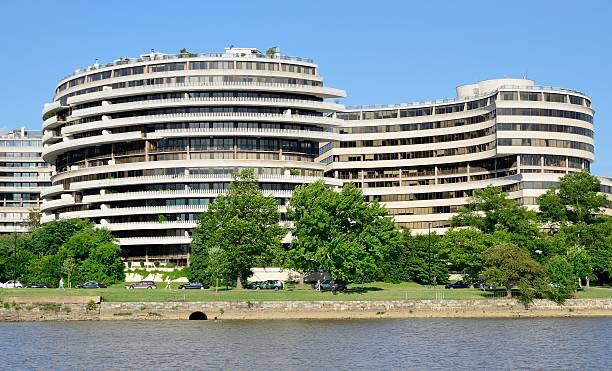
In 1967, the Democratic National Committee (DNC) moved its headquarters into space on the sixth floor of one of those commercial office buildings. And on June 17, 1972, a break-in occurred at those offices that set in motion what was arguably the biggest political scandal of the 20th Century, popularly referred to simply as “Watergate.” It ended the careers of a number of high-level political figures, not the least of whom was the President of the United States, Richard M. Nixon. Conversely, it also was the making of the careers of two young, previously little-known Washington Post reporters: Bob Woodward and Carl Bernstein.
You needn’t have been born before 1972 to be familiar with the Watergate scandal; it remains one of the most written-about, talked-about, analyzed, regurgitated, and debated pieces of 20th-Century American history. And the ghost of that scandal hangs over the White House and its occupants to this day, 50 years after that break-in at DNC headquarters.
To begin with, it led to the passage in 1978 of the Presidential Records Act, clarifying and mandating that all Presidential records are the property of the U.S. Government, not of the President — although word of that has apparently not filtered through to all of the subsequent occupants of the Oval Office, whose names need not be mentioned here.
And virtually every President since Nixon has in one way or another been affected — “haunted,” if you will — by the ghostly memory of Watergate. There was, of course, the Iran-Contra affair during Ronald Reagan’s administration, which engendered its own devastating effect on the entire country while simultaneously dredging up painful reminders of the Watergate scandal a decade earlier. Subsequently, Reagan’s successor, George H.W. Bush, had a difficult time distancing himself from the fact that, in his early political career, he had been a favorite of Nixon’s. And more recently, the many scandals involving Donald Trump, and the similarities that have been drawn between his actions and those of Richard Nixon, are all too familiar to us.
So in one sense, the Watergate complex on the Potomac does have its “ghosts.” But what about the other kind — the ghosts of a paranormal sort? It has long been asserted that there is no shortage of those in Washington, D.C. While cities such as Savannah, Gettysburg and Salem regularly top the lists of the most-haunted U.S. cities, Washington is also known for its large number of specific locations that should be high on any self-respecting ghost-hunter’s bucket list: the “demon cat” in the U.S. Capitol; Abraham Lincoln and others roaming around the White House; the sad young woman in the Octagon House; and the wandering Mr. Lincoln again — and reportedly also John Wilkes Booth — at Ford’s Theater, to name just a few. But I’d like to add one lesser-known location to that list, based on personal experience: the Roosevelt House at 1215 – 19th Street, N.W.
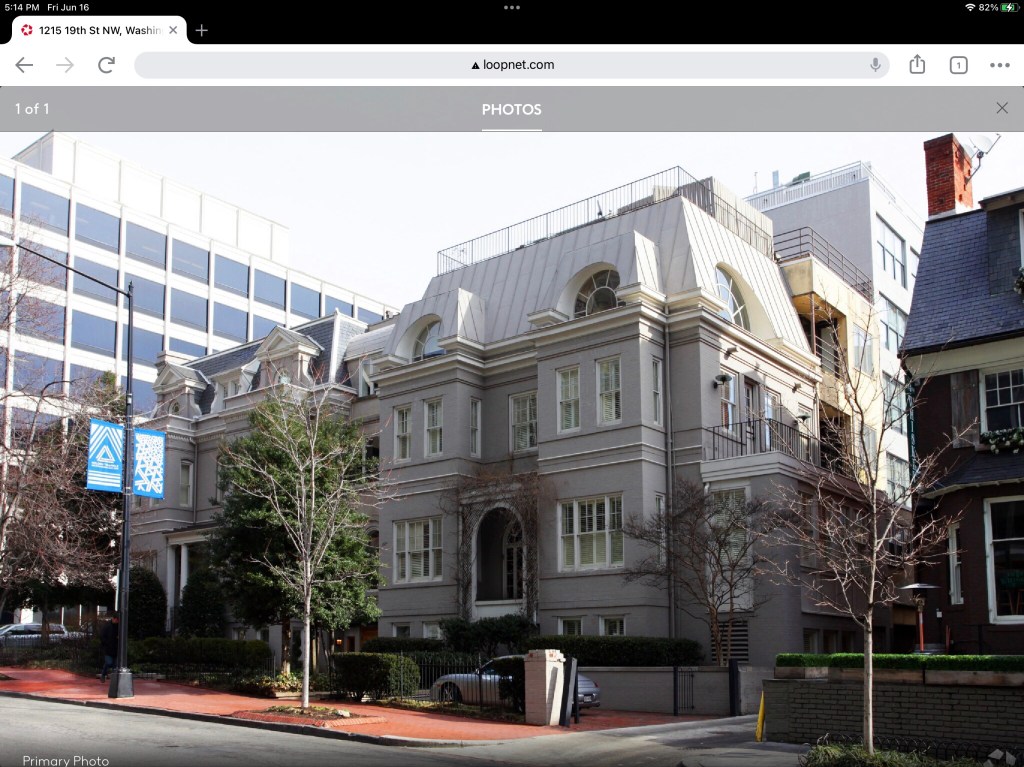
1215 – 19th St., N.W., Washington, D.C.
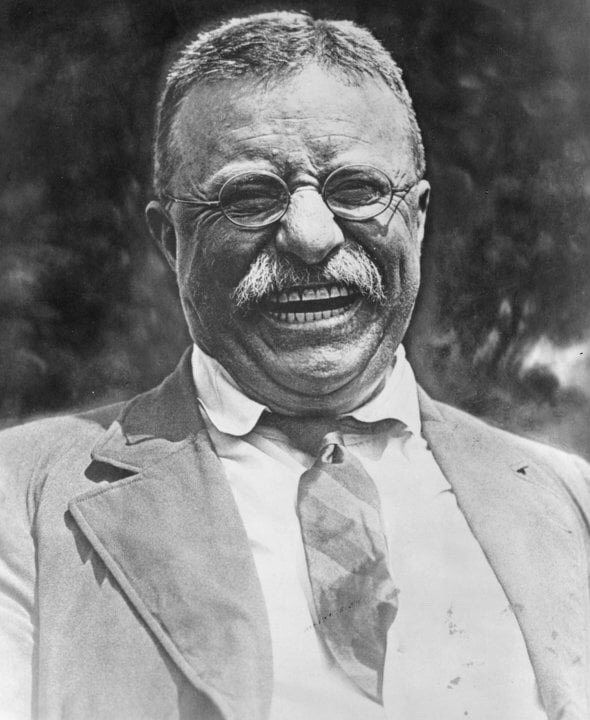
Theodore Roosevelt, Jr. — or Teddy, or T.R., to those of us who came to know him well — was an imposing figure with an exuberant personality and a wide range of interests. He had been a sickly child, but through single-minded hard work and determination he overcame his limitations by forcing himself to adopt a strenuous lifestyle, thus transforming himself into the robust, athletic adult we now recognize. He joined the Rough Riders to fight the Spanish army in Cuba; served as Governor of New York for two years; and became Vice President of the United States under President McKinley for six months until McKinley’s assassination, when he, Roosevelt, succeeded to the Presidency for the remainder of that term, and then was elected to a second full term.
But before all of that, he had served as Assistant Secretary of the Navy, during which time he lived at . . . isn’t it obvious? . . . 1215 – 19th Street, N.W., Washington, D.C. And that is where I came to know him. Or, rather, his spirit. I worked there from 1968 to 1978, when the building was occupied by the law firm of Galiher, Clarke, Martell and Donnelly. And T.R. was still there, mischievous as ever — willing to share his home with the odd assortment of new folks, but determined to let us know he was still in charge.
The interior of the formerly grand residence had been redesigned into four floors of office space, and an elevator was added at the southern side near the internal stairwell. The stairwell itself opened onto each floor, through doors that were kept locked at all times; we had to carry our keys with us, or use the elevator. Visitors entered directly into the ground-floor reception room, and were unable to access the stairway or the elevator unless accompanied. At night, all doors were double-checked to ensure that they were locked, and the elevator also was locked off by the last person to leave for the day.
But T.R. wasn’t hampered by locks and keys. And he loved that elevator, which apparently was like a new toy to him. At random times, with no one aboard, it would simply start up, running up and down and up and down, with no way of stopping it until someone yelled at T.R. to cut it out! The elevator service company would be called, a technician would come out to check the mechanisms, and would invariably declare it to be in perfect working order. Until next time.
T.R. may have loved modern machinery, but he did not feel the same about contemporary music. One evening, a young secretary was working late and was alone in the building. She had personally checked to be sure all of the doors were locked, and had also locked the elevator at her floor. To keep herself company, she had turned on her radio to a rock music station. At one point, she left her desk to go to the copier in another room, and when she returned, the radio had been tuned to a classical music station — FM instead of AM — which would have required the turning of two knobs. Puzzled as to how that was possible, and feeling a little uneasy, she nevertheless changed the station back and returned to work.
A while later, the young lady had to use the rest room, which was on another floor. Taking her keys, she walked up the stairs, did what she had come to do, and walked back down . . . and found her radio once more tuned to the classical music FM station. That was enough for her. She left her work unfinished and fled the building. When she returned to work the next morning, she declared that there would be no more overtime for her unless someone was with her. Several of us tried to reassure her that it was only T.R. being frisky, but she was having none of it.

My own most memorable experience with the former President occurred at Christmastime, on the day of our annual holiday party, which was being held in suburban Maryland. I worked on the second floor with two other women in a large, L-shaped open area, and two attorneys in private offices. Since I lived in Virginia, I had brought my party clothes to work with me so that I wouldn’t have to go home to change before the party. One of the women, a friend of mine named Kathy, lived just a few blocks from the office, but I had offered to drive her to the party and home afterwards, so she had also brought a change of clothes with her. When everyone else had left the building, we double-checked all of the doors and locked the elevator off at our floor. Then she went into one attorney’s office and I went into the other to dress for the evening’s festivities, closing the doors in case someone might return to the office for some reason.
After a few minutes, I heard very distinct, regular, heavy footsteps in the outer area, like someone pacing back and forth on the tiled floor. I called out, “Kathy, is that you?” She shouted back, from the other office:
“What did you say?”
“Is that you walking out there?”
“What are you talking about? I’m over here.”
So who was outside my door? Carefully I opened the door a crack and peered out; the pacing stopped, and no one was there. I went to the elevator and the stairway door, and they were both still locked from the inside. Returning to the attorney’s office, I closed the door and continued changing my clothes. The pacing resumed.
“Kathy, now cut it out!”
“What the hell are you talking about??!!!”
Now dressed, but still needing to fix our hair and makeup, we both came out to the open area, where once again the pacing had stopped. She had not heard a thing. When I told her what I had experienced, Kathy — normally not a skittish person — lost it. She said she was going home and asked me to come with her. But I was fascinated by the phenomenon, and said I would stay, and would pick her up at her apartment in a little while. And with that, she gathered up her things, said she would catch a taxi, and bolted out the door, letting it slam behind her. I was now alone in the building . . . except for the mysterious pacer.
I triple-checked all the locks and headed back into the attorney’s office. But before closing the door all the way, I looked back out into the open area and said, “All right, T.R., it’s your house so you may stay . . . but no peeking.” And as I closed the door behind me . . . you guessed it . . . the slow, steady pacing resumed once more. And when I was ready to leave, and had phoned Kathy to tell her I was on my way, the pacing finally stopped for good. I walked to the exit door, turned around and said to the silent, apparently empty room, “Good night, T.R.”
And since you’re obviously wondering — no, he did not answer. In truth, I’m not sure how I would have reacted if he had. But somehow I knew he was there, and I was sure he was smiling his big toothy grin, happy that at last he would have his house to himself for the rest of the night. He didn’t like it when we stayed late.
*. *. *
I picked Kathy up at her apartment and we went on to enjoy a great party that evening. I never let her live down the fact that she had chickened out — and run out — on me. We laughed about it for many years, but the fact is that that evening made believers out of two hard-core skeptics. And from time to time, to this day when inexplicable things happen, I remind myself that . . .
“There are more things in Heaven and earth, Horatio,
Than are dreamt of in your philosophy.”
— William Shakespeare, Hamlet.
And on that note, I am
Brendochka
6/29/23
 The Blog About Everything … and Sometimes Nothing