If I were asked to pinpoint the true end of the Age of Innocence, I would say it wasn’t the Roaring Twenties of F. Scott Fitzgerald, but the Sobering Sixties of John Fitzgerald Kennedy.
The early ‘60s were a busy time for me. At some point, I decided that I didn’t want to spend the rest of my life working at the same job, or even the same type of job — there was a big world out there, and there must be other opportunities. A client of our law firm ran a small electronics manufacturing company and was looking for someone to manage his office. My entire experience in office management consisted of taking over a few of the tasks of our office manager when she was on vacation each year: handling the payroll, ordering some supplies, and calling maintenance if something broke. But I was ready to learn something brand new, and in the early part of 1962, I said a tearful farewell to the only office family I had ever known, and took my first steps toward a new future.
Why didn’t somebody stop me???!!!!!
Biggest mistake of my life, on two fronts. To begin with, the job itself — compared to the mentally more challenging legal work — was boring, boring, boring. But that would have been easy to remedy; I could simply have quit. The second part wasn’t so simple. One of the industrial engineers was handsome, brilliant and charming, and by August we were married. Stupid, stupid, stupid!
You don’t want to hear the details; and I really don’t want to recite them. Let’s just say that the only things I got out of that marriage were two beautiful children . . . and a divorce. So in 1966 it was back to work in another law firm and onward into the last of the ‘60s as a single mom. It may sound bleak, but it really wasn’t. I was loving my work again, enjoying motherhood, and dating from time to time; life was good just as it was. And the world in the late ‘60s was producing enough fodder to serve as a feast for any student of world history or political junkie such as myself.
*. *. *
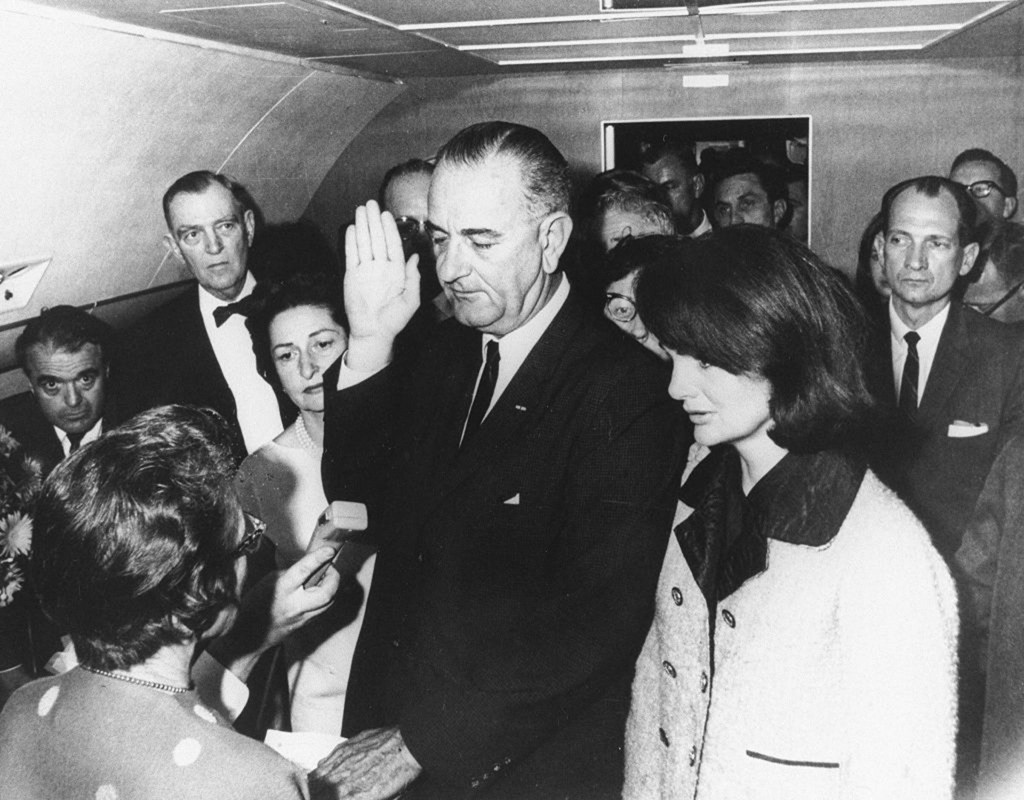
When JFK was assassinated on November 22, 1963, the full weight of the presidency passed immediately and seamlessly to LBJ — Lyndon Baines Johnson — when he took the oath of office in an airplane on the ground in Dallas, Texas, with the widow of the late President Kennedy standing by his side in a pink suit freshly stained with her husband’s blood. A Boston Brahmin had been replaced by a Texas cowboy . . . and the entire character of the White House was transformed once more.
But personal differences aside, Johnson wasted no time jumping into his new role with Texas-sized gusto. During his time in office, from November ‘63 to January ‘69, he created his vision of a “Great Society,” concentrating on advancements in civil rights and desegregation; continuation of his predecessor’s space exploration program; implementation of Medicare and federal aid to education programs; environmental activism; and other by-products of his liberal political leanings. But for every action, we should expect an equal and opposite reaction — right? And we had them, a-plenty!
*. *. *
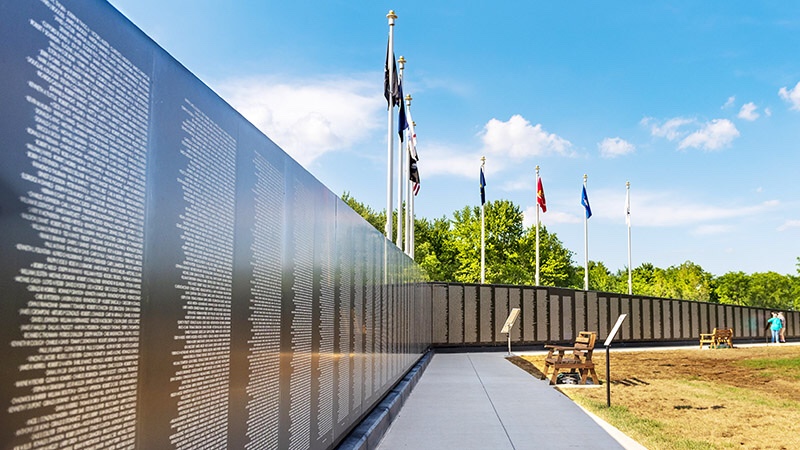
Regardless of your age, I know you’ve heard of a little thing called the war in Vietnam. It began in 1955 and continued to escalate for 20 long years, until the tragic fall of Saigon in 1975. In 1965, during Johnson’s presidency, the U.S. officially entered that conflict for a number of complex reasons, the most palatable of which was the fight against the ever-increasing spread of communism. It was the war that no one really wanted, and it spun off massive protests on university campuses like Yale and Berkeley, and in dozens of major cities in the U.S.
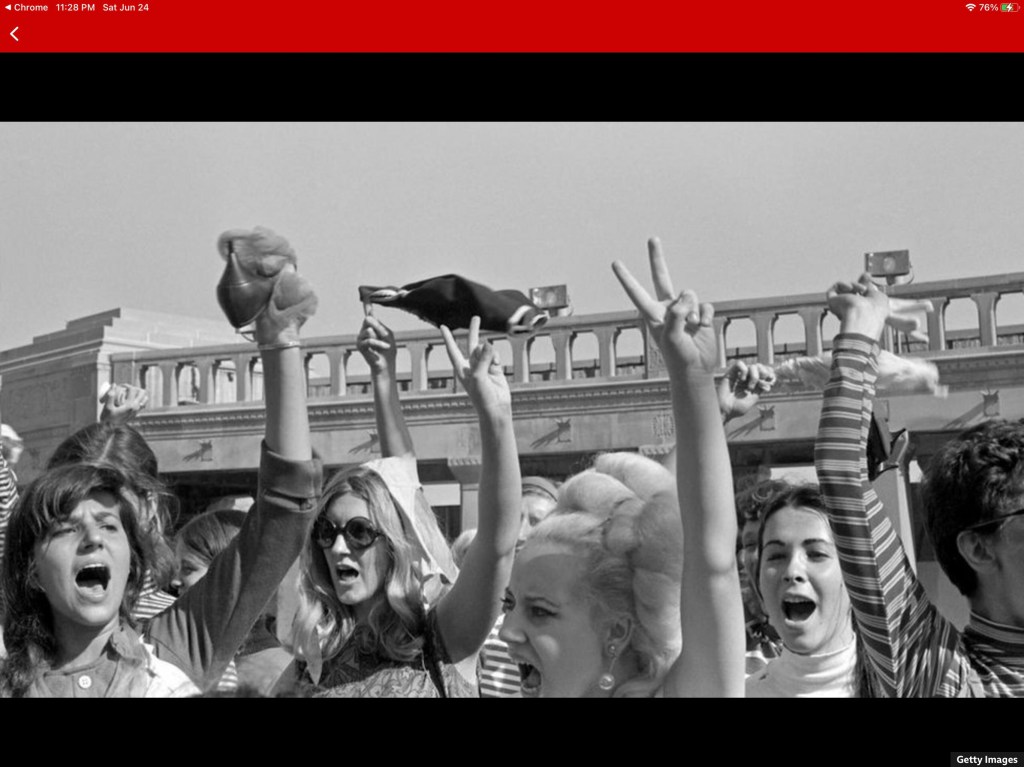
They say it’s an ill wind that blows no one good; and the folk song writers and performers of the ‘60s — such as Barry McGuire (“Eve of Destruction”) and Bob Dylan (“Blowin’ in the Wind”) — profited nicely from that one. The youth of America had found a cause they believed in and began to make themselves heard. Young men burned their draft cards, and many fled to Canada to avoid being called into the war they considered illegal and immoral. And not to be left out of the fun, young women began burning their bras in support of women’s rights — or perhaps simply the right of their bosoms to be truly free. Just an interesting side note.
In 1966, my sister Merna was working for a U.S. research and development company that had a contract with the military to produce technology — I have no idea what kind — in Vietnam. They needed to send a team to Saigon, and Merna quickly volunteered. I had returned home with two babies and a pending divorce, and here was her golden opportunity to escape the resulting chaos. But she knew if she told our mother where she was going, the worry might easily bring about a second heart attack, the first one having occurred just months earlier. So we cooked up a story and told her Merna would be going to Bangkok, which wasn’t a total lie. The team actually would be spending time there first, and while there she could buy up a lifetime supply of postcards and souvenirs, which she then could mail to us from Saigon with an A.P.O. postmark that could have been from anywhere.
I also had to learn to lie to my mother with a straight face, and not to get tripped up by those lies. Merna would write letters addressed to both my mother and me at home, and separate letters to me with the true story of conditions in Saigon, which she would mail to my office address; so I had to remember what she had written in which letters. And my mother did wonder why I had suddenly become so intent on the news broadcasts about the war, which I explained away as being of major worldwide importance and something that she should also be more concerned about.
After about three months, Merna came home for some R&R. But the team was due to return to Saigon in a few weeks, and she decided it was time to confess. And when she did, the reaction from our mother was entirely predictable: she exploded! And exploded again when she found out that I had known the truth all along. Then — declaring that she would never trust either of us again — she proceeded to call all of her friends and brag about her brave daughter. But she never told us how proud she was — we only heard those things second-hand from friends and relatives.
*. *. *
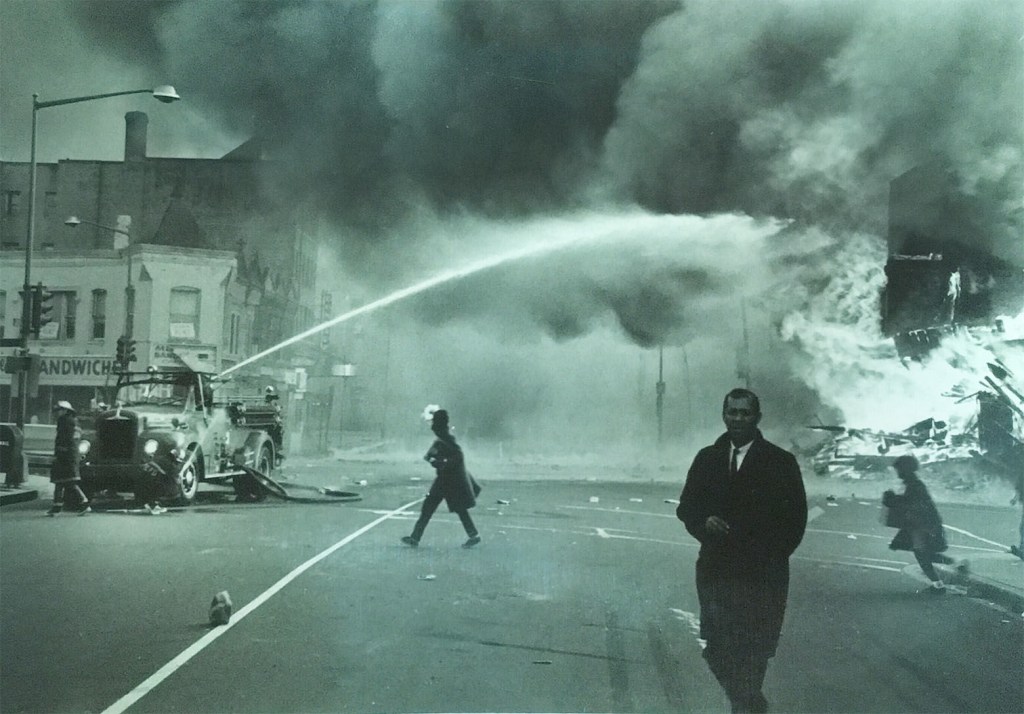
But the war wasn’t our country’s only problem in the ‘60s. Even a cause as nobly-motivated as civil rights is going to have its detractors, and they began coming out of the woodwork. The tension built and built until, on April 4, 1968, the foremost leader of the civil rights movement, Martin Luther King, Jr., was shot to death in Memphis, Tennessee. And the United States began to burn. Aptly-named “race riots” erupted in Chicago, Kansas City, Los Angeles, Baltimore . . . and of course, in Washington, D.C.
I knew a couple at that time who hosted gatherings on Friday evenings for any of their friends who were available — food furnished, bring your own booze. Their apartment was on an upper floor of a high-rise building in close-in Arlington, Virginia, with a beautiful view of D.C. stretching from the Washington Monument to the U.S. Capitol. And on that Friday, April 5, 1968, a group of us sat in their living room staring out of the big picture window at the orange glow from the conflagration that began in the predominantly Black neighborhood known as the “14th Street corridor” and spread east from there. I felt like Scarlett O’Hara watching Atlanta burn, as we all sat helpless, choking back tears.
One of that group of friends arrived late that Friday and explained why he had been detained. He worked at the Veterans Administration Hospital in a not-so-good section of the city, and had to drive home through a neighborhood where some of the spill-over from the riot was taking place. A co-worker of his lived in that neighborhood, and he offered to see her safely home. But when they reached her block, they were unable to get through the crowds to her building. Instead, he dropped her off at the nearby police station, where she would remain safe until she could get to her home. In the meantime, he still had to drive through that crowd, where a group of teenagers suddenly jumped onto his car, rocking it back and forth and trying to turn it over. Terrified for his life, he instinctively hit the gas pedal, sending bodies flying from his car in all directions . . . and he never stopped until he reached Virginia. Then he came to the party; it seemed the only place he wanted to be — with friends.
The next day — a Saturday — I had an unexpected opportunity to see for myself what was going on in the city. We had recently moved to Virginia because it was a better location for my two small children who were approaching school age. My sister had returned safely from Vietnam and had an apartment in Washington, but her long-time hairdresser was in Alexandria, Virginia . . . and she would never, ever miss a Saturday appointment. She didn’t drive, so she took the bus as usual, and expected to be back at her apartment hours ahead of the 7:00 p.m. curfew that had been established for D.C. But while she was in Alexandria, it was announced that the curfew had been moved up to 3:00 p.m., and it was already nearly 2:00.
Now, ordinarily she would simply have spent the night at our place. But that happened to be the week that a friend from California was in town and staying with her, and she couldn’t leave her friend alone all night in the middle of a riot. So, of course, she called me. Could I pick her up at the beauty salon, normally a good 20 minutes away, and get her home — another 20 minutes or so — and get myself back out of D.C. before 3:00? Oh, sure, no problem. Right. But first I’d have to stop for gas because my car was almost on empty — and all the gas stations were also closing early.
So I left my children with my mother, ran out to the car — a cute little Chevy Corvair — and headed for the Beltway. Not the shortest route, but the fastest. And as I drove along, listening to the news reports on the radio, I didn’t realize that I had that baby up to 90 m.p.h. When I noticed it, I did slow down a bit, but not by much. I picked my sister up at the salon, stopped at a nearby gas station, and headed into D.C., where I let her out at her apartment building and watched until she was safely inside. It was 2:45 p.m.; I had 15 minutes to get out of the city.
I was driving down New Hampshire Avenue toward the nearest bridge leading out of D.C. — no more than ten minutes away — when a military convoy approached from the opposite direction and pulled across the road, stopping directly in front of me. I also stopped — not that I had a choice. Several very young soldiers jumped out of their vehicles, carrying bayoneted rifles, and positioned themselves across the roadway. One of them began walking toward my car.
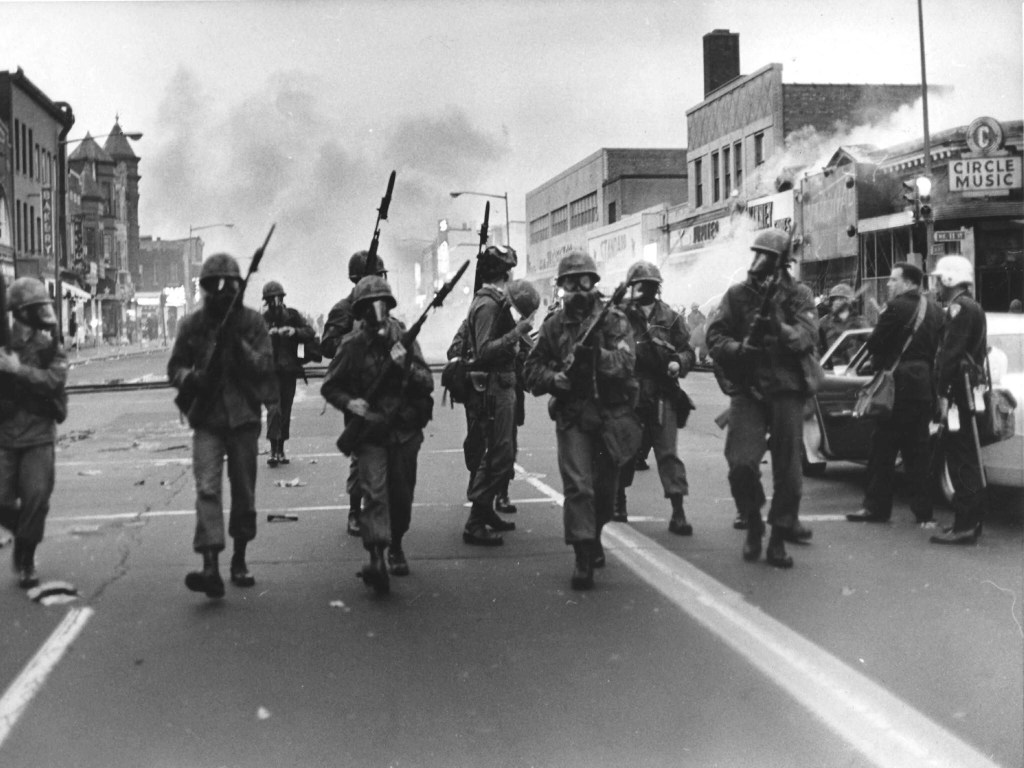
“Excuse me, ma’am, did you know there’s a curfew at 3:00?”
He was so young, and obviously so scared. I explained, very calmly and politely, that yes, I was aware of that, which was why I was trying to get home to Virginia before the curfew. He clearly did not know what to do with me.
By the grace of some higher power, there happened to be an older D.C. police officer standing on the nearby sidewalk, observing our little standoff. He came strolling over and asked me what the problem was. I explained to him that I lived in Virginia and was trying to get out of the city before 3:00. He nodded and smiled, turned to the still-confused soldier, and said, “Listen, son. You’re supposed to stop them from coming into the city, not leaving.” The young man, clearly thrilled to have been relieved of any responsibility in the matter, thanked the police officer . . . and then saluted him. Well, at least his basic training hadn’t been a total waste. Then the soldier signaled to one of the drivers to move his vehicle and let me through, and I was on my way. Somehow, that little Corvair had me back, not just across the bridge into Virginia, but all the way to my apartment by curfew time. She must have sprouted wings and flown home.
*. *. *
As with all things, the riots eventually came to an end. And while Buzz Aldren was preparing for his historic moon landing, and Richard Nixon was settling into his first term in the White House, we found ourselves entering the ‘70s. What could we possibly have to look forward to that could eclipse the excitement of the ‘60s? Time would tell.
TTFN,
Brendochka
6/26/23
 The Blog About Everything … and Sometimes Nothing