“It was the best of times, it was the worst of times . . .”
Oh, sorry — that’s already been done, thanks to Mr. Dickens. But it’s such a great opener, and descriptive of so many periods in history, including the 1960s, that I couldn’t resist borrowing it. And there I was: a young, single woman in Washington, an eyewitness to history in the making. It was indeed the best of times . . . for a while.
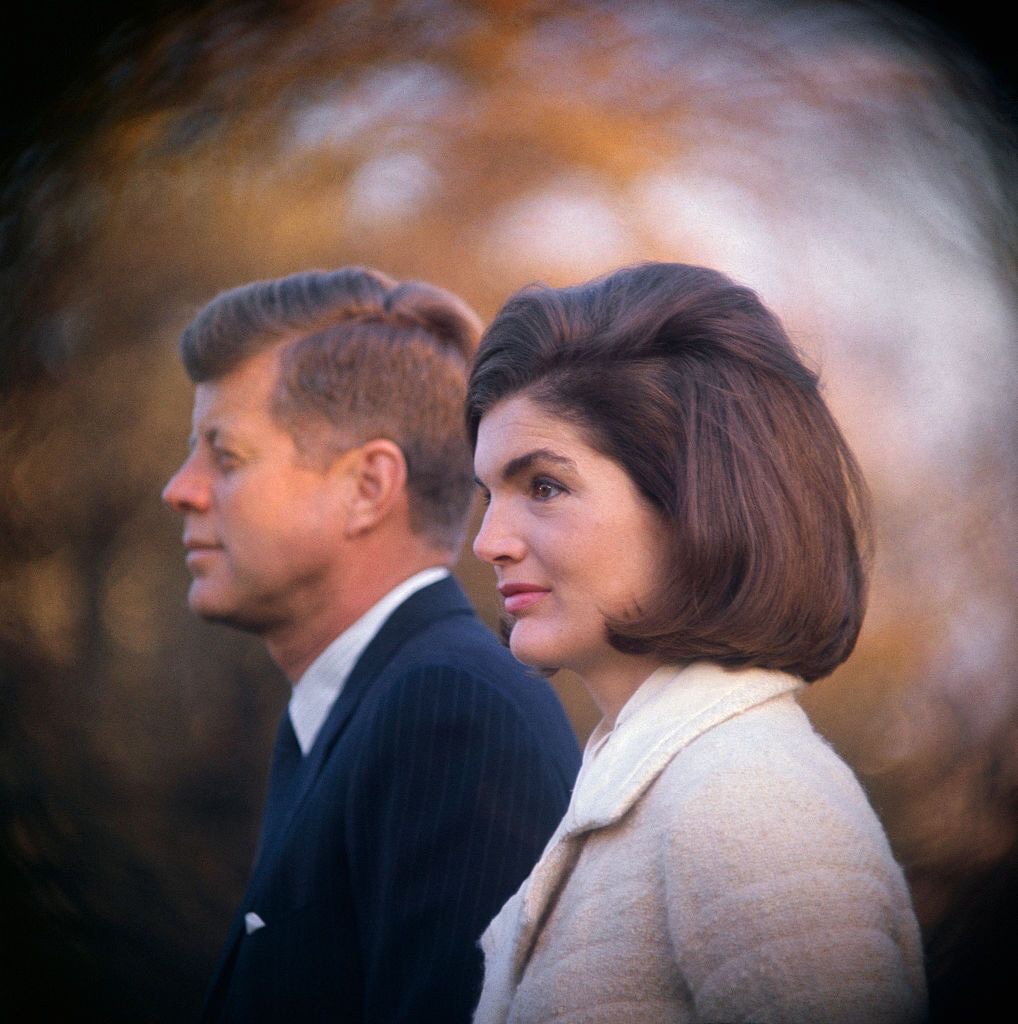
I was on the bus on my way to work one morning shortly before Christmas in 1960, stopped at a red light on Wisconsin Avenue in Georgetown. I happened to look up from my book to glance out the window at an open convertible sitting next to us, which seemed rather odd since it was the middle of December. And there, hatless and smiling in the front passenger seat of the convertible, sat the newly-elected — but not-yet-inaugurated — 35th President of the United States: John Fitzgerald Kennedy. Young, handsome, spirited, full of hope for the future, he exemplified the era in which we were living; and I was staring straight at him, live and in person. How could you not love Washington, where such things were possible?!! Then the light changed, the convertible and my bus moved forward at different speeds, and the moment was broken. But I had seen the new President — the one I had voted for just a month earlier. It was a great day.
In fact, it had been a good year as a whole: a good job, lots of parties, dates, shows, shopping — a typical single girl’s life. Well, except for that one fainting incident . . . It was quite funny, actually. We — still the three of us, mother, sister and self — were now living in a nice eight-story apartment building in an excellent neighborhood known as Glover Park, just north of Georgetown in D.C. On the roof of the building was a sundeck where I enjoyed lounging from time to time. One summer afternoon, I had been suffering from a case of that bane of women everywhere — cramps — and decided the best cure was a shaker of whiskey sours and a little sunshine. So I mixed up my beverage of choice, grabbed a good book and some suntan lotion, and headed for the roof, where I stretched out on a chaise lounge and proceeded to bury myself in the latest John le Carre novel and lose track of time. After a couple of hours, when I finally realized how hot it was up there, I packed up my things and headed back to my air-conditioned apartment.
Of course, I was damp with sweat and suntan lotion, so I went directly to the bathroom for a nice cooling shower. As I stepped out of the shower a few minutes later, I began to feel dizzy and nauseous, so I put on my cotton robe and made a beeline for my bedroom to lie down. But I never made it to the bedroom. I did lie down, though — hard. Passed out cold, hitting the hardwood floor chin-first and splitting it (my chin, not the floor) wide open.
Now, as it happened, my sister Merna and I had had one of our classic arguments that morning and weren’t currently on speaking terms. When I took my swan dive into the hardwood, she was downstairs in the laundry room. My mother was in the living room with a friend, who happened to be legally blind and was therefore of no use whatsoever in an emergency. When my mother heard me crash, she came running. I regained consciousness after just a minute or so, and found her kneeling next to me, rocking back and forth on her heels and wailing, “Oh, my God! Oh, my God! She’s got a hole in her chin! Oh, my God!” How that woman ever managed to raise two children is still beyond my comprehension.
Just then Merna returned, took in the sight of her passed-out sister and her freaked-out mother and the blind lady in the living room calling out “What’s happening? What’s happening?” and, forgetting about our earlier tiff, instantly dove into action. She put a pillow under my head, got a cold compress for my chin, and called for an ambulance. And off we went to the Emergency Room at Georgetown Hospital, where I was given a tetanus shot and a local anesthetic, stitched up, and sent on my way, by now feeling just fine.
But how to get home? I was barefoot and wearing a light cotton robe over . . . well . . . nothing. So we called for a taxi, and when we walked into the lobby of our building — where a few people were still buzzing around the desk trying to find out who had been taken out in the ambulance — I held my head high, pointed to the big white dressing on my chin, and said, “You should see the other guy,” as I sashayed toward the elevator leaving them still wondering why I was barefoot and barely covered. I might have a scar on my chin for the rest of my life; but I saw no reason to sacrifice my dignity . . . or my sense of humor.

But enough about me. Washington in the ‘60s was a visually wondrous place: a city of monuments, museums, restored Colonial townhomes, mansions, parks, tree-lined streets, and wide avenues. And it still is.
But about those avenues . . .
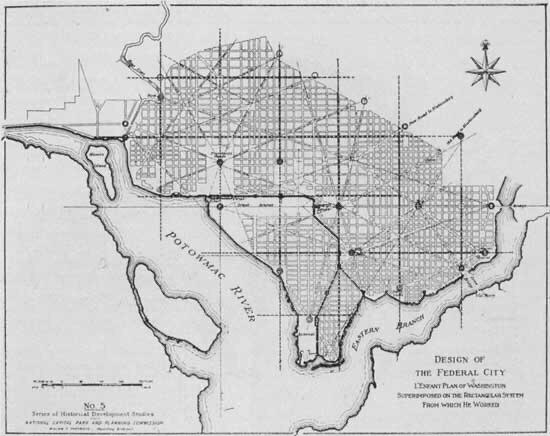
When French engineer Pierre Charles L’Enfant created the plan for the layout of the City of Washington, he designed the streets in a grid pattern, with north-south streets being numbered and east-west streets named alphabetically. So far, so good. But then he criss-crossed those squares with diagonal avenues, and further added circles where all of those streets and avenues intersected, thus creating spaces for his vision of park-like areas for the enjoyment of the city’s residents. Sounds lovely, doesn’t it? Sort of a miniature Paris. But Monsieur L’Enfant could not, in the late 18th Century, have foreseen the invention of the motor vehicle, or the volume of 20th Century traffic that would follow.
And I haven’t yet mentioned the fact that he divided the city into four quadrants: Northwest, Northeast, Southwest, Southeast, each with its own grid of numbered and lettered streets . . . and its share of those diagonal avenues. So that the same address can appear in four different parts of the city, and when giving someone an address, you have to remember to specify which quadrant you’re talking about. So there might be, for example, a 300 K Street, N.W., N.E., S.W. and S.E. The eastern and western halves of the city are divided by the U.S. Capitol Building complex, as are the northern and southern halves; so to the east of the Capitol are First Street, N.E. and First Street, S.E.; to the north are “A” Street, N.E. and “A” Street, N.W.; to the west of the Capitol . . . Oh, what the hell! Just look at a map.
And lest I forget: some of the longer of those avenues — which, by the way, are named after the 50 U.S. states — extend from one quadrant into another, such as Pennsylvania Avenue, N.W. and Pennsylvania Avenue, S.E., which just seems to skip right over the Capitol along the way. Now, add to all of this confusion the amount of rush-hour traffic on a normal weekday, and what have you got? I’ll tell you what you’ve got . . . you’ve got
TOTAL FREAKIN’ CHAOS!!!
The invention of the traffic light was supposed to have mitigated the problem of the circles, and in most cases it did. But there are exceptions, due in large part to the fact that the D.C. Department of Transportation (DDOT ) is solely comprised of human beings — who by their very nature are fallible, and sometimes apparently also a little bit crazy. My favorite example is the light located where northbound 23rd Street, N.W. is stopped short by Washington Circle, N.W., which is also the meeting place of K Street, N.W., New Hampshire Avenue, N.W., and the infamous Pennsylvania Avenue — also N.W. at this point. That particular light mostly stays red for 23rd Street, and only turns to a flashing green right-turn arrow when — now here’s the fun part — the traffic on the circle, which always has the right of way, also has a green light at that point; so the 23rd Street traffic is trying to feed into the onrush of cars from the left, while at the same time trying to ease into the proper lane for their right turns onto Pennsylvania Avenue, or K Street, or New Hampshire Avenue, or the other half of 23rd Street northbound, or all the way around to the other side of K Street, or 23rd Street southbound, or . . .
Whew! Get my point?
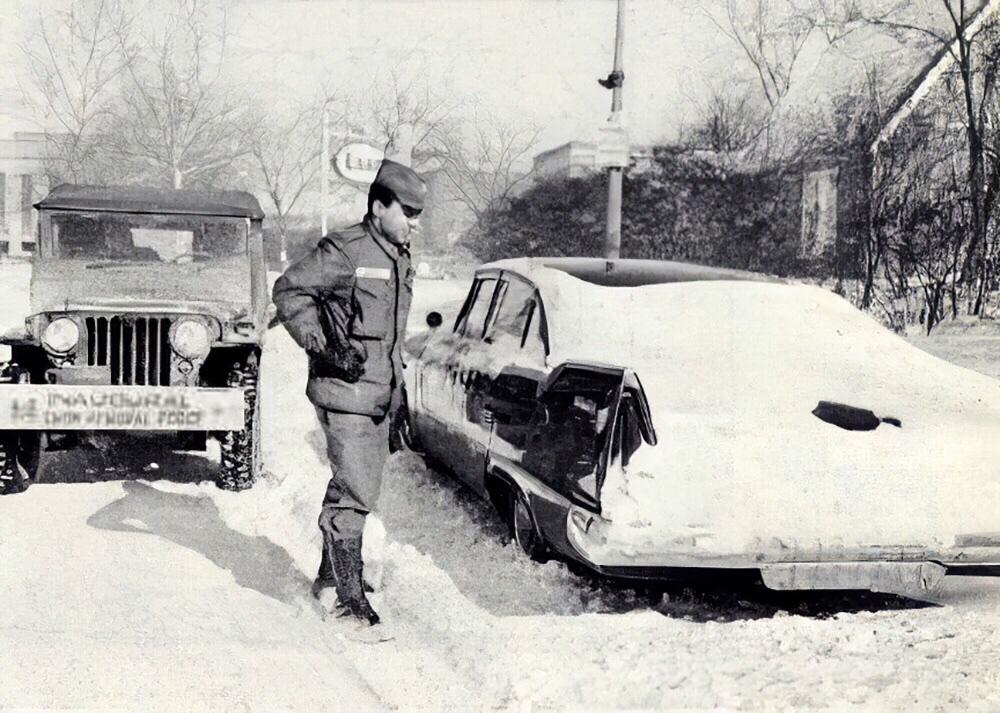
But wait — I’m not finished. Take that mental image of the city streets as a whole, and superimpose on it a snow storm — not a little storm, but a nor’easter of biblical proportions. And have that storm hit the city on January 19, 1961 — the day before the scheduled Inauguration of John F. Kennedy, when half of the political, social, industrial, and financial elite of America are set to converge upon the city en masse to attend that inaugural event and the formal balls and parties that go with it. Now picture people trying to get home from work in that mess, with thousands — literally, thousands — of them having to abandon their cars when they couldn’t make it up an icy hill, or had managed to slide into a telephone pole, or each other. Can you say “total gridlock”? I can — because I was stuck in it, along with those thousands of others.
The usual ride from my office to my apartment building was about 15 to 20 minutes. My boss — my very first boss, Alvin — lived in the same direction but a little farther out, and my mother’s office was just a block from ours. So when the snow started to pile up, he offered to drive both of us home. We could have walked faster — and I actually knew someone in our apartment building who did. We left the parking garage around 5:00 p.m. By 8:00 p.m., we had made it roughly halfway home and were sitting at a dead stop in a lovely residential area (in the Northwest quadrant, if you’re interested), when Alvin suddenly realized that we were just around the corner from the home of some friends of his. Never one to be hindered by rules, he pulled out of the line of traffic onto the wrong side of the road where there were no cars, drove up the street and around the next corner and into his friends’ freshly cleared driveway. There were no cell phones in those days, so we couldn’t call ahead; instead, we simply rang the doorbell and invited ourselves in, where we spent a very pleasant couple of hours eating, drinking, laughing, and using the facilities, not necessarily in that order. When the traffic had finally cleared, we headed home, arriving around 10:30 p.m. — just 5-1/2 hours after we’d started out. And we were among the lucky ones.
*. *. *
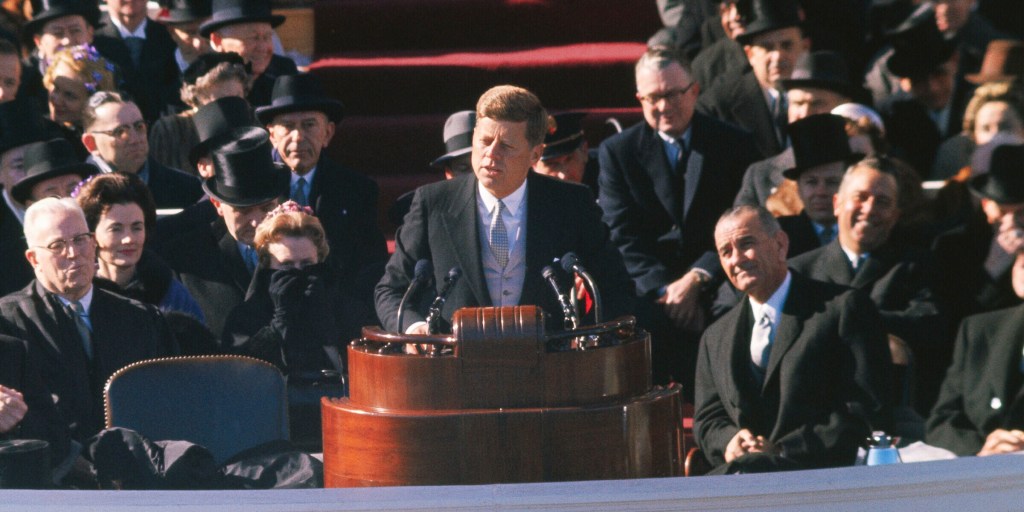
As for the Inauguration, it took 1,000 D.C. employees, together with a contingent from the U.S. Army Corps of Engineers, working through the night to clear the inaugural parade route — first having towed more than 1,400 abandoned cars. But the job had to be done in order for the Constitutionally-mandated passing of the proverbial torch to take place as scheduled on the morning of January 20th, when John Fitzgerald Kennedy — the youngest person ever to have been elected to the Presidency of the United States, and the first Catholic in that office — did famously swear that oath . . . standing, once again hatless, outside the U.S. Capitol on that bitter cold January day. God bless America!
And thus began three years of exhilarating highs and demoralizing lows: the continuing fight for equal rights; the space race; the Bay of Pigs disaster; the Cuban Missile Crisis when Nikita Khrushchev finally “blinked”; Jackie Kennedy’s pillbox hats; little Caroline and John-John playing at their father’s feet in the Oval Office; a brother who became Attorney General and stood up to organized crime; a brother-in-law who founded the Peace Corps; Marilyn Monroe singing “Happy birthday, Mister President” in the White House (I’m still not sure whether that was a high or a low); a wall going up across Berlin . . .
*. *. *
And, on November 22, 1963, the assassination that brought an end to Camelot.
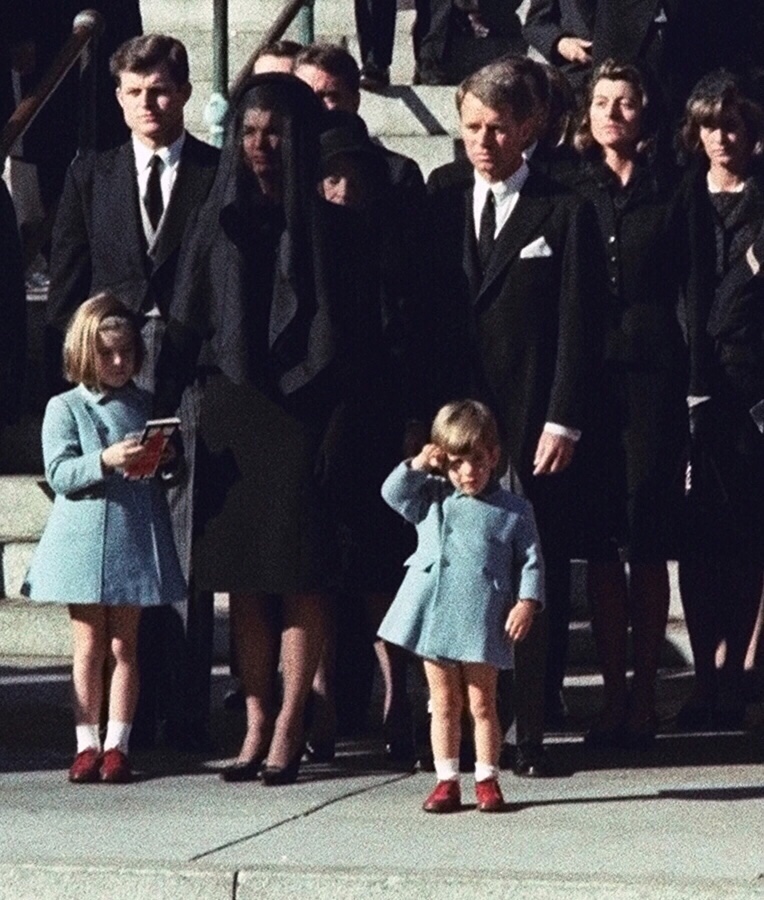
And for a moment the world joined hands, and wept . . .
Brendochka
6/22/23
 The Blog About Everything … and Sometimes Nothing