Do you remember when every car trip, no matter how short, was an adventure? Just the fifteen miles from our house in Woonsocket to my other grandparents’ house in Providence seemed like an endless journey. My sister and I snuggled into our respective corners of the back seat (I was always on the right side, she on the left, with a DMZ in the middle), and played counting games: who could count the most gas stations or BurmaShave signs or whatever on her side of the road. And in December, on the way home after dark, we counted lighted Christmas trees, both indoors and out, and argued over whether wreaths were included.
When we made the move to be nearer my father’s brothers and sisters in Manchester, New Hampshire — a full eighty-seven miles away! — it felt like we were crossing the entire country. Of course, there was no I-495 interstate then, so it wasn’t the quick trip it is today. But it was better, because we got to go through all the little towns along the way and count the houses with red shutters, or the schools . . . or whatever.
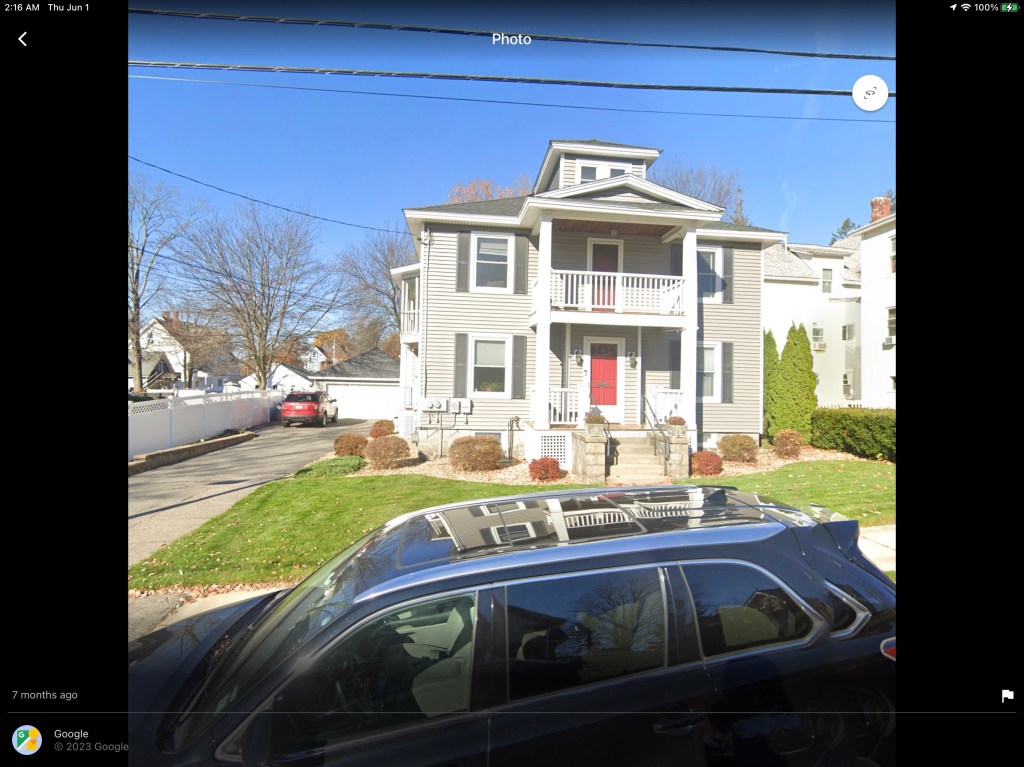
The house my father had rented for us was cute but tiny, and we didn’t stay there long before finding the perfect place and settling in. And here it still is, looking the same except for the paint color and the landscaping — and the SUV in front (bad timing, Google Maps). There were no SUVs in 1948; we had a dark blue Chevy, our first new car since the War. It was bullet-shaped and beautiful, with a manual transmission and windows that had to be rolled down by hand, and a cigarette lighter where now we have cell phone chargers. It was perfect, except for the infernal cigarette thing.
The summer was mostly spent making a few friends in the new neighborhood, and — miracle of miracles! — getting my first bicycle: a red Columbia two-wheeler with a bell and a basket. Soon I was tearing around the neighborhood and investigating the hot spots, such as they were. My favorite was Chris and Harry’s — the little neighborhood market, where the owners would let me hang out and read the comic books for free because I always snacked on ice cream (coffee, with chocolate sprinkles), candy, or potato chips and a Coke while I was reading, so they actually made more money than they would have if I had just bought the comic books. Years later, when I went back with my own son and daughter to visit, Chris was still there and he remembered me: I was “the smart-mouthed kid who always got straight A’s.” What a reputation! He also remembered my family, and who all of my best friends had been. You have to love a small town.

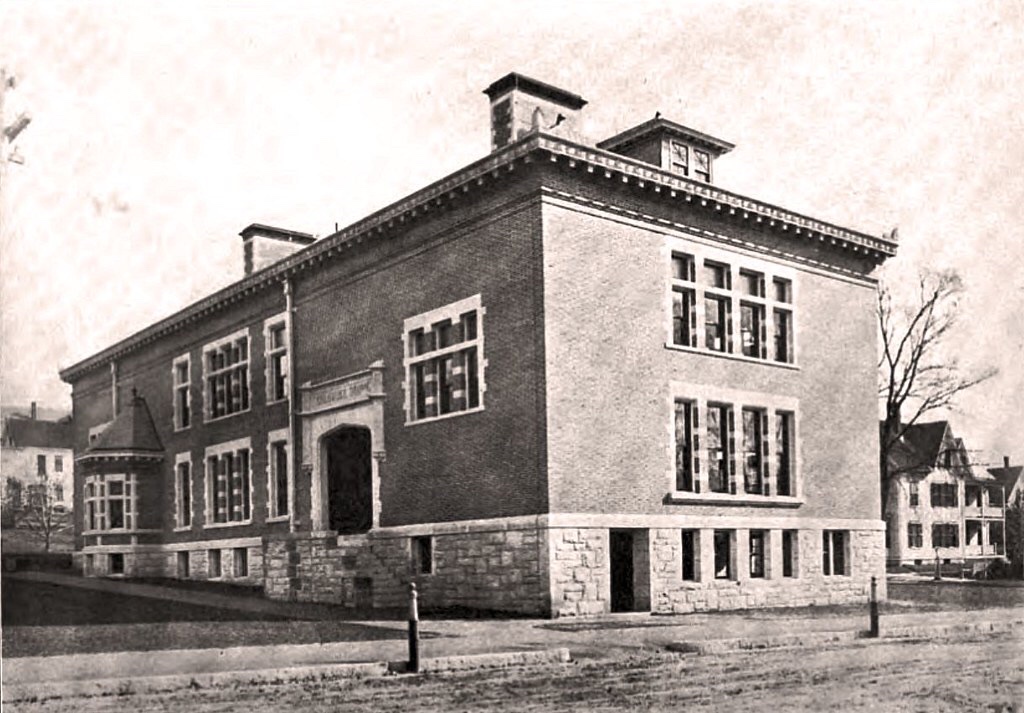
I don’t remember being nervous about moving to a new city, a new school, and all new friends. I was just nine, and it was exciting. And in September, I was enrolled as a sixth-grade student at Chandler Elementary School, just two and a half blocks down the street from our house. The New Hampshire schools had eight grades of elementary school (nine, counting kindergarten) and four of high school — no middle school at all — so while my sixth-grade classmates were only eleven or twelve years old, I was also side-by-side with upper-classmen as old as fourteen. And I hadn’t gotten much taller over the summer. But so what? I just stood as straight and tall as I could and marched right into the fray. Of course, we didn’t tolerate bullying in those days . . . so school was better then.
There was a bit of a glitch that first day, when the principal told my mother she thought a nine-year-old didn’t belong in the sixth grade with the older kids, and that the more advanced courses might also present a problem. But you didn’t mess with my mother when it came to her daughters — she was prepared. Remember that fifth-grade report card with all the “A’s” and the single “B” with the circle around it? She whipped that out of her purse, along with the official document showing that I had been promoted to sixth grade, and asked what possible benefit there could be in having me repeat a grade I had already aced. The principal finally conceded and said we’d give it a try, but no promises.
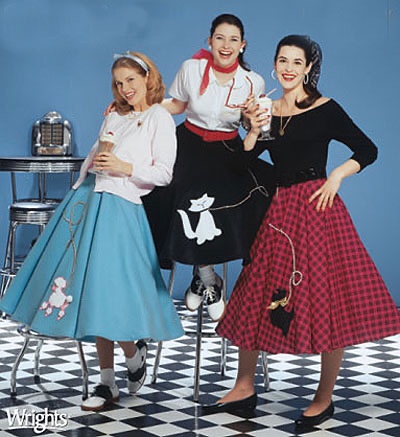
Long story short: I stayed with my class — the youngest, the shortest, but perfectly assimilated; in fact, I had even managed to be accepted into the “in” crowd. Not the pot-smoking, sex-crazed teenagers of the later part of the century, but the clean-cut, fun-loving, poodle-skirt-wearing, jitterbugging kids of the early 1950s.
We hung out at each other’s houses, went to the movies at the Palace every Saturday, and joined the YWCA (the boys were at the YMCA), where we had swimming lessons, craft classes, monthly co-ed dances, and put on shows where I first learned that I loved playing the comic roles. And we all walked home together after the dances at night, because there was no reason not to. It was safer then.
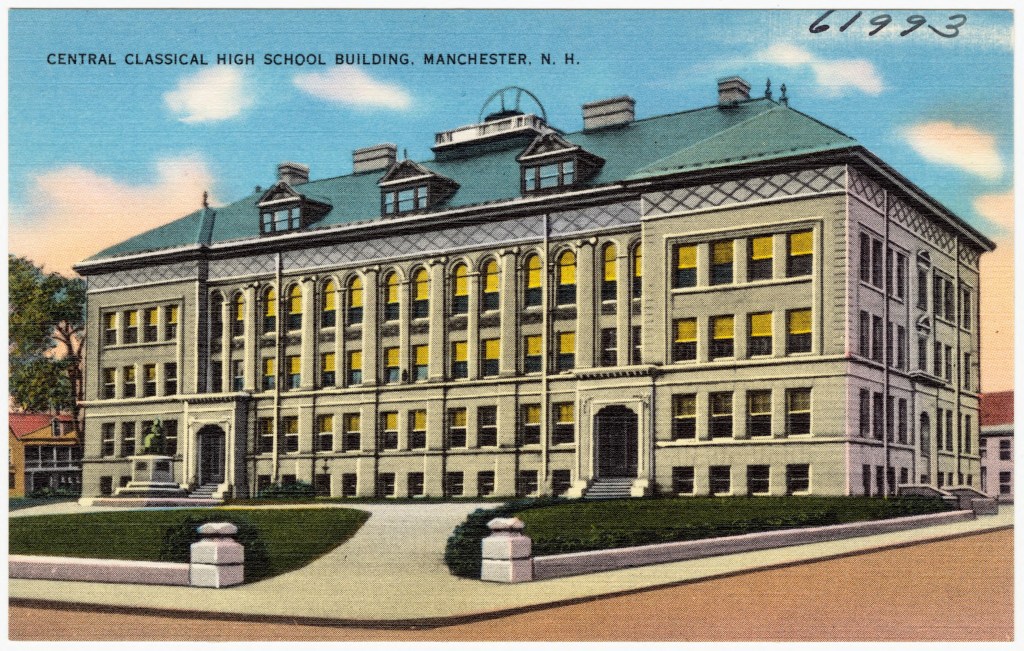
And all too soon, we graduated. Most of us went on to Central High, though a few enrolled at St. Anselm’s, the Catholic high school on the other side of town. And we took different courses, and we lost touch. I still remember them all, though: Sandy (no, not John Travolta’s “Sandy”), Patty, Mary Alice, Diana and Shirley, and the boys, David G., David H., Terry, Robert and Bobby. But I made new high school friends, and three of us — Marlene, Carolyn and I — have remained close over all these years, though we live in different parts of the country now.
*. *. *
My sister had graduated from Central High just three months before I entered as a freshman. She had an outstanding reputation among the faculty members: straight-A student (that old family requirement), active in a couple of clubs, worked in the school library . . . and pretty much an all-around teacher’s pet, or “brown-nose.” And I wasted no time ripping her hard-earned reputation to shreds.
I met my new BFFs in English class, first period, first day of high school. Marlene and Carolyn had gone to a different elementary school than I had, and were already friends. I’m not sure why they particularly noticed me . . . oh, wait — yes, I do! It seems my dear sister, Merna, had been in the same English class, and had made her mark as one of the teacher’s favorites. So as Miss Hoben was taking the roll and came to my name, she recognized the last name and exclaimed, for all the world to hear, “Not Merna’s sister??!!!” I nodded a silent “yes.”
Teacher: “No!”
Me: “Yes.”
Teacher (louder): “No!”
Me (quieter): “Yes.”
Teacher (even louder): “NO!!”
Me (losing patience now): “Yesssss!”
I was doomed. But Marlene and Carolyn were curious, and after class they asked me what that had been about. So I told them, and made it quite clear that I was nothing like my big sister. After that, we were inseparable: the fearsome threesome, who also had another memorable class together later in the day: General Science.
Mr. Tate, our science teacher, was a quiet, serious, professorial type, easily taken advantage of. As a newly-formed triumvirate, we of course chose seats next to each other, about three rows from the front: Marlene on the left, Carolyn on the right, and yours truly dead center, where I could do the most damage, and also be the one to pass the notes back and forth.
Now, I love Marlene dearly. She’s kind, fun-loving, decent, and smart. But, let’s face it — we all have our weak points, and science was hers. So when Mr. Tate would finish explaining a process or a concept to the class, and asked if anyone had any questions, invariably Marlene’s hand would be the first one in the air. He would then ask what part she didn’t understand, and she would usually reply, “All of it.” The poor man would then begin again at the beginning, pausing periodically to ask whether she understood that part, and she would always reply, “Yes.” So he would go on, item by item, until he reached the end. Then: “Do you understand now?”
And here’s where it got to be interesting. Marlene — who, I swear to you, was not being intentionally funny — would reply, “Well, not quite.” And he never learned. The next question, of course, was, “Well, what part don’t you understand?” And her answer? Anybody? Now, let’s not always see the same hands.
“All of it.” (Collective “groan” from the class.) Poor Mr. Tate.
That science class was on the ground level of the older of the two buildings that comprised Central High at that time, and of course was not air-conditioned. There were also no screens on the windows, and one warm spring day, a pigeon dropped by to see what was going on. Mr. Tate’s favorite seat was a stool located at the end of his lab bench, and as he sat there on that mild afternoon, our winged visitor perched at the end of the bench, made itself comfortable, cocked its head to one side, and stared that teacher dead in the eye. Neither moved for fully a minute as Mr. Tate also tilted his head and met that pigeon’s gaze. No one in the class made a sound . . . until I couldn’t stand it any longer. Unable to resist, I broke the silence:
“Birds of a feather . . .”
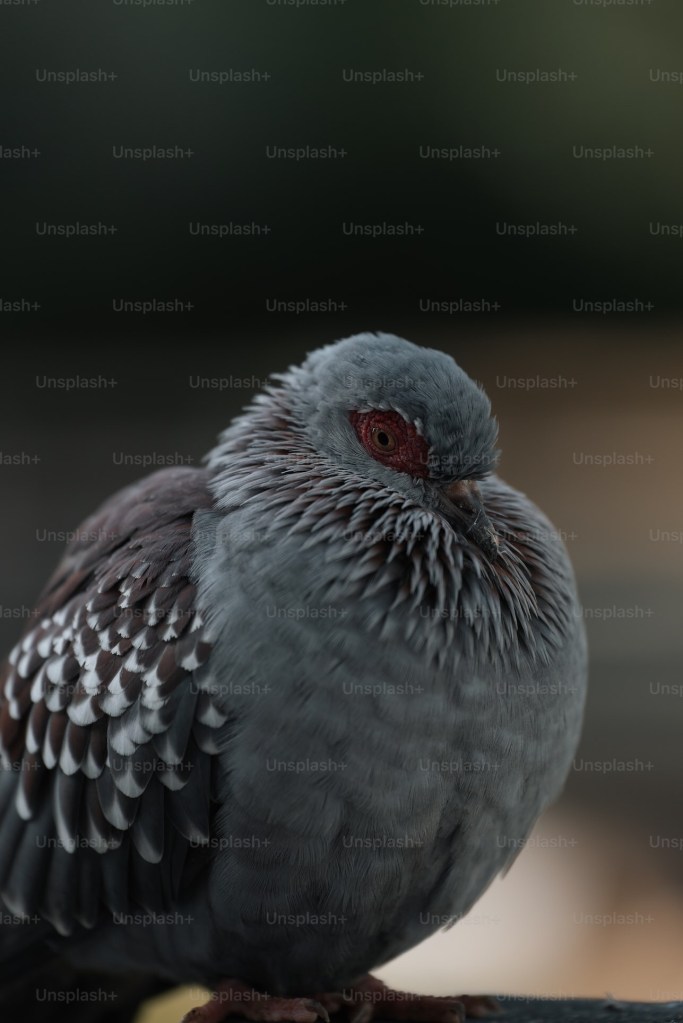
The resulting roar of laughter from the class scared the poop out of that poor pigeon — literally. Thus having relieved itself, it somehow then found its way back out the window as Mr. Tate was left to clean up the mess. For whatever reason, I was never reprimanded; I guess he had a sense of humor after all. And I still got my “A” for the semester, which was a very good thing because it would have been really difficult to explain to my mother that I’d gotten a “B” because of a peripatetic pigeon.
*. *. *
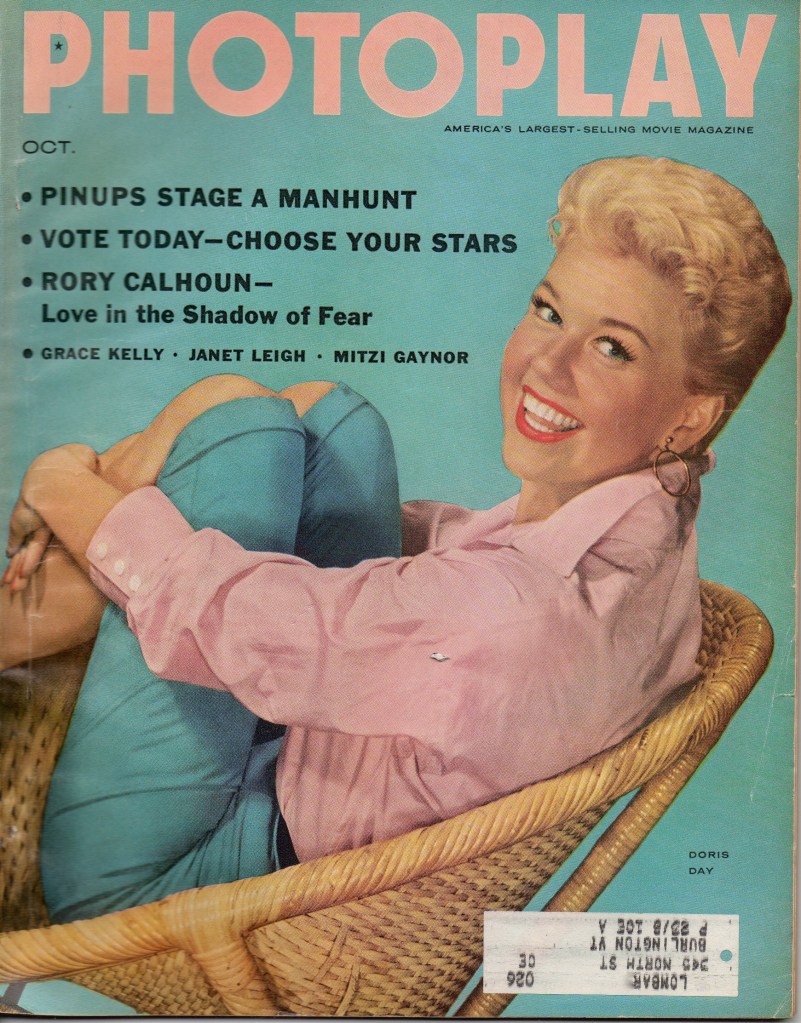
We regularly ate lunch in a booth at Marshall’s Drug Store around the corner from the school, pored over movie magazines like Photoplay and Modern Screen, collected a very young Tony Bennett’s recordings, and swooned over Marlon Brando and Kirk Douglas. We were the teens of the ‘50s, loving life.
And the school year passed all too quickly. Because that summer, my parents separated and my world fell completely apart.
Before I knew what had hit me, we were packing up — my mother, my sister and I — and moving to Washington, D.C., where my mother’s younger brother and his family lived and could help us find a new life . . . and, most importantly, jobs for my mother and sister. On July 3, 1952, we made the long train ride into the unknown, leaving behind the home, the school and the friends I loved. I was no longer that nine-year-old heading into a new adventure four years earlier; I was 13 now, and I was grief-stricken.
I sometimes wonder what my life would have been like if we had stayed in New Hampshire. On the one hand, I look at the good, more conventional lives my friends from Manchester have had, and there’s much to envy. But on the other hand — although I could not have foreseen it — Washington had a different set of opportunities and temptations and complications waiting for me when we stepped off that train . . . and into the hottest, steamiest, muggiest, most unbearable summer Washington had experienced in years. What the hell had we done??!!! Only time would tell.
To be continued . . .
Brendochka
6/15/23
 The Blog About Everything … and Sometimes Nothing