Ted Kaczynski – infamously known as the Unabomber — died in prison this week at the age of 81, apparently at a time and in a manner of his own choosing. Diabolically brilliant, he seems to have found a way to commit suicide in prison. He had spent the last 27 years paying for the lives he had destroyed — three killed and 23 others seriously injured — between the years of 1978-‘95. He will not be missed.
Thinking back to those years, when people in universities, Congressional offices, and even their own homes were afraid to open packages delivered by mail, I am reminded of some of the other long-term periods of fear through which we have lived, and how those experiences have changed our collective perceptions of safety, and of what it means to live in a free society.
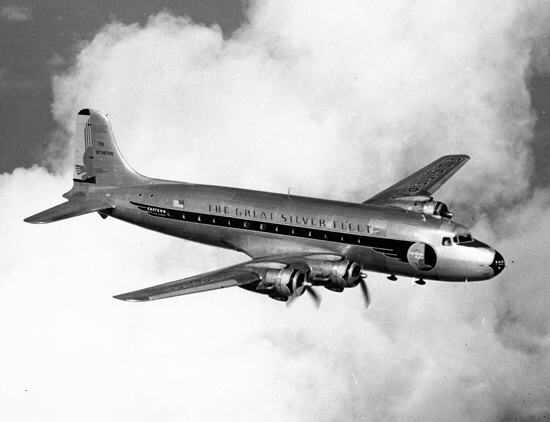
For those of us who can remember back to the ‘60s, there was the rash of 159 commercial plane hijackings — 85 to Cuba alone — between 1961 and 1973. These were mostly politically motivated, and not done for the purpose of taking lives. But they did have the effect of making people think twice about getting onto a plane to anywhere. I recall taking my sister to the airport to board a flight to the Bahamas via Miami. As she handed her ticket to the airline agent and walked toward the gate, I called out her name. She looked back and I waved at her, shouting, “Say hello to Fidel [Castro] for me.” Me and my big mouth! Today, of course, we both would immediately be taken into custody; but at the time, those hijackings were so commonplace and security generally so lax, hardly anyone paid attention. A couple of people did laugh. Not really funny, though.
On a more local level, there were a couple of cases that made London’s Jack the Ripper look like an amateur. One was Albert DeSalvo, charmingly dubbed the Boston Strangler. Between 1962 and ‘64, he killed 13 women in the Boston area. Though he had confessed, the evidence could not definitively tie him to the murders, and he was sentenced in 1967 to life in prison for multiple rapes; and the women of Boston could finally sleep peacefully. He had only served six years before being stabbed to death in the prison infirmary in 1973. His guilt was at last established beyond doubt by DNA evidence when his body was exhumed 40 years later, in 2013. So long, Albert.
And who can forget Jeffrey Dahmer, the “Milwaukee Cannibal,” who terrorized that area between 1978 and 1991, during which time he killed and dismembered 13 male victims. Yecchhh . . . and good riddance.
*. *. *
But when we entered the 21st Century, things really amped up. I need hardly mention the terrorist attacks of September 11, 2001. Even those who weren’t yet born or were very young at the time are familiar with the details of that day. But it’s the personal stories that make it real.
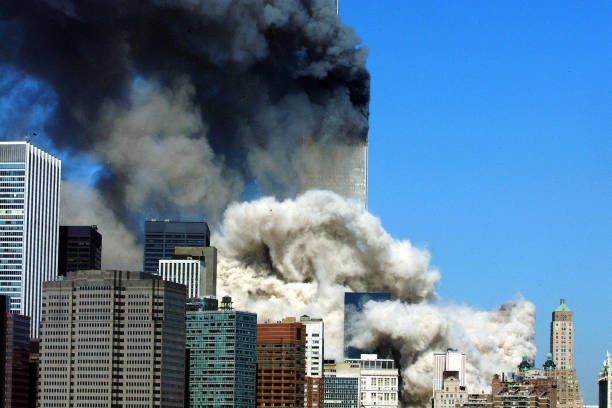
I was on my way to work on that bright, crisp, early fall morning, heading toward the ramp that would take me from Virginia’s Arlington Boulevard to the Key Bridge and into the District of Columbia. As usual, I was listening to an all-music radio station, when the programming was interrupted by a news flash announcing that a plane had flown into one of the twin towers of the World Trade Center in New York City. How on earth could that happen on such a clear day? Had the pilot fallen asleep, or been taken ill? Was it mechanical failure? Whatever the reason, it was a calamity. And then the second announcement: the other tower had been hit by yet another plane. This, then, was clearly no accident. This was terrorism on American soil.
I had just reached the place where I could either continue on into the city and my office, or take the road that would lead me back home. I did not want to be alone, and decided to go to work — a decision for which I would always be grateful. For, had I decided to head home, that road would have taken me directly past the Pentagon and into the path of the next plane to come crashing to earth.
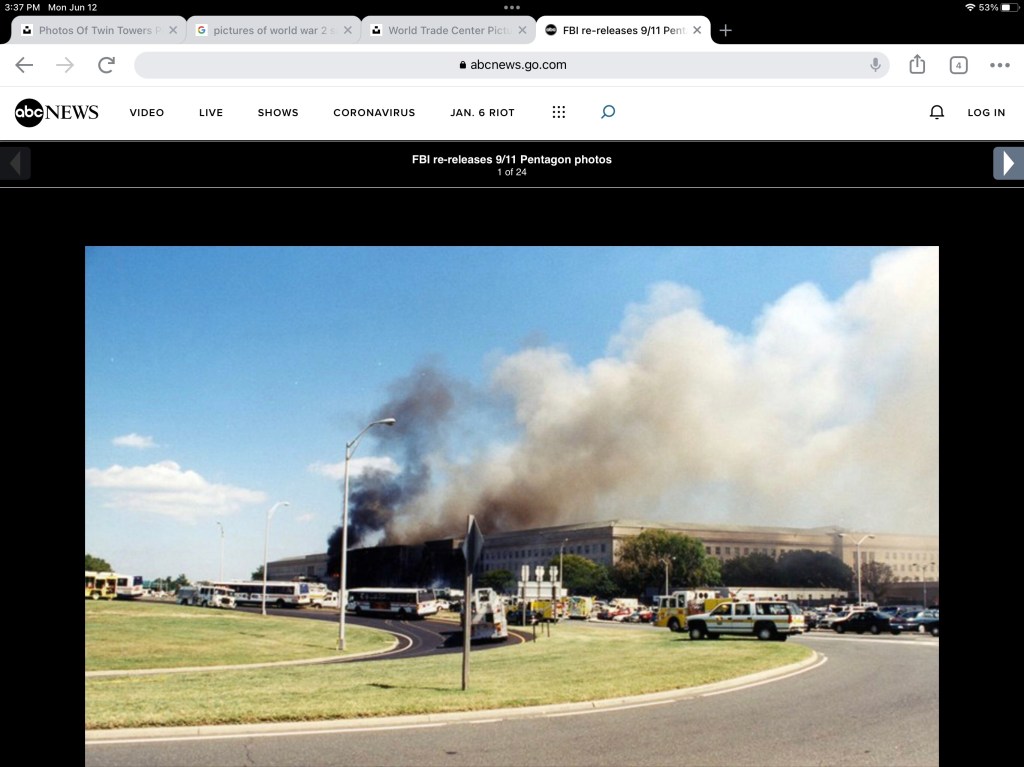
When I arrived at the office, the scene was as I had expected — no one was working. As we stood together, talking about the possible meaning of what had just happened, my phone rang. It was a friend who was at home on maternity leave; she was watching the news unfold on TV, and needed someone to talk to. Suddenly, she screamed into the phone, “Oh, my God! Another one just hit the Pentagon!” Our offices were located on the banks of the Potomac River, facing toward Virginia. I ran to the nearest window, looked out across the river in the direction of the Pentagon on the other side, and saw a gigantic plume of smoke rising toward the sky. Time — and my heart — seemed to stop. Was this war?
Another phone line rang; it was my boss, who was still at home and calling to tell me to go home. That was unnecessary; I had already decided to do just that. But first I had to call my family to let them know I was all right. But the phone lines — both landlines and cell towers — were now jammed. I finally decided to just leave, head back to Virginia to try to get to my sister, and get us both home. She worked in suburban Arlington for the Association of the U.S. Army (not located near the Pentagon). In the meantime, I would keep trying to call from the car.
And on the way, I noticed a strange phenomenon: although the streets were gridlocked by people in their cars trying to get out of the city, there was no sense of panic or hostility. Drivers were actually yielding the right of way to other drivers, and no one was leaning on their horn or yelling. We were all in this together, and that sense of unity only grew stronger in the days, weeks and months ahead.
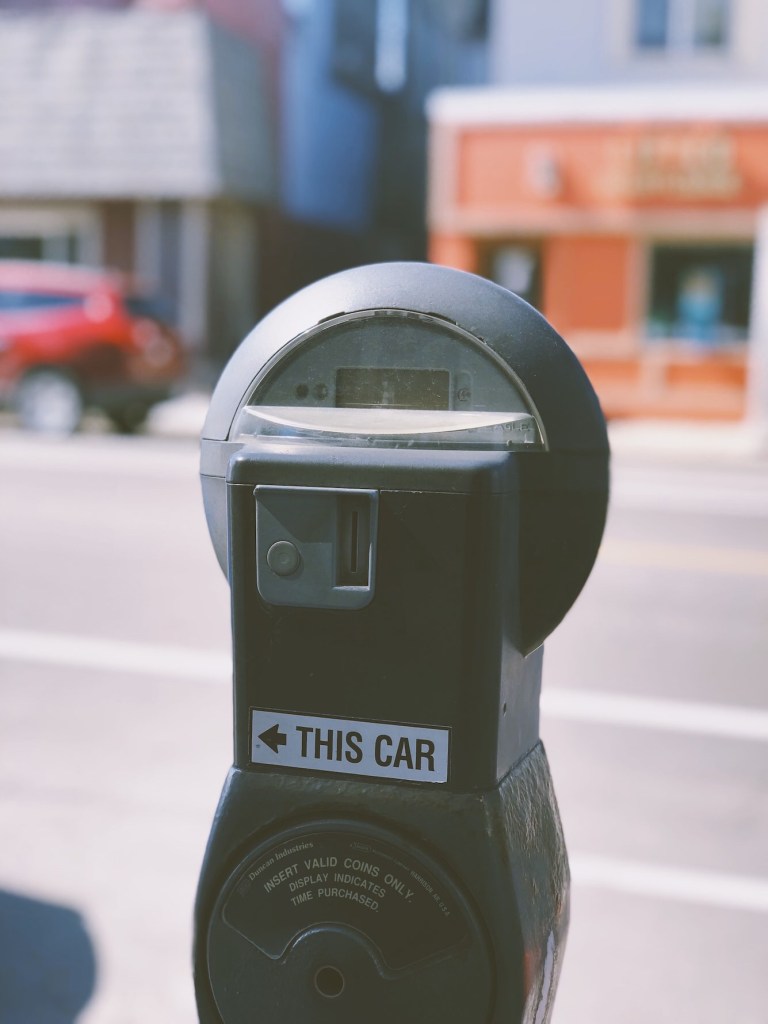
My son, who lived in Georgia, had been trying to call me to find out about my sister. He knew who she worked for, but didn’t know her location and feared that she might have been in the Pentagon. He somehow got through to me, and I reassured him as I continued my slow drive toward her office. When I finally got there, I found a vacant metered parking space in front of her building, and automatically pulled out change to feed the meter. But the slot was jammed by a coin, which explained why the space was vacant, and for a moment I worried that I might get a ticket if I parked there. Then I came to my senses. What police officer was going to be checking parking violations today? Didn’t they have better things to do? Duh! (Final note: I did not get a ticket.)
I found my sister in her office, relieved to see me as she too had been unable to get an open phone line. We headed home in the still jammed traffic, and finally made it — normally a ten-minute drive — in about an hour. And then began the period of disbelief and mourning.
There were so many other stories: a co-worker who was in New York and had to run for her life; another who was in her car on the road alongside the Pentagon, where I might have been, when that plane flew right above her; and some who lost family members, friends, or business associates on that day. I am grateful that no one I knew was killed. But in some sense, we all lost so much on 9-11; and on each anniversary, when the films are once more shown on news programs and documentaries, we relive the pain and disbelief as though seeing and feeling it again for the first time.
It happened that we had two family birthdays that September in 2001 — my sister’s on the 18th and my granddaughter’s on the 23rd — so my sister and I drove the 100 miles to my daughter’s home for a quiet celebration of both. As I walked into the house, my three-year-old grandson came running toward me, yelling, “Nana! Nana! Did you hear? Some bad guys blowed up a building!” And once again, my heart seemed to stop. What could I say to him? And what do you say to those innocent children who had just lost a parent? How do you ever make them feel safe again?
*. *. *
Before we even had time to begin to heal, along came the Anthrax killer one week later, on 9-18, beginning a string of mailings containing the deadly powder to U.S. Senators, members of the news media and others, killing five and infecting 17 others. We even received a suspicious letter in my office — an envelope that was leaking a powdery white substance. A nationwide protocol had been established for this type of situation. The mail room was immediately evacuated and closed off; the police were called; the mailroom employees were sent to the nearest hospital for testing; the HAZMAT team arrived, looking oddly like those guys in the white suits and masks from “E.T.”; and everyone was sent outside until we received the all-clear. It took a while, so some of us who had not been exposed went to lunch while we waited. It was ultimately determined that it was not Anthrax, but they never did tell us what it actually was.
The investigation of the crimes eventually focused on one Bruce Edward Ivins, though nothing was resolved for years. He committed suicide in 2008 — the same year that DNA evidence finally connected him to the crimes — without ever actually having been charged. The FBI case was at last closed in 2010.
*. *. *
And just five months after the 9-11 attacks, along came John Allen Muhammad and Lee Boyd Malvo, now and forever memorialized as the D.C. Snipers, to embark on a shooting spree that would terrorize the District of Columbia and surrounding areas of Maryland and Virginia into October of 2002. Their targets were chosen so randomly and were so widespread, you never knew where a bullet with your name on it might come from. I can still see myself stooping down behind my car to pump gas or put groceries into the trunk, looking in all directions at possible places where a sniper might be hiding. People stayed home a lot more for a while.
*. *. *
So why have I suddenly veered from my tiptoe through the tulips of the 1940s and ‘50s, to focus on the macabre and frightening crimes of more recent decades? I have no idea, but I’m inclined to blame it all on Ted Kaczynski for having made the news again and brought all of this to my mind. It’s an uncertain world out there — but then again, it always has been. There is no consensus on a possible solution to our problems at this point in time, though there is no shortage of opinions. But the beauty of living in America is that we are free to differ in our opinions, and to continue seeking reasonable, humane answers to the questions that plague us.
And as we wait for those solutions, I offer you the advice of a long-ago friend of mine — who did not, however, guarantee the accuracy of the Latin version: “Illegitimi non carborundum est.” Loosely translated: “Don’t let the bastards wear you down.”
And on that note, I remain
Faithfully yours,
Brendochka
6-12-23
 The Blog About Everything … and Sometimes Nothing