In 1984, I enrolled in an evening course at the local community college. My children were grown, and I found myself luxuriating in some quiet time in the evenings and on weekends. Watching what passed for TV entertainment was not an exciting option, and I’m simply not an artsy-craftsy person (no talent); so I decided on the next most logical thing to fill my free time: the study of a second language. Why not?
Actually, at the time, I was envious of some of my co-workers who were bilingual or multilingual. When I thought about studying a foreign tongue, I recalled high school French class, where I had learned the grammar and vocabulary but exhibited what any self-respecting Parisian would consider a truly insulting accent. So that’s when I came up with the obvious next choice: Russian. “Why obvious?” you ask? Well, it was a genetic thing. All four of my grandparents had emigrated in the early 1900s from what is now Ukraine but was then part of the greater Russian Empire, and their entry documents to the United States listed their nationalities as Russian. So I have always identified as a second-generation American of Russian descent, until recently; now I proudly introduce myself as a second-generation American of Ukrainian descent, for obvious reasons. But something about Russia stays with me: her history, her culture . . . even her interminable misery.
Our class, which met twice a week, started out with about 27 students. By the end of the first semester, we were down to a close-knit, hardcore group of 12 survivors. Some called us masochists, but we didn’t agree. Together with our amazing teacher — a delightful lady from Moscow named Ekaterina, who was now a citizen of the U.S. — we had a wonderful time exploring the intricacies of an impossible language, and delving into Russian history, literature, and politics on the side. One day, when Ekaterina learned of my Russian/Ukrainian ancestry, she shook a finger at me and exclaimed, “Aha! It’s in your blood” — thereby consigning me to a lifetime obsession with all things Slavic.
After three years, one of my classmate friends, a German woman named Gisela, and I decided it was time to get a first-hand look at the mysterious place we had been studying for so long. In 1987, we began planning and putting aside money for our trip, and in August of 1988, we were off. Which is just what our families and friends thought we were when we told them where we had chosen to take our big (and my first) overseas vacation. We didn’t care. We signed up with a tour leaving in mid-August, packed some clothes, walking shoes, and every over-the-counter medication we could think of, and headed into the unknown.
But first . . .
Oh, yes, first there was my boss Walter Surrey’s reaction. When I told him of my plans, his initial thought was, “Well, what am I going to do for two weeks?” Then, sensing a business opportunity, he remembered Viktor Akimov. And he also remembered a client who had been trying to sell his company’s product, an electric men’s shaver, in various parts of the world including Russia. And here was I, the perfect middleman. So, contrary to Russian law restricting foreigners’ business activities under tourist visas, two electric shavers also went into my luggage as “gifts” for Walter’s old friend Viktor.
We sent a telex — high-tech in those times — to Viktor, advising him of my impending arrival and itinerary. We did not hear back from him before my departure date, but I had his phone number with me, and instructions to ditch the shavers before coming home if I was unable to find him.
After an exhausting trip from DC to New York and overnight from New York to Moscow (an eight-hour time difference), we arrived at Sheremetyevo Airport looking like a bunch of . . . well . . . just what we were: bedraggled American tourists. We were greeted by Tamara, our official Intourist guide (one of a slew of government-controlled organizations directly answerable to the KGB), claimed our luggage, and headed for Passport Control. There were two lines open, and I was steered to one that was manned by a tall, blond, handsome young man with an appropriately stern facial expression. I put my passport, open to the front page, in the little tray at the base of the bullet-proof glass window. He picked it up, checked the visa, looked at the picture, looked at me, looked at the picture, looked at me, looked at . . . oh, well, you get the idea. Then he asked, in his best, heavily-accented English, “This your photo?” At the time, I was a 40-something, reasonably decent-looking redhead, not easily disguised, so yes, it was obviously my photo. I replied, in my best, American-accented Russian, “Yes, that is I.” Ekaterina was a stickler for grammar.
Tall-blond-and-handsome began again: looked at the passport, looked at me, looked at the passport, etc., and finally asked: “You sure this your photo?”
Enough, already. The impatient, impetuous, and somewhat impish American in me burst forth, and I smiled, this time answering in English: “Well, it’s not Raisa Gorbachev.”
Oh, my God! This was the hockey puck fiasco all over again (see last week’s episode), but worse — I was now on their turf. I began to wonder what the inside of a Russian prison looked like and what the usual sentence was for being an American smart-ass.
But miraculously, “Sourpuss” broke rank and actually smiled. Barely managing to stifle an audible laugh, he stamped my passport and waved me through, and I knew I had made his day. Welcome to Moscow, Mrs. Gorbachev — or whoever you are.
After a long and thorough clearance procedure through Customs, we were finally in a bus on our way to the impressively large Cosmos Hotel, nowhere near the center of Moscow but still within the city limits. The outside was fairly nice; the interior, not so much. Face it: it was shabby, without the chic. Our luggage made it off the bus and into the lobby, and when everyone else had claimed their two bags, there remained . . . nothing. An empty cart. My bags were nowhere to be seen.
“TAMARA!!!”
Poor Tamara. Missing luggage was the last thing she needed to deal with. Muttering a very Russian “Oy,” she set to work earning her pay. She consulted someone at the front desk, who shrugged and said something unintelligible while waving a hand in the direction of a staircase. Tamara told me that I had to go — by myself, since she couldn’t leave the rest of the group — downstairs to “Lost and Found.” In the basement. Of an enormous Russian hotel. In Moscow. Alone. Even Gisela wasn’t allowed to come with me.
With our exhausted and puzzled group waiting anxiously in the lobby, I steered my shaky legs down the steps to a large, dimly-lighted, unfurnished and unoccupied room. I called out — “Hello?” — and waited. After a few seconds, I called out again, louder. “Hello?!!” Finally, a man emerged from behind a closed door, and I told him I was looking for my two suitcases. Showing him my baggage claim check, and carefully spelling my name, I waited while he went back through the same doorway. About 12 hours later — all right, it was just a couple of minutes, but it felt . . . you know — he returned, miraculously with my actual bags, which seemed no worse for the wear. I resisted hugging him, but did say thank you about 100 times, and struggled back up the steps, shlepping my bags behind me. My fellow travelers heaved a collective sigh of relief when I returned in one piece, and we all headed for our assigned rooms. But as Tamara handed Gisela’s and my room keys to us, I swear she looked at me strangely. Or was I simply coming down with early symptoms of Soviet paranoia? I didn’t have any pills for that.
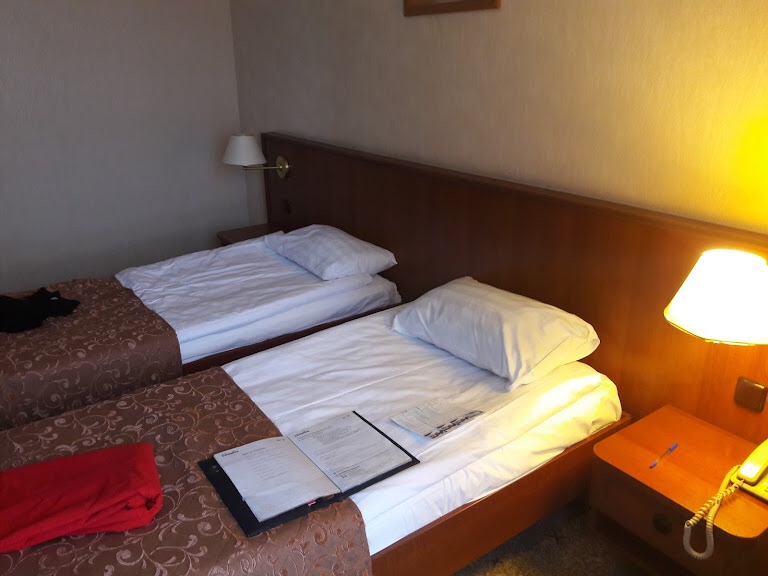
By now, we had been in Russia for several hours, between the lengthy airport processing, the bus ride, and the mystery of the disappearing suitcases, and it was nearly time for lunch with our group in the hotel dining room. There was just enough time to take our things to our room. Gisela and I reached our floor and introduced ourselves to the dezhurnaya — the female concierge (a.k.a. watchdog) on every floor — entered our room, set our bags down, began to look around . . . and the phone rang. “What the hell . . . ?”
Well, when a phone rings, you answer it — right? So I did, and a man whose voice I didn’t recognize asked for me by name. He introduced himself as Georgi Karpov (not his real name), a colleague of Viktor Akimov, who he said was on holiday and had asked him to get in touch with me as requested in Walter’s telex. All of that made sense, but what was totally spooky was the timing of his call, as though he had known precisely when we reached our room. Maybe it really was coincidence. Or that pesky paranoia.
In any event, we arranged to meet in the hotel’s coffee shop the next morning at 9:00, right after the group’s scheduled 8:00 breakfast. And then I had to tell Tamara that Gisela and I wouldn’t be joining the group on their first tour the following day because I had an early meeting with an official from the Foreign Ministry, after which we had an appointment at the American Embassy. Way to blend into the crowd, Brenda. Predictably, Tamara was less than amused, but had no recourse. I knew that she was, however, required to report any anomalies to her superiors, who in turn reported directly to the scary folks at KGB headquarters. First day, and I’m already on their radar. Oh boy!
After a quick lunch in the hotel dining room, we were herded back onto our bus for a driving tour of some of the city’s highlights — no stops, but views of the outside of the Kremlin, the entrance to Red Square, the front of the Bolshoi Theatre, and the like. The real tours were to start the next day. Then dinner in a rather nice restaurant, back to the hotel, and up to bed. As we unpacked our bags, Gisela and I staged the first of what were to become our nightly chats for the benefit of the hidden microphones in the room; found that the shower actually dispensed hot water; and slept rather soundly, all things considered. So far, so good.
* *. *
This tale is getting a bit long for a single post, so I will leave you here until next week, when I will expand on Mr. Karpov and his attempted provocation; the “gypsy” (unregistered) cab driver and his attempted provocation; a near-kidnapping (us) and an actual drug bust (not us) in Tbilisi, Georgia; and perhaps a few other improbable but absolutely true tales from the pages of my journals. See you then.
Brendochka
1/5/23
 The Blog About Everything … and Sometimes Nothing